Amitabha Buddha with a Lotus Vessel: A Close Visual Reading
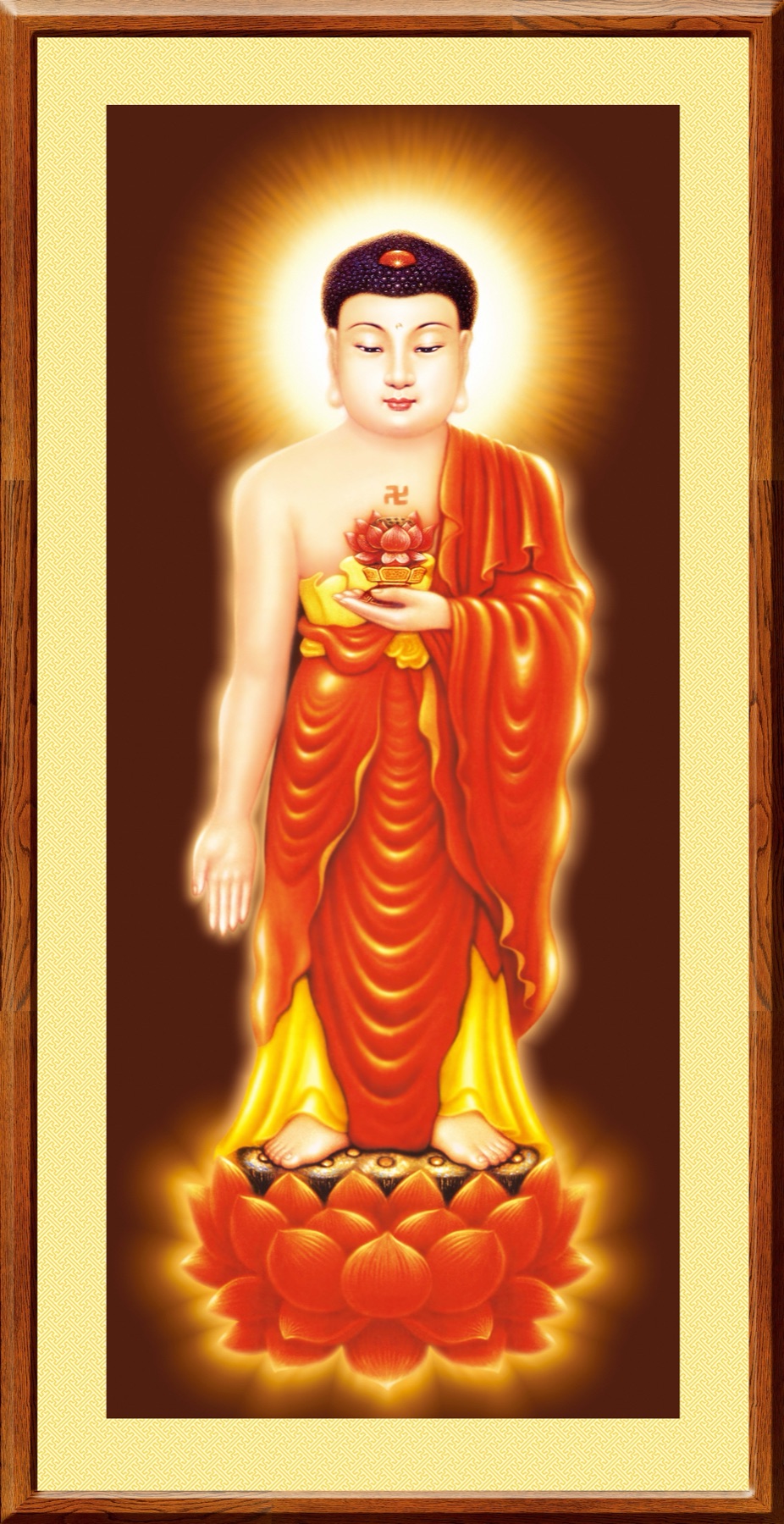
Quick answer: TK0215 is best read as a modern devotional image of standing Amitabha, not as Amitayus. The decisive evidence is the monastic robe, standing posture, lowered welcoming hand, lotus support, and absence of crown and jewelry. The chest-level lotus vessel is relevant, but it should not outweigh the figure’s complete visual system.
TK0215 presents a standing Buddha in red robes, surrounded by radiating light and framed by a pale patterned border. One hand reaches downward, while the other supports a small lotus-shaped vessel at the center of the chest. The figure stands on a large red lotus. This cluster makes the image useful for studying how an Amitabha Buddha lotus vessel functions within a modern devotional composition.
The picture should not be confused with a traditional Tibetan thangka simply because it belongs to a Thangka archive. Its smooth gradients, intense glow, simulated wooden frame, and digitally regular border suggest a modern reproduction or graphic devotional treatment. That does not make it unworthy of study. It means the record should describe the object accurately and separate religious iconography from assumptions about medium or age.
How the composition establishes Amitabha
The central figure has a Buddha’s monastic appearance: short curled hair, elongated earlobes, a calm face, a robe that leaves part of the chest visible, and no jeweled crown. Red is prominent in the robe and lotus base. Amitabha is widely linked with red and the western Pure Land, but color alone cannot settle the identification. The standing form, downward gesture, lotus object, and devotional glow work together.
The body is strictly frontal and nearly symmetrical. That frontality produces presence rather than narrative action. The downward hand breaks the symmetry and creates a path from the Buddha to the viewer. The gesture resembles the welcoming vocabulary seen in descent images, although this particular work has no visible attendants or landscape to define a full narrative scene.
What is the lotus-shaped object?
The left hand supports a compact object shaped like a red lotus on a small base. It may be read as a lotus vessel, lotus reliquary, or stylized devotional emblem. The image does not provide enough documentary evidence to assign a precise ritual name. Describing its visible structure is safer: a layered red bloom or bud rises from an ornate support held against the chest.
This is an important cataloguing lesson. Digital archives often inherit confident filenames while the small attributes remain ambiguous. Rather than convert resemblance into fact, record the object’s form, color, location, and relationship to the hand. If a liturgical text, inscription, temple label, or verified catalogue later supplies a name, the descriptive record will still remain useful.
The lowered hand and the idea of approach
The right arm hangs beside the body, and the palm turns outward. The long fingers point toward the lower part of the image. In Pure Land devotional imagery, this open movement can suggest reception or guidance. It visually lowers the distance between the radiant Buddha and the devotee.
Compare the gesture with an earth-touching mudra. Shakyamuni’s hand normally reaches over a seated knee toward the ground, while the body remains cross-legged. Here the figure is standing, the arm extends freely, and the gesture belongs to a different compositional logic. Pose and context prevent a superficial hand-shape match from producing the wrong identification.
The red lotus pedestal
The feet rest on a large red lotus whose petals spread in several tiers. Lotus thrones are shared across Buddhist art, so the base confirms sacred status without identifying the figure by itself. In this image the saturated red pedestal echoes the robe and the vessel. The repeated color unifies body, attribute, and support.
The pedestal also marks the boundary between ordinary space and sacred manifestation. The Buddha does not stand on natural ground. He appears on a perfected floral support, bathed in light. Because no landscape is shown, the lotus carries much of the Pure Land association that architecture, ponds, or celestial assemblies would supply in a more complex painting.
Radiant halo and dark background
A white-gold halo surrounds the head and expands into rays against a dark brown field. The strong contrast makes the head visible from a distance. A second glow traces the shoulders and body, separating the red robe from the background. This layered light is a modern graphic strategy that translates the older idea of sacred radiance into an immediately legible digital effect.
Radiance is meaningful but not diagnostic. Buddhas, bodhisattvas, teachers, and protective figures can all have halos or aureoles. When cataloguing, record the shape and color of the light, but do not use “glowing” as a substitute for iconographic evidence.
Border, frame, and reproduction history
The image includes a pale geometric border and a wood-grain outer frame. These elements may belong to the digital file rather than to a physical hanging. A scan can capture an actual textile mount; a designer can also add a simulated mount after photography. The regularity of the pattern and the rendered wood appearance deserve careful examination at full resolution.
For digital humanities work, the distinction matters. Researchers should record whether a border is part of the painted support, a textile mounting, a photographic environment, or an added graphic layer. Cropping the frame away may create a more attractive thumbnail but destroys evidence about the file’s presentation history.
The chest symbol in context
The swastika on the chest is a long-standing Buddhist auspicious sign and a traditional mark associated with a Buddha. It should be documented as a Buddhist symbol whose history predates modern European political use. Clear contextual language helps international readers understand the image without projecting a twentieth-century meaning onto an Asian devotional work.
How this image differs from Amitayus
Amitayus and Amitabha are related, yet their common artistic forms are not interchangeable. Amitayus usually appears seated, crowned, jeweled, and holding a longevity vase in both hands. TK0215 shows a standing monastic Buddha without crown or jewelry. The small lotus-shaped object is not enough to turn the figure into Amitayus, especially when the broader posture supports a standing Amitabha reading.
Close-reading checklist
- Identify the standing monastic body before considering color.
- Describe the open lowered hand and avoid assigning an overly specific mudra.
- Record the chest-level object as a lotus-shaped vessel or emblem unless a verified source names it.
- Note the red lotus pedestal, halo, body glow, dark field, patterned border, and simulated frame.
- Distinguish iconography from the unknown production method of the digital file.
- Keep authorship, date, workshop, and provenance uncertain.
Frequently asked questions
Does a lotus-shaped vessel automatically identify Amitayus?
No. Amitayus is normally crowned, jeweled, seated, and holds a longevity vase in both hands. A single vessel-like object in a standing monastic image is not enough to override the broader Amitabha evidence.
Can a digitally produced devotional image still be studied seriously?
Yes. It can preserve meaningful iconography and show how older visual forms are adapted for modern devotion. The record should simply distinguish religious interpretation from production history and historical attribution.
Why is the chest symbol explained in context?
The Buddhist swastika is an ancient auspicious sign whose Asian religious history predates modern European political use. Naming the Buddhist context prevents a culturally inaccurate interpretation.
| Feature | TK0215 | Common Amitayus form |
|---|---|---|
| Posture | Standing | Seated in meditation |
| Dress | Monastic robe | Crown and jewelry |
| Hands | One lowered, one at chest | Both support longevity vase |
Conclusion
TK0215 is valuable because it shows how a modern devotional image can preserve familiar Amitabha themes while using digital glow, graphic framing, and simplified attributes. A careful reader can appreciate the religious visual language without pretending that the file is an undocumented ancient painting. The standing posture, welcoming hand, lotus vessel, monastic dress, and lotus pedestal form the strongest identification network.
Sources and editorial method
This article is based on direct visual analysis of the TANGKAWORLD archive image. Religious identification is separated from uncertain artist, date, school, collection, and provenance claims. For the broader reading method and institutional references, consult Amitayus identification guide and the TANGKAWORLD learning journal.
Prepared and reviewed by the TANGKAWORLD editorial team. Last reviewed: August 5, 2026.
