Amitabha Pure Land Painting: Palace, Pond, and Sacred Assembly
Quick answer: An Amitabha Pure Land painting organizes sacred space rather than ordinary landscape. The lotus pond, bridges, assemblies, central Buddha, palace terraces, and radiant sky form a visual path. Read these zones in sequence, identify figures only when attributes are clear, and keep iconographic interpretation separate from uncertain artist or dynasty labels.
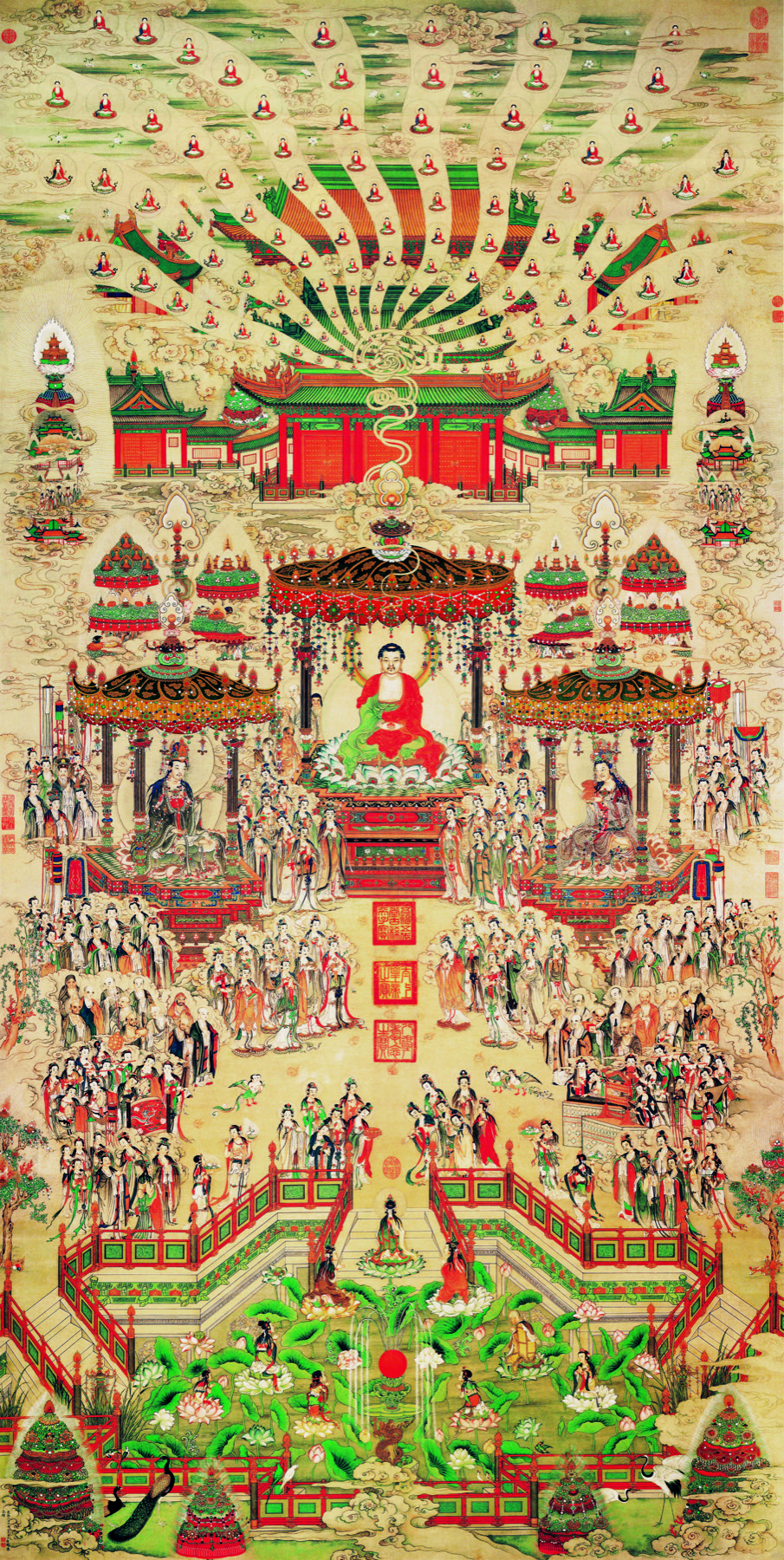
An Amitabha Pure Land painting is not meant to be read as a natural landscape. It organizes doctrine, aspiration, ritual imagination, and sacred hierarchy into a visual world. TK0255 contains a lotus pond at the bottom, bridges and terraces, large assemblies of figures, Amitabha enthroned near the center, palace architecture above, and many small Buddhas rising through streams of light. The eye must travel through layers rather than search for one isolated attribute.
The file’s title proposes a Qing date and connection with Ding Guanpeng. Those claims require a traceable institutional or scholarly source. This guide concentrates on the visible composition and uses uncertainty language for historical metadata.
Read from the lotus pond upward
The lowest register is a walled pond filled with broad lotus leaves, blossoms, birds, small figures, and a luminous red disk or jewel-like form near the center. Stairways and bridges lead from this garden zone toward the crowded terraces above. The pond is both a place and a symbol. Lotus growth expresses purity, while lotus birth is a central motif in representations of Sukhavati.
Beginning at the bottom prevents the dense upper assembly from overwhelming the viewer. Follow the water, identify the architectural boundaries, and note how bridges create a route inward. The painting turns looking into a symbolic ascent.
Bridges and terraces structure sacred access
Red railings form strong geometric lines around the pond. A central stair and bridge direct the eye toward the main assembly. These features do not need to obey ordinary perspective. Their function is to separate zones, guide attention, and show that the Pure Land is ordered.
Figures gather along both sides of the route. Some are seated; others stand in groups. Their individual identities may not be legible in a web-sized image. It is better to describe categories such as monastic figures, courtly attendants, bodhisattva-like figures, and worshippers than to assign names from costume alone.
Amitabha at the compositional center
A seated Buddha occupies the central pavilion, elevated on a lotus throne beneath an ornate canopy. The red robe, frontal meditation, halo, and symmetrical placement establish Amitabha as the focus. Two larger flanking figures sit beneath separate canopies. In many Pure Land compositions, Avalokiteshvara and Mahasthamaprapta accompany Amitabha, but the present reproduction should be examined at full resolution before those attendants are named with certainty.
Scale is theological rather than optical. Amitabha is larger because he is the central object of devotion, not because he is physically closer to the viewer. Hierarchical scale allows a dense assembly to remain intelligible.
The canopy as a visual crown
The central canopy is dark, richly patterned, and hung with jewels or tassels. It frames the halo and isolates Amitabha from the surrounding crowd. Smaller canopies repeat on either side, creating a triadic rhythm.
Canopies in Buddhist art signal honor, sacred presence, and royal protection. Here they also solve a compositional problem: without them, red robes and crowded figures would merge into the architecture. The dark shapes create clear islands around the principal deities.
Palace architecture and perfected order
Above the central assembly rises a large red-and-green palace complex. Gates, roofs, towers, and terraces occupy the middle-upper zone. The buildings combine sacred realm imagery with architectural forms familiar to the painting’s viewers. Pure Land is made imaginable through an idealized visual language rather than depicted as an archaeological plan.
Symmetry, bright color, and repeated rooflines convey inexhaustible order. Clouds pass around the structures, dissolving any simple boundary between palace and sky. The realm is architectural but not limited by ordinary geography.
Rays filled with small Buddhas
From a knot of light above the palace, broad pale rays spread outward and upward. Numerous small seated Buddhas appear inside the rays and across the sky. The repetition suggests immeasurable manifestation. The viewer encounters not a single static figure but a realm filled with awakened presence.
At web scale, counting every small figure would invite errors. Researchers should use the original high-resolution file, divide the rays into numbered sectors, and record uncertain or damaged forms separately. Repetition is meaningful even when an exact count is not established.
Crowds without confusion
The middle and lower registers include many groups with different robes, ages, postures, and social types. The crowds communicate abundance and universal access. They may also preserve narrative or lineage-specific identities that require textual comparison.
A practical method is to map the groups by location: lower-left terrace, lower-right terrace, central stair, left of Amitabha, right of Amitabha, and upper palace zones. Describe visible attributes within each area. This spatial index is more reliable than a long list of guessed names.
Birds, flowers, and sensory richness
Peacocks and cranes appear near the lotus pond, while flowers, trees, clouds, banners, and jeweled structures enrich the scene. Pure Land paintings use beauty as a religious language. Sound, fragrance, light, and color are suggested through visible forms.
Not every bird must be given a doctrinal identity. Record species only when distinctive features are clear. The broader point is that the realm is alive, harmonious, and responsive to practice.
How to handle the archive attribution
The filename connects TK0255 with the Qing period and Ding Guanpeng. To verify that claim, researchers should locate a matching object in an official collection database or published catalogue. The seals, inscriptions, dimensions, material, crop, and damage must match. If the source says “attributed to,” “after,” or “workshop of,” preserve that wording.
Until such a record is documented, a responsible caption states that the attribution is present in the archive filename but remains unverified. The visual analysis of Pure Land structure does not depend on claiming an artist.
A step-by-step viewing checklist
- Begin at the lotus pond and identify water, flowers, birds, and small figures.
- Follow bridges and stairs into the lower assembly.
- Locate central Amitabha through scale, throne, halo, and canopy.
- Examine the two flanking enthroned figures without naming them prematurely.
- Map the crowd into spatial groups.
- Trace palace roofs, gates, towers, and cloud boundaries.
- Follow the radiating streams and record the small Buddhas by sector.
- Keep iconographic observation separate from uncertain artist and date metadata.
Frequently asked questions
Why is the lotus pond important in Pure Land painting?
The pond marks rebirth, purity, and entry into the sacred realm. It also gives the viewer a clear starting point before the eye moves through bridges, assemblies, throne, palace, and sky.
How can Amitabha be located in a crowded composition?
Look for the largest centrally placed Buddha supported by throne, halo, canopy, flanking figures, and architectural alignment. Scale and axis are safer clues than color alone.
Do palace buildings represent a historical location?
Not necessarily. Architecture often expresses perfected order and sacred access. A building may resemble a historical style without functioning as a literal record of a specific palace or period.
| Zone | Visual clues | Reading role |
|---|---|---|
| Lotus pond | Water, flowers, birds, emerging figures | Entry and rebirth |
| Assembly | Grouped devotees and attendants | Sacred community |
| Central throne | Large Buddha, halo, canopy, axis | Primary hierarchy |
| Palace and sky | Terraces, towers, clouds, rays | Perfected order and radiance |
Conclusion
TK0255 presents the Pure Land as a carefully ordered path from lotus pond to assembly, throne, palace, and radiant sky. Its density is not decorative excess. Architecture and repetition teach the viewer how to move through a sacred realm. By reading the painting in registers and preserving uncertainty around attribution, one can appreciate both its religious logic and its value as a digital research object.
Sources and editorial method
This article is based on direct visual analysis of the TANGKAWORLD archive image. Religious identification is separated from uncertain artist, date, school, collection, and provenance claims. For the broader reading method and institutional references, consult How to Read a Thangka and the TANGKAWORLD learning journal.
Prepared and reviewed by the TANGKAWORLD editorial team. Last reviewed: August 5, 2026.

