Amitabha Welcoming Descent Painting: How to Read the Pose
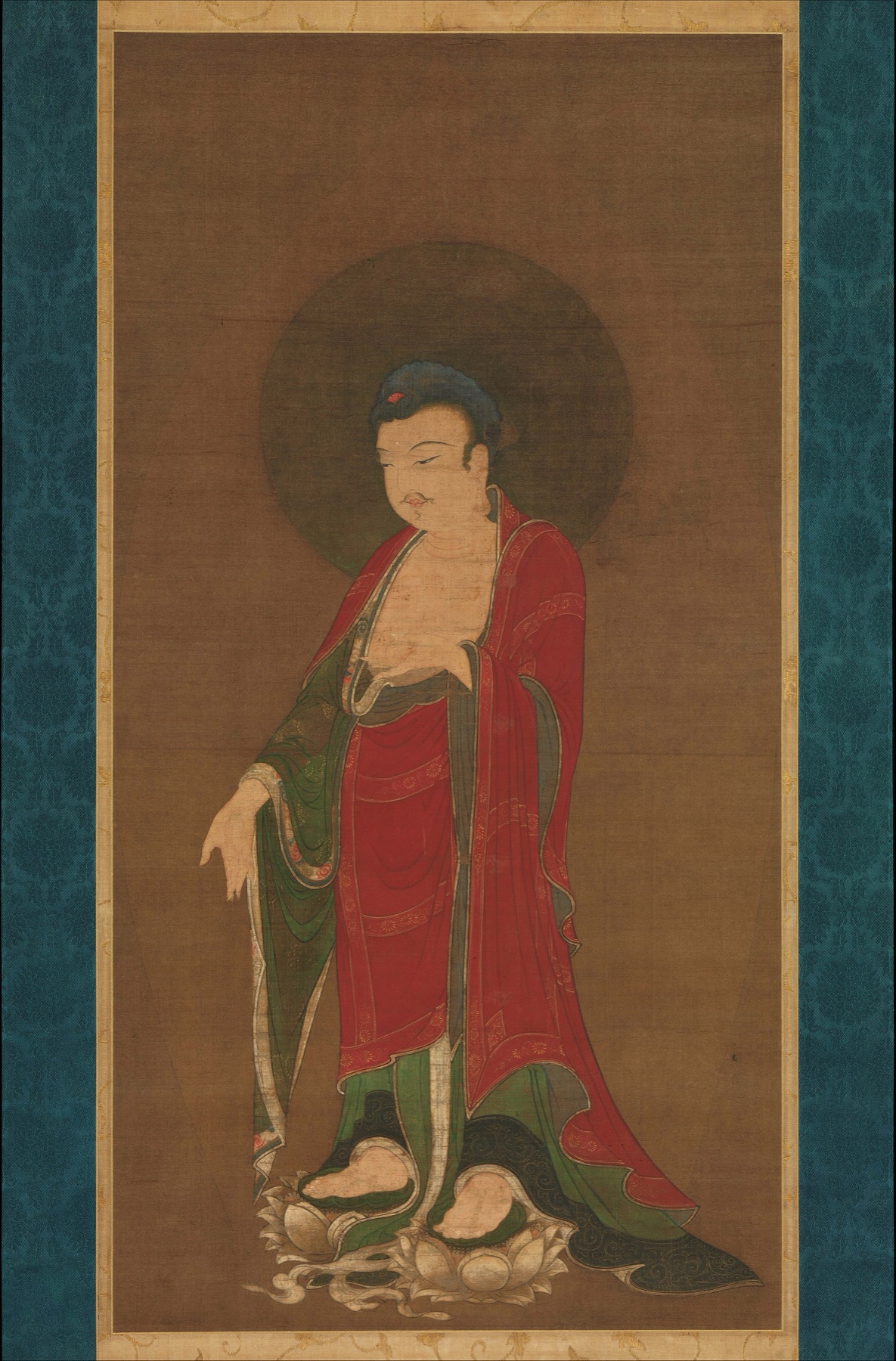
Quick answer: A welcoming-descent Amitabha is identified through a coordinated sense of approach: a standing monastic Buddha, inclined body, hands lowered at different levels, flowing robes, halo, and lotus support. These visual clues are stronger than color or filename labels, while dynasty, museum, and provenance claims still require independent documentation.
An Amitabha welcoming descent painting often communicates its subject through movement rather than a crowded Pure Land setting. TK0232 shows a single standing Buddha with a dark halo, layered robes, a lowered hand, and a lotus support. The head tilts, the hands descend at different levels, and the garment flows toward the base. These choices make the figure appear to approach the viewer.
The archive title links the image with a historical period and museum, but the public record here remains cautious. Iconography can be analyzed from the visible file; date, ownership, and attribution need documentary verification. Keeping those tasks separate allows a detailed reading without overstating provenance.
What “welcoming descent” means visually
Pure Land traditions developed images of Amitabha arriving to receive devotees. Some compositions show Amitabha with Avalokiteshvara, Mahasthamaprapta, musicians, clouds, banners, and a dying person below. Others reduce the idea to a single descending figure. The key visual problem is how a sacred Buddha can appear both transcendent and near.
TK0232 solves this through posture. Amitabha is upright but not static. The head inclines, the upper body turns slightly, and the hands reach downward. A large dark halo preserves sacred authority, while the lowered gestures create contact with the space beneath the figure.
The right hand leads the descent
The lower hand projects away from the robe. Fingers point down, and the palm is partly visible. This is the strongest directional feature in the composition. The gesture draws attention below the Buddha, toward the imagined devotee or destination outside the painted field.
Do not confuse this with the earth-touching gesture of Shakyamuni. In a standard earth-touching image, the seated Buddha extends one hand over the knee to call the earth as witness. TK0232 is standing, and the hand participates in an overall descent. Pose changes the meaning of a similar downward direction.
The upper hand creates a second level
The other hand rests near the waist or lower chest. Its fingers form a compact configuration, but wear and reproduction make exact details difficult to determine. Together, the two hands establish a stepped rhythm: face, upper hand, lower hand, lotus base. This visual staircase guides the eye down the figure.
A precise ritual term should be used only if the finger configuration is clear and a reliable iconographic source supports it. Descriptive language is not a lesser form of scholarship. It preserves what future viewers can verify.
Halo and empty ground
A broad dark halo encircles the head and shoulders. Unlike a bright digital glow, it is restrained and close in tone to the brown background. This makes the figure emerge gradually. The large areas of empty ground around the body prevent distraction and emphasize the gesture.
Empty space can carry narrative force. The absence of attendants does not make the image incomplete. It invites the viewer to occupy the open field and to imagine the Buddha’s movement beyond the frame. In a ritual or devotional setting, this direct relationship may be more important than descriptive scenery.
Robe movement and the idea of approach
The outer robe is red with patterned bands; green and dark inner layers appear beneath it. Long edges curve around the body and trail near the feet. These folds do not simply show clothing. They give direction to the descent and soften the transition from torso to lotus.
The left side of the garment opens more widely, while the opposite side falls in a narrower vertical mass. The asymmetry makes the pose feel active. Even without painted clouds, the robe suggests movement through space.
The lotus support
The feet rest on pale lotus forms. In Buddhist art, a lotus support indicates purity and sacred presence. Here it also provides a visual landing point. The descending figure does not step onto ordinary earth; the lotus creates a purified threshold between Buddha and viewer.
Damage or cropping can make the base difficult to read. Record the visible petals, colors, and relationship to the feet. Avoid reconstructing a complete pedestal if the lower edge is missing in another reproduction.
How this differs from a full Pure Land assembly
A full Pure Land painting can contain palaces, ponds, bridges, lotus births, musicians, bodhisattvas, arhats, donors, and multiple manifestations of Amitabha. Its reading is spatial and encyclopedic. TK0232 is concentrated and relational. The viewer reads one body and one act of approach.
Both formats express Pure Land ideas, but they answer different visual needs. The assembly maps an ideal realm; the welcoming descent dramatizes contact between that realm and a devotee. Recognizing the difference prevents a solitary image from being dismissed as a fragment of a larger scene.
Comparing Amitabha with Amitayus
Amitabha normally wears monastic robes and may appear standing in descent. Amitayus is typically seated, crowned, jeweled, and holding a longevity vase. TK0232 lacks princely ornaments and a vase. The standing monastic type therefore agrees with Amitabha rather than the common Amitayus form.
Condition and reproduction caution
The support shows tonal variation, small losses, and fine marks. Red and green remain visible, but subtle details may have faded. A photograph can exaggerate brown tones or suppress the halo. Any digital enhancement should be saved as a derivative and should never replace the unaltered source.
The surrounding textile mount is also evidence. Blue-green side panels and gold bands frame the central painting. If the museum association in the filename is researched, this mount, the exact damage pattern, and the crop will be as useful as the figure for matching the object.
Research checklist for a welcoming descent image
- Confirm that the figure is standing and monastically dressed.
- Trace the head tilt, shoulder angle, robe flow, and direction of the hands.
- Describe the lowered hand before naming a mudra.
- Record halo, empty ground, lotus base, and textile mounting.
- Compare Amitabha with Amitayus and Shakyamuni using attributes, not color alone.
- Verify any dynasty or museum claim through an official object record.
- Keep condition observations separate from iconographic reconstruction.
Frequently asked questions
What makes an Amitabha figure appear to descend?
The effect comes from the inclined head and shoulders, unequal hand levels, downward gesture, robe movement, empty ground, and lotus support. Together they make a stationary painted body feel as though it is approaching.
How is standing Amitabha different from Amitayus?
Standing Amitabha usually wears monastic robes and may extend a welcoming hand. Amitayus is commonly seated, crowned, jeweled, and holds a longevity vase in both hands.
Is a dark halo evidence of a particular period?
No. Halo color may reflect pigment, aging, lighting, reproduction, or later treatment. It supports visual description but cannot independently establish a date or workshop.
| Feature | Amitabha | Amitayus |
|---|---|---|
| Dress | Monastic robes | Crown, jewelry, celestial garments |
| Posture | Seated or standing | Usually seated in meditation |
| Key object | Often no vessel in standing form | Longevity vase held in both hands |
Conclusion
TK0232 shows how a single standing body can communicate the welcoming descent of Amitabha. The downward hands, inclined head, flowing robes, dark halo, and lotus base form a coordinated visual argument. Historical labels remain to be verified, but the visible composition already offers a clear lesson in how posture turns doctrine into movement.
Sources and editorial method
This article is based on direct visual analysis of the TANGKAWORLD archive image. Religious identification is separated from uncertain artist, date, school, collection, and provenance claims. For the broader reading method and institutional references, consult Amitayus identification guide and the TANGKAWORLD learning journal.
Prepared and reviewed by the TANGKAWORLD editorial team. Last reviewed: August 5, 2026.

