Historic Standing Amitabha Painting: Robes, Gesture, and Condition
Quick answer: A historic standing Amitabha painting should be read through both iconography and material condition. Monastic robes, hand position, halo, and lotus imagery support identification, while mount, abrasion, creases, and color loss explain what may be missing. A museum or dynasty label remains uncertain until the exact object record is matched.
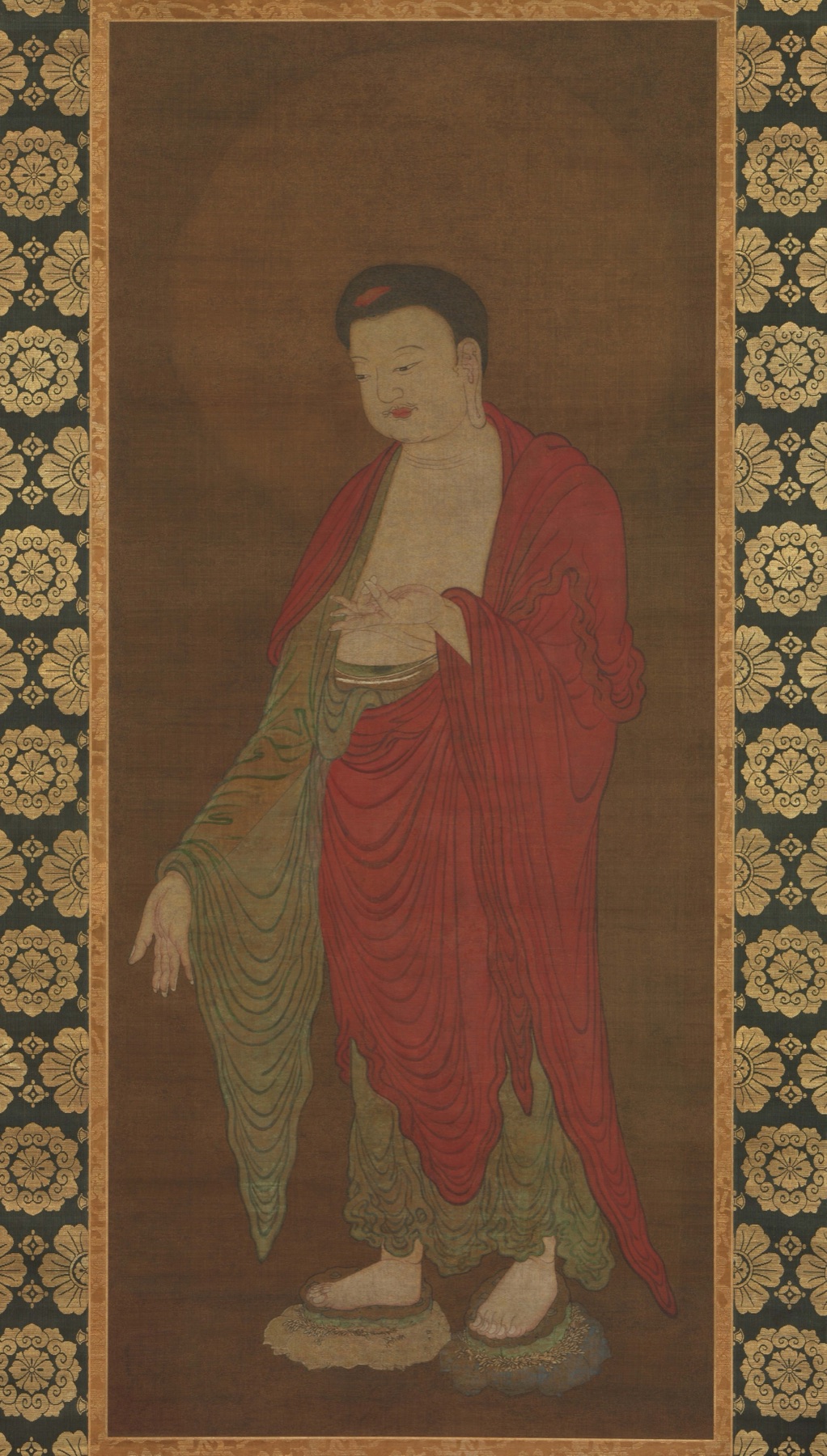
TK0237 looks very different from a bright modern devotional graphic. The palette is muted, the fabric mount is visible, the painted support shows age, and the standing figure is defined by quiet contour rather than digital glow. The file is labeled as a Song dynasty Amitabha painting associated with a museum, but this guide does not treat that filename as verified provenance. Instead, it asks what a historic standing Amitabha painting can reveal through robes, gesture, mount, and condition.
Close reading is especially important with old Buddhist paintings because wear can remove small attributes. A faded hand may resemble a different mudra; a lost halo can make the figure appear secular; a later mount can alter the original proportions. Observation should come before reconstruction.
The body creates a gentle diagonal
The Buddha stands with the head inclined and the body subtly turned. The figure is not rigidly frontal. One shoulder sits higher, the robe shifts across the torso, and the lower garments angle around the legs. This gives the impression of approach. The pose is calm, but it contains movement.
Standing Amitabha images connected with welcoming descent often use this gentle forward or downward orientation. The Buddha seems to enter the viewer’s space rather than remain enthroned in a remote realm. Yet narrative context is minimal here: no attendants, donor, dying devotee, or landscape is visible. The pose supports a welcoming interpretation without proving the full scene.
Read the hands in relation to the body
The lower hand extends beside the robe, palm directed outward and fingers pointing down. The upper hand rests near the abdomen with fingers arranged in a compact gesture. Abrasion and low contrast make exact finger positions difficult to read. It is therefore safer to describe “a lowered open hand and a chest-level hand gesture” than to name a highly specific mudra.
The two hands operate together. One lowers toward the earthly zone while the other remains close to the center of the body. This creates a visual rhythm between sacred composure and compassionate approach. The gesture is more diagnostic when combined with the standing monastic figure and red robe.
Layered robes as visual evidence
A large red outer robe wraps over green and brown inner garments. The folds are outlined rather than modeled by dramatic shadow. Some hems contain fine patterns that become visible only at higher resolution. The contrast between red and green helps the viewer follow overlapping fabric across the torso and legs.
Robes can provide information about workshop practice, regional convention, and historical style, but they should not be used in isolation to date a painting. Later artists copied earlier garment schemes, and restorations can strengthen faded outlines. A secure comparison requires documented works, material analysis, and attention to the support.
The face and marks of Buddhahood
The Buddha has elongated earlobes, dark curled hair, a calm downward gaze, and a red form at the crown. A circular halo is not strongly visible in the current reproduction, so the head emerges from the brown ground with restraint. The facial drawing relies on fine lines and limited color.
Loss and darkening may affect the appearance. Pigments can fade at different rates, varnish or accumulated grime can lower contrast, and photographic exposure can compress subtle transitions. The web image should be treated as evidence of the current reproduction, not a perfect substitute for viewing the object.
Why the textile mount matters
A patterned textile border surrounds the painting. Large floral roundels repeat along the sides, separated from the central picture by narrower bands. Mounting is not merely decoration. It affects scale, handling, storage, ritual display, and the viewer’s transition from ordinary fabric to sacred image.
The mount may be original, later, repaired, or assembled from multiple periods. A museum record can sometimes distinguish the painted support from mounting textiles. In a digital archive, preserve the uncropped mount whenever possible. It can help identify another reproduction of the same object and can contain evidence about collection history.
Condition is part of the image’s meaning
The central field appears dark and uneven. Fine creases and tonal variations may reflect age, folding, abrasion, or photographic conditions. Rather than describing these as flaws to be digitally erased, document them. Wear tells us how the object was used, stored, mounted, and reproduced.
Digital enhancement can reveal details, but aggressive contrast or color correction may invent edges and intensify pigments beyond the object’s state. Keep an unaltered source file, record every transformation, and label enhanced derivatives. Conservation documentation should be reversible and transparent.
Amitabha, Amitayus, or another Buddha?
The standing monastic body and welcoming gesture favor Amitabha. Amitayus normally appears in celestial ornaments, seated with a longevity vase. Shakyamuni can stand, but the lowered receptive gesture and red robe are compatible with East Asian Amitabha imagery. No medicine bowl or distinctive blue body indicates Medicine Buddha.
The identification remains a reasoned conclusion rather than a reading of a visible inscription. If the institutional record connected to the filename can be located, its title, object number, dimensions, medium, and catalogue history should be added to the archive record.
How to verify the museum and dynasty labels
- Search the institution’s official collection database for matching composition, mount, and dimensions.
- Compare the exact crop, textile border, damage patterns, robe folds, and hand positions.
- Record the object number and the institution’s current attribution wording.
- Check whether the date is a firm period assignment, a range, or a former attribution.
- Note the medium and whether the museum image shows the same mounting.
- Preserve a citation and access date in the internal archive record.
Until that chain is complete, “archive filename labels the work Song dynasty and associates it with a museum; unverified” is the appropriate public wording.
A visual study checklist
- Trace the body’s gentle diagonal and the relationship between the two hands.
- Separate the red outer robe from the green and brown inner layers.
- Zoom into patterned hems, face lines, hair, ears, and crown mark.
- Record the textile mount rather than cropping it away.
- Map creases, abrasion, stains, and color loss without digitally “repairing” the source.
- Compare only with documented works and preserve uncertainty about date and provenance.
Frequently asked questions
Why should the textile mount be recorded?
The mount can preserve evidence about display, remounting, ownership, and later conservation. Its proportions and damage may also help match a digital file to an institutional object record.
Can damage change the identification of a Buddha?
Yes. Abrasion can erase a hand, attribute, halo, inscription, or lotus. Researchers should distinguish visible evidence from reconstructed details and avoid filling gaps solely from expectation.
How can a museum attribution be verified?
Match the composition, crop, textile border, dimensions, material, inscriptions, seals, and damage to an official object record. Preserve the institution’s exact attribution wording and object number.
| Evidence | Can support | Cannot prove alone |
|---|---|---|
| Posture and attributes | Iconographic identification | Artist or exact date |
| Mount and damage | Object matching | Original provenance |
| Official catalogue | Current institutional record | Every earlier attribution |
Conclusion
TK0237 rewards a slow reading. Its standing pose, lowered hand, quiet face, and layered red-green robes support an Amitabha identification, while the muted support and patterned mount open questions about material history and preservation. The filename’s dynasty and museum labels are useful research leads, but the image itself teaches a broader lesson: historical Buddhist art must be read through both iconography and condition.
Sources and editorial method
This article is based on direct visual analysis of the TANGKAWORLD archive image. Religious identification is separated from uncertain artist, date, school, collection, and provenance claims. For the broader reading method and institutional references, consult How to Read a Thangka and the TANGKAWORLD learning journal.
Prepared and reviewed by the TANGKAWORLD editorial team. Last reviewed: August 5, 2026.

