How to Evaluate a Buddhist Painting Attribution: TK0260
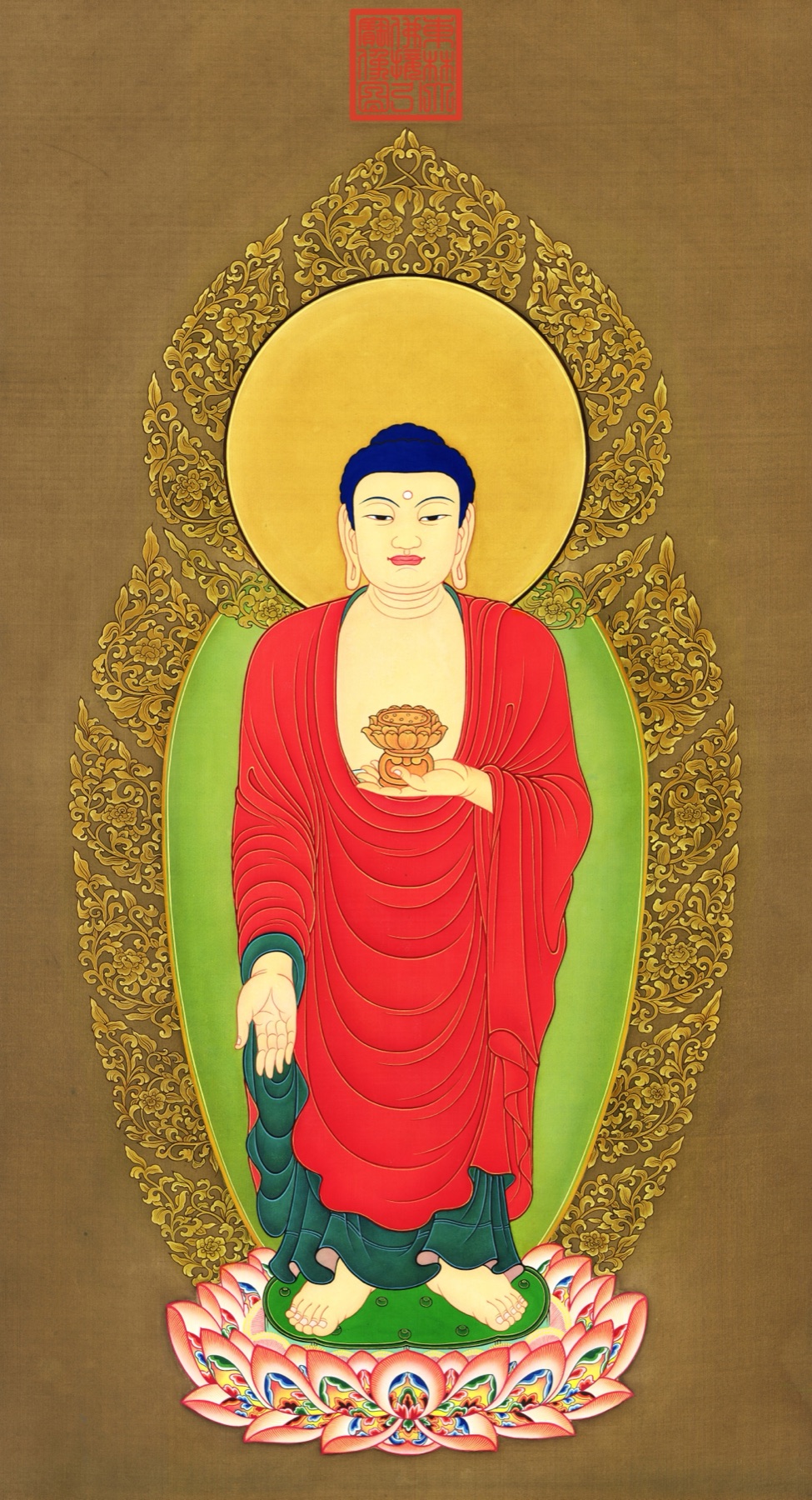
Quick answer: A Buddhist painting attribution should separate three questions: what the digital file is, which religious subject it depicts, and whether a proposed artist or date is documented. Filename labels, stylistic resemblance, and seals are useful leads, but a reliable attribution requires a traceable source chain and a match to the same physical object.
A filename can be a useful lead, but it is not proof. TK0260 is labeled in the archive as an Amitabha image associated with the Qing dynasty and the painter Ding Guanpeng. The visible file, however, has exceptionally clean outlines, intense flat color, a decorative halo, and a prominent red seal. Those features raise questions that should be investigated before the historical label is repeated as fact. This makes TK0260 an ideal case study in Buddhist painting attribution.
The goal is not to disprove the filename. A digital image might be a modern tracing, restored reproduction, publication plate, or devotional remake based on an older composition. The correct research response is to separate what the image visibly shows from what the metadata claims, then build an evidence trail.
Start with three separate records
Create one record for the digital file, one for the depicted religious subject, and one for the proposed historical object. These may overlap, but they are not automatically the same thing.
- Digital-file record: filename, TK number, dimensions, file type, color profile, modification date, crop, border, and visible graphic additions.
- Iconographic record: standing monastic Buddha, red robes, lowered hand, lotus-shaped vessel, lotus pedestal, halo, and ornamental surround.
- Attribution record: the unverified statement connecting the work with a Qing date and Ding Guanpeng.
This structure prevents a later researcher from mistaking a modern derivative file for a direct photograph of the attributed original.
What the visible image can support
The central subject can reasonably be described as Amitabha. The figure wears monastic robes, stands on a lotus, lowers one hand in a receptive gesture, and holds a lotus-like vessel. The red robe and devotional context agree with common Amitabha imagery. A green inner robe, circular gold halo, and dense gold floral aureole create a formal frontal presentation.
The chest bears a Buddhist swastika, an ancient auspicious mark. A large red seal appears above the halo. None of these elements, by themselves, proves a date or artist. They describe the design now visible in the file.
Why style is evidence but not a signature
Researchers often date a work by comparing line, color, drapery, figure proportions, ornament, and spatial construction with securely documented examples. This is legitimate stylistic analysis, but it produces a probability, not a certificate. A modern copy can imitate old forms, while a restored or color-corrected photograph can look unexpectedly new.
TK0260 has smooth contours, high saturation, and repeated ornamental curves. The floral aureole is extremely regular. These qualities may reflect a graphic reproduction process. To decide, one would need to inspect the original pixels, look for canvas or silk texture, compare edge behavior at high magnification, and locate another publication of the same composition.
Do not authenticate an artist from a filename
Ding Guanpeng is associated with Buddhist subject matter and court painting in the Qing period, so his name can sound plausible beside an elaborate devotional image. Plausibility is not provenance. An attribution should be supported by a collection record, inscription, seal study, documented ownership history, scholarly publication, or a reliable institutional catalogue.
Names are frequently copied through image-sharing sites without their original qualifiers. “Attributed to,” “after,” “style of,” and “formerly attributed to” can collapse into a simple “by.” A bilingual filename may then preserve the simplified claim long after its source disappears.
How to read the seal responsibly
A visible seal is evidence that a seal-shaped mark exists in the image. It does not immediately identify the artist or collector. Seals can be ownership marks, imperial collection marks, studio seals, later additions, facsimiles, or graphic decorations copied from another reproduction.
First transcribe the seal without guessing missing strokes. Compare its size, script, placement, and impression with documented examples. Determine whether the mark sits naturally on the support or floats as a separate digital layer. If the image is a reproduction, find the version in which the seal first appears. Seal analysis is a specialized field, and uncertainty should be recorded rather than hidden.
Build a source chain
- Preserve the exact filename and TK0260 identifier.
- Record where and when the file entered the archive.
- Search for identical compositions using reverse-image and visual comparison methods.
- Prefer collection pages, published catalogues, exhibition records, and high-quality object photography over reposting sites.
- Compare dimensions, crop, seals, inscriptions, damage, and mount across versions.
- Record every source with access date and the precise wording of its attribution.
- Keep a distinction between the historical object and a derivative digital rendering.
Use confidence language
A catalogue can be informative without pretending certainty. Suitable wording might include “archive filename identifies the subject as Amitabha and associates the composition with Ding Guanpeng; attribution unverified.” If later evidence supports a source object, the record can be updated to “digital reproduction after a painting attributed to Ding Guanpeng,” with the collection and object number cited internally.
Avoid promoting a tentative association into a title that search engines will repeat as settled fact. Digital catalogues shape future knowledge, and a cautious phrase can prevent years of circular citation.
Check medium and condition before historical comparison
Historical paintings on silk or paper normally reveal material information: weave, fibers, abrasion, pigment loss, creases, repairs, stains, mounting seams, or changes in opacity. TK0260’s web view emphasizes crisp design rather than surface. That may be the result of a modern redraw, aggressive restoration, compression, or a source image optimized for devotional display.
Before using fine stylistic details, examine the highest-resolution file at 100 percent and above. Look at transitions around the face, robe outlines, gold ornament, seal edges, and background. Material evidence can determine whether comparison should focus on an original painting, a print, or a digital derivative.
Iconography remains useful even when attribution is uncertain
Uncertainty about artist and date does not make the image unusable. The standing Buddha, lotus support, open hand, robe structure, halo, and floral aureole can still support a study of Amitabha visual language. Researchers should simply avoid turning iconographic relevance into historical authenticity.
This separation is one of the most valuable habits in Buddhist art research: identify what is visible, state what is probable, document what is claimed, and reserve certainty for evidence that can be checked.
Attribution checklist
- Is the proposed artist named in a traceable collection or publication record?
- Does the source say “by,” “attributed to,” “after,” or “style of”?
- Are seals and inscriptions legible and independently studied?
- Is this file a photograph of an object, a print, a tracing, or a digital remake?
- Do crop, mount, damage, and dimensions match a known object?
- Have contradictory attributions been preserved in the research notes?
Frequently asked questions
Is a seal enough to identify a painter?
No. A seal may be copied, added later, reproduced from another source, or too unclear to read. It must be studied with inscriptions, material, object history, and a documented comparison.
What is the safest wording for an uncertain attribution?
State the visible subject confidently when supported, then preserve the source claim separately: for example, “archive filename associates the image with a named artist; attribution not independently verified.”
Can style still be useful when authorship is uncertain?
Yes. Style can guide comparison of line, color, composition, garments, and reproduction technique. It should narrow research questions rather than function as a signature.
| Evidence | Value | Main limitation |
|---|---|---|
| Filename | Preserves a prior claim | Unknown source |
| Style | Guides comparison | Can be copied or revived |
| Seal | Useful alignment clue | May be reproduced or later |
| Official object record | Traceable current attribution | Wording may remain qualified |
Conclusion
TK0260 demonstrates why a responsible archive must resist the authority of a confident filename. The image supports an Amitabha reading, but the Qing and Ding Guanpeng labels require a verifiable source chain. By separating file, iconography, and attribution, researchers can preserve useful information without manufacturing certainty.
Sources and editorial method
This article is based on direct visual analysis of the TANGKAWORLD archive image. Religious identification is separated from uncertain artist, date, school, collection, and provenance claims. For the broader reading method and institutional references, consult How to Read a Thangka and the TANGKAWORLD learning journal.
Prepared and reviewed by the TANGKAWORLD editorial team. Last reviewed: August 5, 2026.

