Pure Land Painting Archive Variants: Crops, Borders, and Text
Quick answer: Archive variants can preserve different evidence from the same Buddhist composition. A border may record publication history, a crop may remove iconographic context, and a clearer scan may reveal inscriptions or seals. Researchers should group related files, document each transformation, and retain every source instead of choosing one supposedly perfect version.
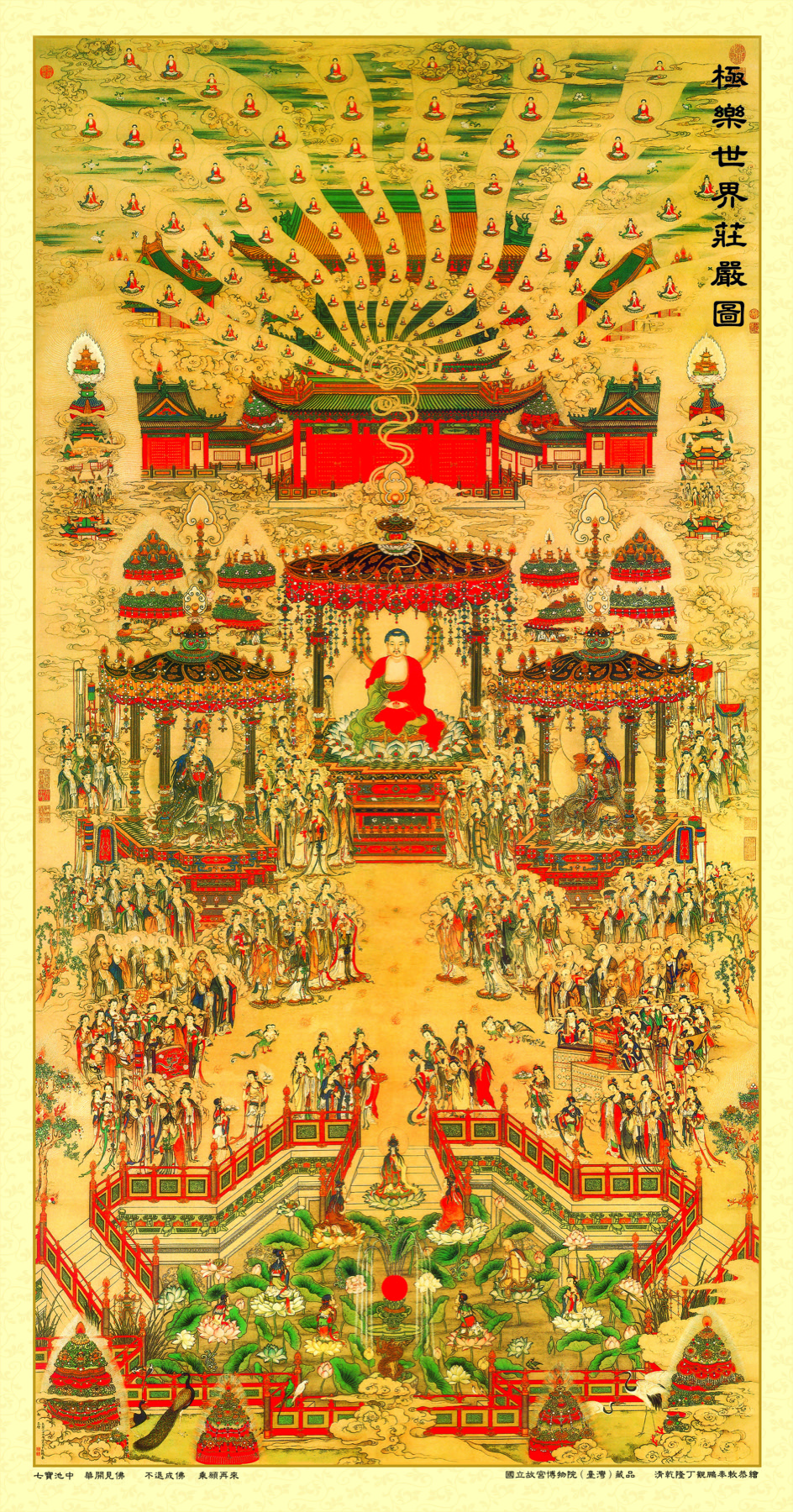
Digital collections often contain more than one file of the same composition. TK0258 shows a densely populated Amitabha Pure Land scene inside a pale patterned border, with a vertical Chinese title added at the upper right and publication-like text along the bottom. Other archive files preserve a closely matching composition with different crops and no added border. Studying such Pure Land painting archive variants reveals how reproduction changes the way an artwork is understood.
A duplicate is not necessarily useless. One version may retain an inscription; another may preserve more of the painted edge; a third may have better color or resolution. The research task is to determine the relationship among the files rather than deleting every repeated image.
Composition identity comes before filename identity
Two files can have different names and TK numbers while depicting the same underlying object. Compare stable visual landmarks: the central Amitabha canopy, flanking pavilions, red palace gate, radiating bands of small Buddhas, lotus pond, bridges, birds, seals, and crowd arrangements. If dozens of these features align exactly, the files probably share a common source composition.
Do not rely only on overall similarity. Pure Land paintings repeat established themes, and two different works can have related structures. Exact agreement in small figure positions, roof ornaments, seal locations, and damage patterns is stronger evidence.
The border may belong to the publication, not the painting
TK0258 includes a pale decorative field around the central picture. The border has a regular graphic pattern and may have been added for a printed plate, poster, calendar, devotional publication, or later digital presentation. It should not automatically be described as the original textile mount.
Inspect the transition between image and border. A perfectly even edge, uniform pattern, and embedded title often indicate a designed reproduction. If another version shows more of the painted field without the border, record both crops. The bordered version documents reception and publication history, while the unbordered file may be better for close study of the painting.
Added text changes interpretation
A vertical title appears in the upper-right margin. Text can identify a subject, advertise a devotional image, name a collection, or reproduce wording from an original inscription. Its location outside the central field suggests that it may belong to the derivative layout. The bottom line of text also looks like publication information.
Transcribe added text exactly and identify its script and reading direction. Keep transcription separate from translation. If characters are unclear, mark them rather than guessing. A later title can be historically important even when it is not part of the original painted support.
Cropping changes the visual hierarchy
A close crop makes the central assembly larger and easier to read, but it may remove borders, seals, captions, or the ends of architectural forms. A wider crop preserves context at the cost of smaller details. Neither is inherently superior; each serves a different research purpose.
Record the pixel dimensions and aspect ratio of every variant. Overlaying scaled versions can reveal whether one is simply cropped or whether it has been stretched, rotated, or perspective-corrected. Never overwrite the source while creating comparison files.
Color is not stable across reproductions
TK0258 appears warm and strongly yellow. Another file of the same composition may look cooler, greener, or less saturated. Differences can arise from lighting, scanner settings, print stock, color profiles, editing, or aging of the reproduction itself.
Do not use a web JPEG to make precise claims about original pigment. Preserve embedded color profiles when possible and record any correction. For comparative iconography, relative color relationships may still be useful, but material conclusions require calibrated photography or direct examination.
Resolution and sharpening can invent detail
High pixel count does not guarantee faithful detail. A large file can be upscaled from a smaller source, and sharpening can create bright halos around lines. Examine hair, roof tiles, small faces, and fine text at 100 percent. Repeated blocks or smooth artificial edges can reveal compression and interpolation.
A lower-resolution file may preserve more authentic tonal transitions. Keep both when they contribute different evidence. Generate web derivatives from the best source for the intended use, but maintain a clear link back to every original archive file.
Seals are comparison anchors
Red seals appear in several zones of the composition. Their exact placement is useful for aligning variants. If a seal disappears in one file, determine whether it was cropped, retouched, covered by a border, or absent from the source.
Do not use the presence of seals to confirm an artist without specialized study. In variant analysis, a seal is first a visual landmark. Authentication is a separate research question involving transcription, documented impressions, and provenance.
Create a variant group, not eight isolated records
A good digital catalogue can assign each file its own identifier while linking related items in a “variant of” group. The group record describes the shared composition; individual records preserve unique crop, text, border, resolution, color, and file history.
For TK0258, useful fields include: bordered layout, vertical Chinese title, bottom publication text, warm color cast, visible seals, pixel dimensions, and a note linking it to matching unbordered Pure Land files. This prevents both accidental duplication and premature deletion.
How variants support iconographic study
The bordered version still presents the main Pure Land system: lotus pond below, processional and devotional groups, central Amitabha, flanking figures, palace architecture, and rays populated by many small Buddhas. Added text can even help confirm how later audiences understood the subject.
Another variant may reveal fine figures more clearly or preserve the edge of the pond. Researchers can combine observations across files while citing which variant supports each detail. This is more transparent than silently treating the clearest fragments as one perfect image.
Archive-variant checklist
- Compare exact landmarks rather than titles alone.
- Record TK number, filename, dimensions, file size, and color profile.
- Classify borders, captions, and titles as original, reproduced, or uncertain.
- Transcribe visible text without guessing.
- Map crop, rotation, stretch, and retouching.
- Compare seals and damage patterns as alignment anchors.
- Link related files through a variant-group record.
- Preserve every source and document derivative creation.
Frequently asked questions
Are two similar image files always duplicates?
No. Matching composition does not mean matching evidence. Crops, captions, borders, color balance, resolution, and inscriptions may differ enough to make each file useful for research.
Which variant should be treated as the master file?
Keep the least altered source as the preservation master when possible, but do not discard other variants. A bordered or captioned version may retain publication or cataloguing evidence absent from the clean image.
Can color differences prove that two paintings are different?
Not by themselves. Scanning, compression, white balance, fading, and later editing can shift color. Compare stable landmarks, seals, damage, crop, and proportions before deciding whether two files represent different objects.
| Variant feature | Possible effect | Research action |
|---|---|---|
| Crop | Removes borders or secondary figures | Map the missing area |
| Added text | Preserves later identification | Transcribe without guessing |
| Color shift | Changes perceived palette | Compare neutral landmarks |
| Sharpening | Can invent false edges | Retain the unprocessed file |
Conclusion
TK0258 demonstrates that a digital border, title, and crop are not trivial packaging. They shape subject identification, color perception, and the survival of evidence. Treating related files as documented variants allows a collection to preserve both the Pure Land composition and the history of how that composition circulated.
Sources and editorial method
This article is based on direct visual analysis of the TANGKAWORLD archive image. Religious identification is separated from uncertain artist, date, school, collection, and provenance claims. For the broader reading method and institutional references, consult How to Read a Thangka and the TANGKAWORLD learning journal.
Prepared and reviewed by the TANGKAWORLD editorial team. Last reviewed: August 5, 2026.

