Can Series Context Identify Vipaśyin Buddha? TK1143
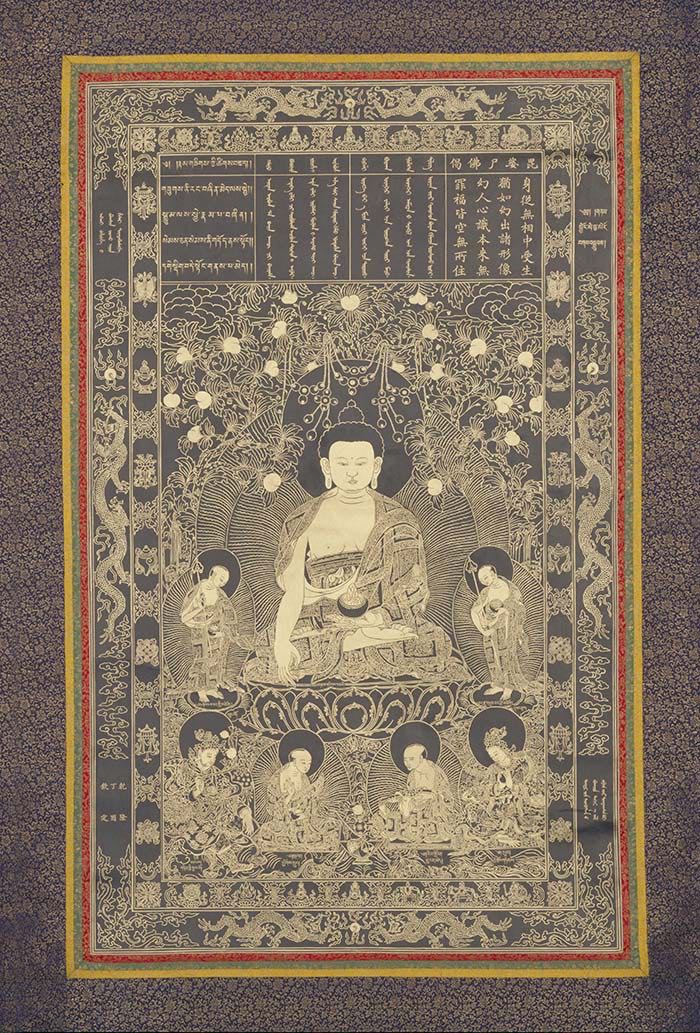
Quick answer: Series context can strengthen but not complete a Buddha identification. TK1143 repeats the border, multiscript panel, central seated Buddha, two standing attendants, and four lower figures seen in related archive images, while its filename names Vipaśyin Buddha. Confirmation still requires a verified inscription, sequence order, or reliable catalogue record.
To identify a Buddha within an image series, researchers must separate features shared by the entire set from evidence that distinguishes one member. TK1143 belongs to a run of archive files presented as the Seven Buddhas of the Past. Its repeated template establishes series membership more convincingly than it establishes the central Buddha’s individual name.
The filename gives the English title Seven Buddhas of the Past — Vipaśyin Buddha. That label is valuable prior metadata. It may preserve a translation, an earlier catalogue, or a file-naming decision, but the image must still be checked for a securely positioned name, sequence number, or other independent evidence.
What series evidence is visible in TK1143?
TK1143 visibly belongs to a coordinated Buddhist image system. A large seated Buddha occupies the central axis, two standing attendants flank the throne, and four haloed figures form a lower register. Above them is a rectangular text panel containing Tibetan, Chinese, and additional vertical-script columns. Dragons, auspicious motifs, cloud forms, and narrow ornamental units repeat around the border.
Which features are repeated, and which may distinguish this image?
Repeated features establish the family resemblance of the series, while variable features provide the best candidates for individual identification. The distinction prevents a common error: using the prestige of a coordinated set as proof that every filename is correct.
| Feature | Role in the series | Research value |
|---|---|---|
| Dark ground and pale linework | Shared visual system | Supports common production or reproduction context |
| Dragons and layered borders | Repeated frame | Helps match members and orientation |
| Upper multiscript panel | Repeated information zone | May contain the strongest naming or sequence evidence |
| Central seated Buddha | Shared sacred focus | Confirms subject class, not necessarily individual name |
| Two standing attendants | Repeated flanking structure | May help if attributes or labels differ |
| Four lower haloed figures | Shared lower register plan | Differences in dress, objects, and labels may distinguish members |
| Flowering canopy | Variable internal design | Useful for file matching and workshop comparison |
| Filename “Vipaśyin Buddha” | Archive metadata | Research lead requiring independent confirmation |
Why can’t the central pose identify Vipaśyin by itself?
The central pose cannot identify Vipaśyin by itself because broadly shared Buddha attributes recur across many subjects. In TK1143, the Buddha sits cross-legged on a lotus throne. The proper right hand lowers beside the knee in an earth-touching-like position, while the left rests near the lap beside a dark bowl-shaped form. Monastic robes, elongated ears, a halo, and calm expression reinforce Buddhahood.
These features are meaningful, but they are not uniquely diagnostic. A coordinated series may intentionally keep posture, dress, throne, and attendants similar so that viewers recognize unity. Individual names may instead be carried by inscriptions, ordering, subtle attributes, or ritual knowledge not recoverable from a single low-resolution reproduction.
The safest wording is therefore layered: “central seated Buddha in a series file named Vipaśyin Buddha.” It preserves what is visible and what the archive claims without pretending that the gesture alone settles the identification.
How can the text panel anchor the sequence?
The text panel can anchor the sequence if a qualified transcription connects a name, epithet, verse, or ordinal position to the central figure. Its placement directly above the image makes it a stronger identification candidate than a detached filename, but placement alone does not reveal the panel’s function.
At least three visual text groups are present: horizontal Tibetan lines at the upper left, vertical Chinese characters at the upper right, and several narrow vertical columns between them. Additional small text blocks appear along the side borders and near the lower corners. The precise scripts and languages of every column remain uncertain.
Researchers should not assume that all columns translate the same sentence. One block may name the Buddha, another may give a verse, and another may record a donor, maker, ritual formula, or series explanation. Each zone needs its own crop number, transcription, reading direction, uncertainty marks, and reviewer.
A seven-step method for identifying a Buddha within a series
Use the whole set as a controlled comparison, but require individual evidence for individual names.
- Inventory every member. Record TK number, filename, dimensions, checksum, orientation, and the archive’s proposed name.
- Build a shared-feature list. Mark borders, text zones, figure counts, throne type, palette, and repeated ornaments that define the series.
- Build a variable-feature list. Record changes in hands, vessels, attendants, lower figures, flowers, labels, and column arrangement.
- Map all inscriptions. Number the top panel, side notes, lower captions, seals, and any reverse text separately.
- Transcribe before translating. Preserve unclear characters and do not repair a reading merely because it resembles the filename.
- Test the proposed order. Compare verified names or sequence numbers with the folder order, filenames, and physical arrangement only after transcription.
- Assign a confidence level. Use confirmed, probable, possible, or archive label only, and state what evidence would change the conclusion.
The TANGKAWORLD guide to reading a thangka provides a broader whole-image sequence, while the high-resolution study guide explains how to move from composition to small attributes without overstating a reproduction.
How should the lower register be described?
The lower register should be described through observable differences before any figure is named. Four haloed figures sit beneath the central throne. The outer two appear more richly ornamented, while the inner two have simpler hair or head treatment and distinct hand positions. Small objects and captions are present, but the current 700 × 1033 source does not support confident identification of each one.
Their symmetrical placement may express hierarchy, transmission, attendance, or a structured group associated with the central Buddha. Those are interpretive possibilities rather than verified roles. A future high-resolution file, reliable transcription, or catalogue record could make the figures more specific.
Do not treat every lower figure as an independent witness to the filename. If all names derive from the same unverified series label, repeated agreement is circular. Independent evidence requires a readable caption, distinctive attribute, documented sequence, or external record tied to this exact image.
What should remain uncertain about TK1143?
The exact central identity remains uncertain despite the Vipaśyin filename. So do the names of the attendants and lower figures, the full transcription and translation, and the purpose of each text block. The physical medium cannot be determined from the photograph; pale linework on a dark field could represent painted, printed, woven, embroidered, or another textile-related technique.
Date, artist, workshop, school, patron, collection, and provenance also remain uncertain. Repeated borders and coordinated layout may support a common production context, but stylistic unity cannot replace documentary history or material examination.
Why preserve the series metadata?
Series metadata preserves relationships that a single isolated image cannot show. Keep folder order, filenames, TK numbers, dimensions, checksums, and neighboring files together even when names are questioned. A corrected identification should be added as a new evidence layer rather than erasing the earlier archive label.
The TANGKAWORLD learning center offers related visual-reading and evidence methods.
Frequently asked questions
Does the filename prove that TK1143 depicts Vipaśyin Buddha?
No. It preserves an earlier identification, but confirmation needs a securely transcribed name, verified series order, distinctive iconographic evidence, or a reliable catalogue record for this exact image.
Can repeated borders establish that images belong to one set?
They can strongly support a shared visual or reproduction system, especially when composition and text zones also align. They cannot alone prove original physical set membership, workshop, date, or provenance.
Why not identify the lower figures from appearance?
Their scale and resolution do not preserve enough distinctive attributes for confident names. Neutral descriptions and numbered positions are more useful until captions or better images are available.
What is the strongest next step?
Create exact crops of every text zone and seek qualified transcription across the full series. Names should then be tested against panel position, sequence, and the visible iconography.
Conclusion
TK1143 demonstrates why a series is both valuable and dangerous evidence. Repeated design establishes relationships, yet it can encourage researchers to copy one uncertain label across several files. The strongest method separates shared template, variable features, inscriptions, archive metadata, and historical attribution. That structure makes Vipaśyin a testable identification rather than a guess.
Sources and editorial method
This article is based on direct visual analysis of TANGKAWORLD TK1143 and comparison with neighboring series images TK1141 and TK1142. Visible composition, figure count, gestures, text zones, borders, and floral design are separated from religious naming and historical attribution. The archive’s Vipaśyin Buddha title is retained as prior metadata, while exact transcription, additional script names, individual figure identities, medium, date, artist, school, collection, and provenance remain uncertain. Related TANGKAWORLD guides route readers to their Sources and further reading sections.
Prepared and reviewed by the TANGKAWORLD editorial team.
Last reviewed: August 26, 2026.
Explore more Thangka art at TANGKAWORLD. Visit the TANGKAWORLD home page, continue with the Thangka learning center, or download the complete Thangka image collection.

