Does the Bowl Identify Medicine Buddha? An Evidence Test with TK0538
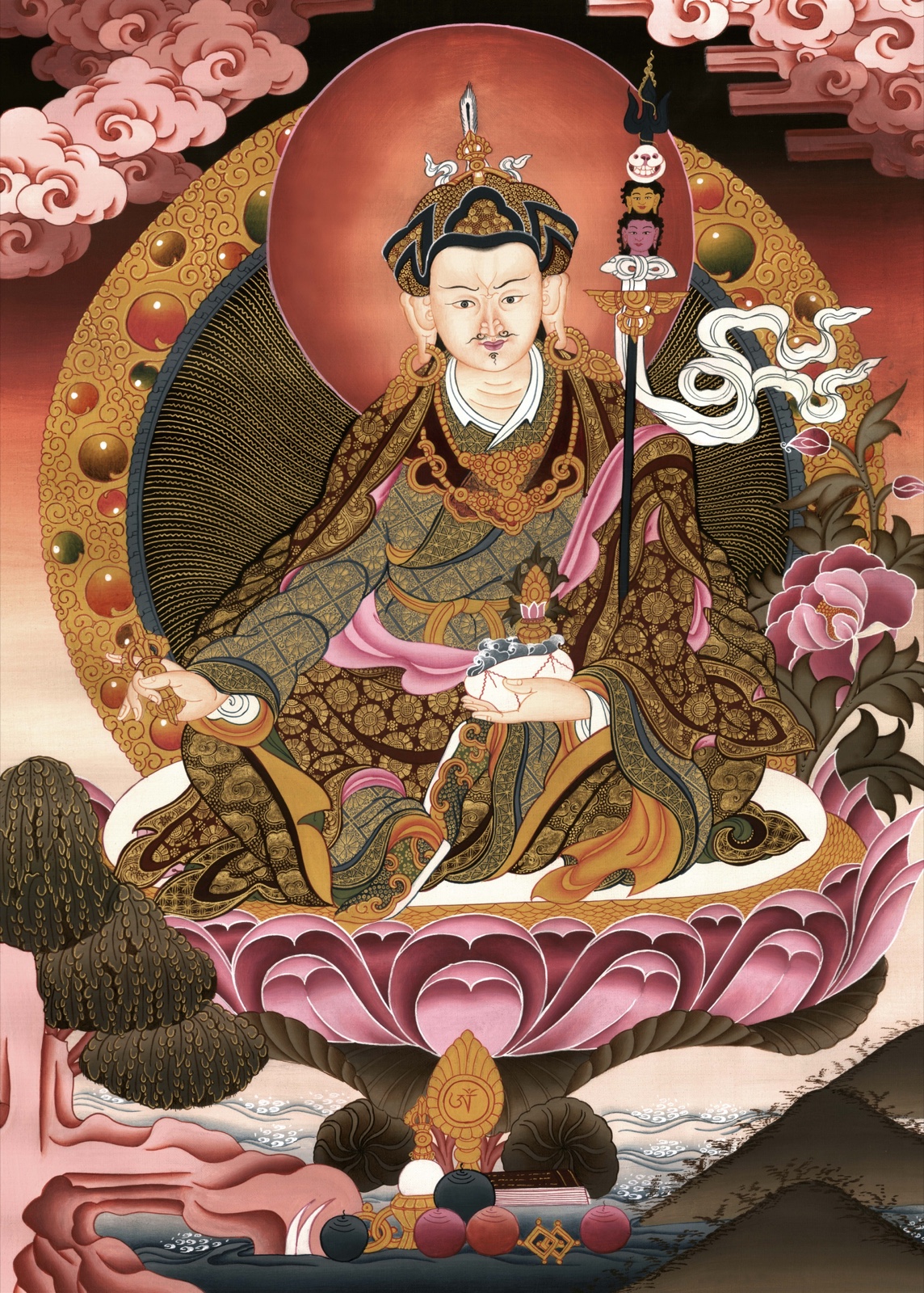
Quick answer: No—the white vessel in TK0538 does not by itself identify Medicine Buddha. The archive filename supplies that title, but the visible figure wears ornate teacher’s robes, has a moustache, and sits beside a multi-faced staff with a skull finial. Those conflicting signals require an uncertain identification.
A filename can be a useful lead, but it is not a catalogue record. TK0538 demonstrates why Medicine Buddha bowl identification must compare the vessel with the figure’s body, dress, hands, companion objects, and documentary history. Here, some details evoke healing or ritual practice, while several prominent details do not match the most familiar Medicine Buddha type.
This article does not replace the archive title with another confident name. Instead, it tests the title against what the image actually shows. That approach preserves the English title and TK number while preventing a single ambiguous object from controlling the identification.
What is directly visible in TK0538?
TK0538 shows an ornately dressed seated Buddhist teacher rather than an unmistakable blue Buddha in plain monastic robes. The figure sits cross-legged on a broad pink lotus. A red circular halo and a jewel-like outer aureole frame the upper body. The face is pale, with a small moustache and a short mark below the lower lip. Large earrings, patterned textiles, layered garments, and a decorated head covering give the figure a portrait-like, teacherly appearance.
One hand supports a white vessel marked by fine red lines. Dark curling forms rise from its opening, although the photograph does not establish whether they represent smoke, plants, medicine, fabric, or another substance. The other hand extends outward and holds a small golden implement whose precise form is unclear.
A tall staff stands beside the figure. Its upper section displays three colored faces, a white skull-like finial, and a dark flame-shaped top. Pink lotus blossoms grow on the opposite side. Below the lotus seat are rounded offerings, a rectangular book-like object, and an emblem bearing a visible syllable-like sign. These observations are descriptive; they do not yet prove a name.
Why can a bowl suggest Medicine Buddha?
A bowl can support a Medicine Buddha reading when it appears within a consistent group of attributes. Familiar representations often show a blue, monastically robed Buddha seated on a lotus, with a bowl in the meditation hand and a medicinal plant associated with the other hand. Retinue figures, inscriptions, or a documented series can strengthen that reading.
The object’s position also matters. A vessel resting calmly in the lap has a different visual role from a cup, vase, skull bowl, offering container, or ritual vessel held at chest level. Shape alone is rarely decisive because many Buddhist teachers, Buddhas, adepts, and protective figures hold containers. For the standard comparison, see the TANGKAWORLD Medicine Buddha identification guide.
What evidence argues against a secure Medicine Buddha label?
The strongest caution comes from the complete figure, not from the vessel. TK0538 lacks the immediately visible blue body that commonly distinguishes Bhaisajyaguru in Tibetan painting. Color is not infallible—pigments, regional conventions, repainting, photography, and variant traditions can complicate it—but a pale body means other identifying evidence must do more work.
The costume is another warning. Instead of the relatively simple monastic robe expected for a Buddha, the figure wears highly ornate textiles, large earrings, and an elaborate head covering. The moustache and individualized facial treatment further suggest a human or semi-historical teacher portrait, although the exact person remains uncertain. None of those observations alone rules out every unusual form, but together they weaken a routine Medicine Buddha attribution.
The tall multi-faced staff is especially important. It is visually dominant and should be identified before the smaller vessel is allowed to decide the subject. The visible faces and skull-like finial may belong to a lineage, ritual, visionary, or protective context, but naming the implement or its owner without a reliable comparison would exceed the image evidence.
How should the vessel itself be described?
The safest label is “white vessel with dark curling contents.” That wording records color, form, and the visible material at the opening without pretending to know its substance. Calling it a medicine bowl would already convert an interpretation into a fact; calling it an alms bowl would make a different unsupported assumption.
High-resolution viewing helps separate the vessel from the hand, clothing, and rising forms, but resolution cannot recover absent documentation. A sharper scan may reveal brushwork or an attribute’s outline while still leaving its ritual name uncertain. The broader high-resolution iconography workflow explains how to record these layers without overclaiming.
Evidence table: what supports or weakens the archive title?
| Visible feature | Possible relevance | Assessment |
|---|---|---|
| White vessel with dark forms | Could relate to medicine or ritual contents | Suggestive, not diagnostic |
| Seated lotus posture and halo | Marks sacred status | Shared by many Buddhist figures |
| Pale body | Differs from the familiar blue Medicine Buddha type | Cautionary evidence |
| Ornate robes, earrings, and head covering | More teacher-like than standard Buddha dress | Strong caution |
| Moustache and individualized face | May indicate a portrait or lineage figure | Important but not conclusive |
| Multi-faced staff with skull finial | Points to a specialized ritual or lineage context | Requires separate identification |
| Archive filename “Medicine Buddha” | Provides a prior label | A lead, not verified documentation |
A seven-step Medicine Buddha bowl identification test
- Record the supplied title. Preserve its exact wording and TK number, but label it as archive information.
- Describe the vessel neutrally. Note its color, shape, contents, hand position, and relationship to the body.
- Check the figure type. Compare body color, monastic or jeweled dress, facial treatment, crown, hair, and earrings.
- Inspect the other hand. Look for a clearly rendered medicinal plant or another distinctive implement.
- Weight dominant objects. A large staff, throne, retinue, or inscription may carry more identifying value than a small bowl.
- Seek internal confirmation. A named inscription, documented series, matching companion painting, or stable catalogue record can turn a possibility into evidence.
- State the confidence level. Separate visible fact, traditional association, probable reading, and unresolved attribution.
Applied to TK0538, the test produces a cautious result: the archive title is preserved, the vessel keeps Medicine Buddha in the comparison set, but the complete visual pattern does not securely confirm that identity.
What can the surrounding composition tell us?
The lotus, halo, clouds, flowers, water, and offerings establish a sacred environment, but they are widely shared. They confirm religious importance more readily than personal identity. The book-like object below may suggest teaching or transmission, yet its exact nature cannot be proved from shape alone.
The face-bearing staff deserves priority in future research because it is both unusual and prominent. A careful next step would compare securely catalogued images that combine similar garments, facial hair, white vessel, and staff structure. Until that comparison succeeds, assigning a specific master, lineage, school, period, or collection would be speculative. Readers new to this method can use How to Read a Thangka to move from the central figure outward.
Frequently asked questions
Does every bowl in a Buddhist painting identify Medicine Buddha?
No. Bowls and vessels can be alms containers, offering objects, ritual cups, longevity vessels, medicine containers, or other implements. Identification depends on the vessel’s placement and the full attribute set.
Must Medicine Buddha always be blue?
Blue is a major and highly useful identifier in familiar Tibetan representations, but color should not be used alone. Variant conventions, pigment change, image processing, and damaged surfaces require confirmation from hands, plants, dress, retinue, and documentation.
Who is the figure in TK0538?
The exact identity is uncertain. The ornate robes, moustache, earrings, head covering, vessel, and multi-faced staff make a teacher or lineage-portrait interpretation worth investigating, but they do not justify a specific name without reliable comparative or textual evidence.
Why retain the English archive title if it may be wrong?
Retaining it preserves the image’s documentary trail. The responsible solution is to distinguish “archive title” from “verified identification,” allowing future researchers to trace, test, and correct the record without losing its history.
Conclusion
TK0538 shows why a bowl is evidence, not a verdict. The white vessel and sacred setting explain how a Medicine Buddha label could arise, yet the pale individualized face, ornate teacher’s dress, and remarkable multi-faced staff conflict with a standard identification. The image should therefore remain under its supplied English title with a clear uncertain qualifier until stronger evidence appears.
Sources and editorial method
This article is based on direct visual analysis of the TANGKAWORLD TK0538 image at full and web resolution. Visible evidence is separated from religious identification, while the archive filename is treated as an unverified prior label. Historical attribution—including the figure’s exact name, date, artist, school, collection, and provenance—remains uncertain. Related TANGKAWORLD guides provide the comparative method and route readers to their own sources and further reading.
Prepared and reviewed by the TANGKAWORLD editorial team.
Last reviewed: August 20, 2026.
Explore more Thangka art at TANGKAWORLD. Visit the TANGKAWORLD home page, continue with the Thangka learning center, or download the complete Thangka image collection.

