How Does a Wrathful Buddhist Painting Create Movement? TK1235
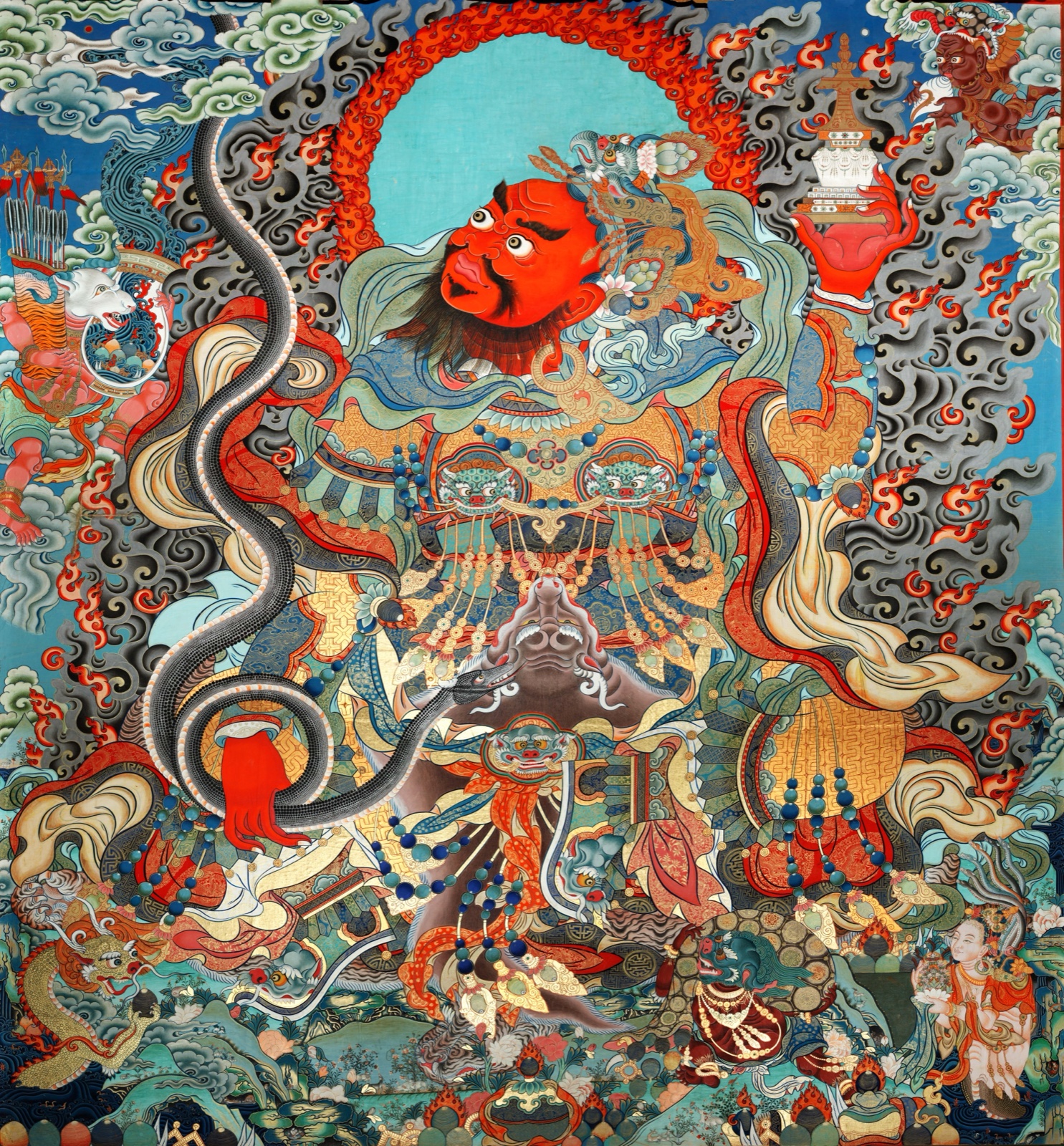
Quick answer: Wrathful Buddhist painting creates movement by linking the central gaze, raised attribute, looping serpents, streaming scarves, flame tips, smoke curls, weapons, and surrounding figures into directional paths. In TK1235, these paths circulate around a stable red-faced center. They organize attention without proving the inherited Maitreya or mural labels.
Wrathful Buddhist art can look chaotic at first glance. Flames turn in several directions, attendants crowd the edges, weapons interrupt the field, and long creatures cross the body. Yet a strong composition does not distribute energy randomly. It gives the eye routes to follow, pauses to recover, and repeated shapes that bind separate incidents into one visual system.
TK1235 makes movement in wrathful Buddhist painting visible: a monumental red-faced figure anchors serpents, smoke, flames, scarves, gazes, weapons, and smaller bodies. Its inherited identity remains uncertain.
What creates the first sense of movement in TK1235?
The first sense of movement comes from opposition between a stable central body and a restless perimeter. The large torso occupies most of the vertical axis. Its frontal mass, broad shoulders, patterned armor-like clothing, and nearly centered placement establish weight. Around that weight, long lines bend, rise, fall, and return.
The face turns slightly toward the upper left rather than staring directly forward. At the same time, the raised hand on the upper right lifts a multi-tiered stupa- or pagoda-like object. This creates a diagonal tension across the head: gaze travels one way, gesture reaches another. The eye moves back and forth instead of stopping at the face.
How do the serpents guide the eye?
The serpents create the longest continuous routes in the picture. A large dark serpent rises from the lower left, bends past the shoulder, and continues toward the upper field. Its pale-edged body remains legible against clouds, garments, and smoke. A second serpentine line crosses the lower torso and redirects attention toward the center.
The curves should be described before they are interpreted. A serpent can carry several religious meanings depending on the figure and tradition, but its compositional function is visible without a secure deity name. Here it links top, center, and lower register into one path.
Why do flames and smoke feel different?
Flames accelerate the eye, while smoke delays it. The red flame tips are small, repeated, high-contrast forms that point and flicker. They create a fast rhythm around the head and along the sides. Dark gray smoke expands in broader spirals, making the eye circle rather than jump.
Together they build an outer ring of pressure. The hot red-orange flames separate from the turquoise ground, while black and gray smoke provides visual weight. This ring frames the pale blue space behind the head and makes the central face appear even more intense.
The related TANGKAWORLD guide to Palden Lhamo discusses flames in a securely named protector context. TK1235 requires more caution: flame and smoke support a wrathful or protective visual mode, but they do not identify the figure by themselves.
How do gaze, hand, and stupa form a directional triangle?
The face, raised hand, and architectural object form a directional triangle across the upper third. The wide eyes and tilted head pull attention leftward. The raised red hand opens upward on the right. The pale stupa-like object extends vertically above the palm, giving the eye a clear endpoint.
This triangle prevents the upper body from becoming a static portrait. It also creates a sequence: encounter the face, follow the gaze, return across the headdress and flame ring, then rise through the hand to the object. A viewer may repeat this loop several times before moving downward.
The object should remain “stupa-like” or “architectural” until its exact ritual identity is documented. The Maitreya visual guide explains when a stupa can contribute to Maitreya identification, but one object cannot override the unusual wrathful combination visible here.
How do textiles and jewelry continue the motion?
Textiles convert bodily mass into flowing movement. Pale scarves sweep outward from the shoulders, bend down the sides, and curl back toward the lower body. Red, blue, gold, and green garment borders repeat arcs already established by serpents and smoke.
What role do attendants, animals, and weapons play?
The smaller figures create countercurrents around the central body. On the left, clustered animal-headed and guardian-like forms look inward or upward. Weapons and standards rise vertically, interrupting the serpents’ curves. On the lower right, richly dressed attendants and offering figures introduce calmer poses and smaller gestures.
Armor, weapons, and animal forms can suggest protective roles, but they do not automatically establish the Four Heavenly Kings or any other named group. The Four Heavenly Kings visual guide shows why directional position and attributes must converge before a name is assigned.
| Visual device | Direction or rhythm | Effect on viewing |
|---|---|---|
| Central torso | Stable vertical mass | Creates an anchor for surrounding motion |
| Head and gaze | Upper-left pull | Starts a diagonal reading path |
| Raised hand and stupa | Upward-right lift | Balances the gaze and forms an upper loop |
| Serpents and scarves | Long S-curves | Connects top, center, and lower register |
| Flames and smoke | Fast points and slow spirals | Builds pressure around the central figure |
| Retinue and weapons | Inward glances and vertical interruptions | Returns attention to the sacred center |
How can you map movement in a dense Buddhist painting?
A movement map records visible direction before assigning religious meaning.
- Find the visual anchor. Identify the largest stable body, throne, mandala center, or architectural axis.
- Trace the face and gaze. Note where eyes, head angle, and open mouth direct attention.
- Follow the longest curves. Track serpents, scarves, clouds, halos, rivers, and garment borders from end to end.
- Separate fast and slow rhythms. Compare repeated flame tips, beads, feathers, or weapons with broad smoke, cloth, and body shapes.
- Mark diagonals and verticals. Raised arms, staffs, arrows, and architectural objects often counterbalance curved motion.
- Read the retinue as a group. Map inward gazes, gestures, and changes of scale before naming individuals.
- Check the lower register. Offerings, donors, animals, and landscape often slow the descent and close the visual circuit.
- State what movement cannot prove. Composition may suggest a protective mode while deity, episode, medium, date, artist, site, collection, and provenance remain uncertain.
Does movement help identify the central figure?
Movement can define a visual category, but it rarely proves identity. The flame-and-smoke field, forceful gaze, serpents, weapons, animal-headed forms, and active retinue support a wrathful or protective reading. They distinguish the image from a quiet seated Buddha portrait.
That distinction is still broad. Many Buddhist protectors and local guardian traditions use dynamic curves, fire, smoke, weapons, and subordinate figures. A secure name requires the complete attribute system, inscriptions, documented ensemble, ritual context, or a matching institutional record.
How does TK1235 relate to the earlier archive files?
TK1235 and TK0548 have the same 8000 × 8616 dimensions and identical decoded pixels in a uniform comparison sample, although their file hashes differ. TK1234 preserves the same composition at only 700 × 754 pixels. These facts support a shared digital-image history, not three independent witnesses for a Maitreya identification.
The three posts therefore serve different research questions: TK0548 audits the inherited label, TK1234 defines low-resolution evidence limits, and TK1235 maps compositional movement. Keeping those questions separate prevents a repeated image from producing repeated search intent.
Frequently asked questions
Where should I look first in a crowded wrathful painting?
Start with the largest stable figure, then follow the gaze, raised hands, longest curves, and outer flame or smoke ring. This reveals the main circulation before small details compete for attention.
Do flames always identify a wrathful protector?
No. Flames communicate sacred energy, transformation, or force in several contexts. They support interpretation only when read with body type, posture, attributes, attendants, inscriptions, and documented tradition.
Can a serpent identify the deity in TK1235?
No. The serpents are major visual and compositional evidence, but their religious meaning depends on the full attribute system. They should not replace a missing inscription or object record.
Why keep TK1235 if its decoded image matches TK0548?
A separate file can preserve filename history, metadata, timestamps, compression, or circulation evidence. Link related records and avoid treating the duplicate as independent proof of subject or provenance.
Conclusion
TK1235 creates motion through controlled opposition: a heavy central body against looping serpents, lifted gesture, streaming scarves, flickering flames, circling smoke, vertical weapons, and inward-looking attendants. Mapping those routes makes a dense image readable without forcing a deity name. The archive title Maitreya — Mural remains preserved, while subject, support, site, date, artist, collection, and provenance remain uncertain.
Sources and editorial method
This article is based on direct visual analysis of the complete TANGKAWORLD TK1235 image and comparison with the related TK0548 and TK1234 digital files. Visible directional evidence, religious identification, digital-file relationships, and uncertain historical attribution are kept separate. Related guidance includes How to Read a Thangka, the Palden Lhamo protector guide, the Four Heavenly Kings guide, the Maitreya visual guide, and the TANGKAWORLD Learn center.
Prepared and reviewed by the TANGKAWORLD editorial team. Last reviewed: August 19, 2026.

