How to Map Repeated Attributes in Buddhist Art: TK0579
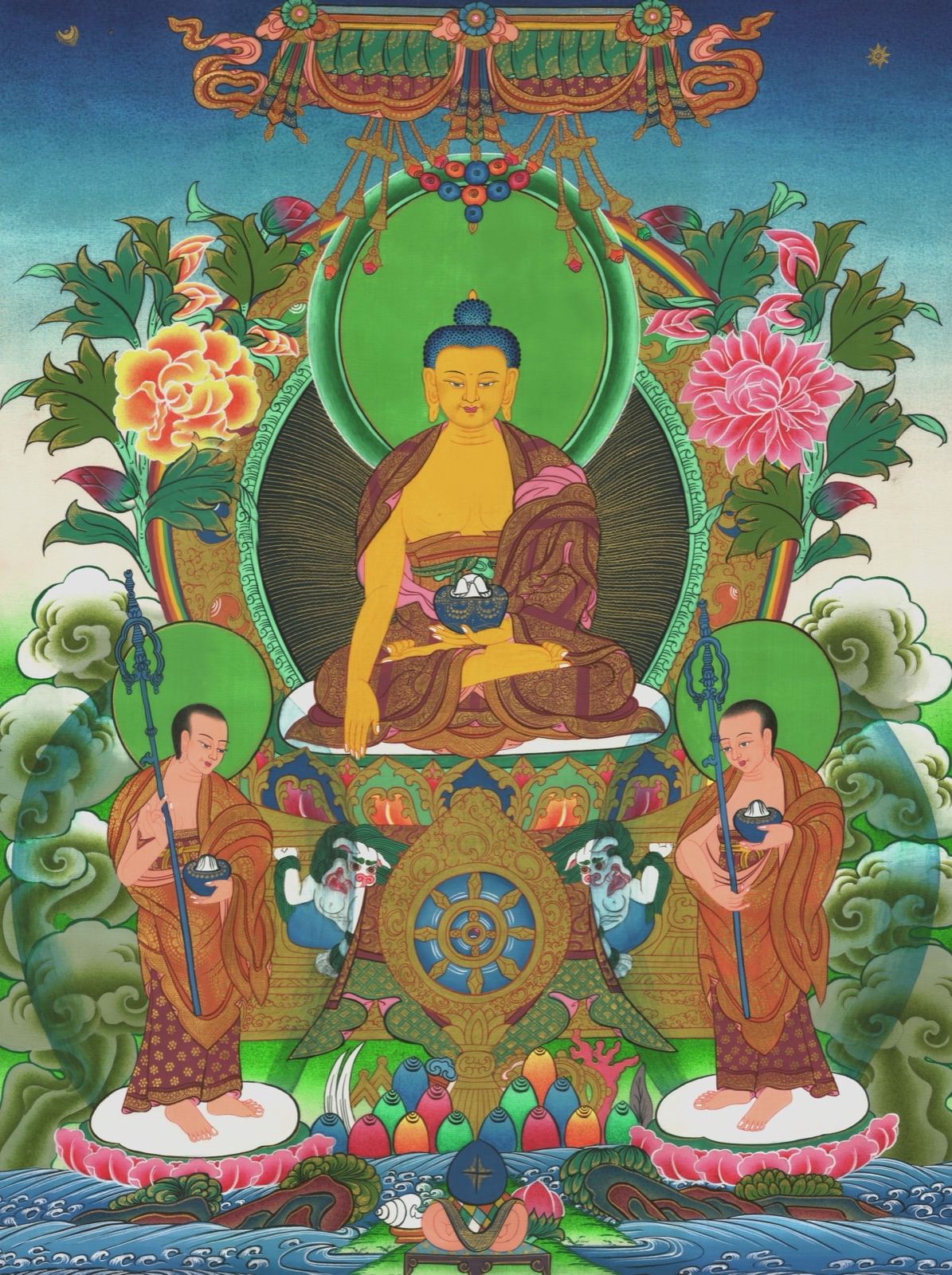
Quick answer: Repeated attributes can reveal how figures are grouped without proving every identity. In TK0579, bowls recur with the central seated figure and two standing attendants, while paired staffs, halos, flowers, and a wheel-shaped emblem organize distinct roles. Map each object first; interpret it only after checking contact, position, scale, and repetition.
A single object in Buddhist art can be ambiguous. A bowl may suggest monastic life, medicine, offering, or ritual service; a staff may identify a role or simply mark an attendant; a wheel may refer to teaching, sovereignty, or a wider symbolic program. Repetition makes these objects easier to study because each occurrence can be compared with the others.
TK0579 is especially useful for learning how to document repeated attributes in Buddhist art. A large seated Buddha-like figure holds a blue vessel in the lap and lowers the other hand toward the throne. Two smaller standing monastic figures each carry a long staff and a similar blue vessel. Below them, two muscular blue-white figures flank a large wheel-shaped emblem. Flowers, halos, clouds, jewels, a canopy, and water complete the arrangement.
What is a repeated attribute in Buddhist art?
A repeated attribute is an object, gesture, color, or formal feature that appears with more than one figure or in more than one zone. Repetition can connect participants, distinguish ranks, or establish a ritual sequence, but it does not automatically prove that all repeated forms have the same meaning.
In TK0579, the clearest repeated objects are blue vessels with pale contents. One rests in the central figure's lap, and one appears with each standing attendant. The vessels are related by color and rounded form, yet their placement differs. That difference is evidence: the central vessel belongs to a seated meditative pose, while the side vessels are carried by standing figures who also hold staffs.
Why should objects be mapped before figures are named?
Objects should be mapped first because visible relationships are more secure than uncertain identities. A researcher can record that a hand touches a vessel, a staff rises beside a halo, or two figures mirror one another without deciding who every participant is.
This order reduces circular reasoning. If a figure is named first, every nearby object may be forced to support that name. If the objects are recorded first, the identification can be tested against a neutral inventory. The method is particularly important when a filename contains a museum, deity, or period label that has not yet been matched to a reliable catalogue record.
Which attributes repeat in TK0579?
TK0579 repeats vessels, staffs, circular halos, floral forms, and paired arrangements. Each repetition operates at a different level of the composition.
| Feature | Where it appears | What can be recorded safely |
|---|---|---|
| Blue vessels | Central lap and both standing attendants | Three related containers with pale contents; exact substance uncertain |
| Long staffs | One beside each standing attendant | A mirrored pair held vertically |
| Circular fields | Behind the central and standing figures | Halos distinguish three primary human figures from the lower supporters |
| Large flowers | Left and right of the central halo | Paired floral masses balance the upper field |
| Wheel form | Lower center between two supporting figures | A dominant emblem; a Dharma-wheel reading is plausible but not proven here |
How do contact and support change an attribute's meaning?
Contact shows which figure controls, carries, presents, or supports an object. The same object can perform a different role when it rests in a lap, is carried at chest height, or is displayed between attendants.
The central figure's left hand supports the vessel at the lap. Each standing figure holds a smaller vessel near the torso while the other hand controls a vertical staff. The lower blue-white figures do not hold vessels; their raised arms appear beside or behind the large wheel-shaped form. These contact patterns separate three role groups even before any participant is named.
How does symmetry help identify role groups?
Symmetry links figures that share position, posture, scale, and objects. In TK0579, the standing attendants mirror one another across the center, and the lower supporting figures form another pair around the wheel.
Mirroring does not make the two members identical in every detail. Their faces, robe folds, hand positions, and vessel placement should still be compared separately. Symmetry is strongest as evidence of coordinated function: the two standing figures frame the Buddha-like center, while the lower pair emphasizes the central emblem.
Does the large wheel identify the whole scene?
The wheel supports a teaching-related interpretation, but one emblem should not determine the entire scene by itself. Wheel imagery is widely associated with Buddhist teaching, yet the exact ritual, narrative, or doctrinal program of TK0579 remains uncertain.
The safest description is visual: a large blue-and-gold wheel-shaped emblem occupies the lower center, enclosed by ornate framing and flanked by two powerful figures. Its exceptional size makes it a secondary focal point beneath the seated Buddha. A specific name or episode would require comparative texts, inscriptions, or a matched collection record.
What does the central vessel contain?
The vessel contains pale folded or pointed forms, but their material and identity cannot be confirmed from the image alone. The corresponding vessels carried by the standing attendants contain similarly pale forms.
Researchers should record shape, color, count, and edge behavior before applying a label such as food, medicine, cloth, flowers, or ritual substance. The repeated vessels establish a shared motif, while the contents remain uncertain. This distinction preserves useful evidence without inventing specificity.
How can you build a repeated-attribute map?
A repeated-attribute map can be built by assigning every visible object a neutral identifier and then comparing its relationships. The process works well for dense paintings, damaged images, and files with uncertain metadata.
- Divide the image into zones. Use upper, center, lower, left, and right positions before assigning religious names.
- List recurring forms. Record vessels, staffs, halos, flowers, wheels, jewels, clouds, and other repeated shapes.
- Trace hand contact. Note whether an object is held, touched, supported, worn, or merely adjacent.
- Compare scale. Measure whether the repeated object changes size with the figure or becomes an independent emblem.
- Mark paired placement. Test whether left and right objects mirror each other around a central axis.
- Separate observation from interpretation. Keep a visible-evidence column and a proposed-meaning column.
- Assign confidence. Use confirmed, probable, possible, or uncertain rather than treating every label as equally secure.
What should remain uncertain in the archive record?
The exact identities of the two standing attendants, the lower supporting figures, the vessel contents, the wheel's specific doctrinal role, and the small foreground participant remain uncertain. The crescent, solar emblem, flowers, jewels, waves, and canopy can be described, but their relationship to a specific narrative has not been demonstrated.
The filename's Museum of Fine Arts, Boston reference is also unverified. A museum attribution would require a matching object record, accession number, dimensions, image, title, and provenance. The archive title may be preserved as a research lead, not presented as confirmed ownership or authorship.
Frequently asked questions
Do repeated bowls prove that all three figures are the same person?
No. Repeated vessels can link a ritual or monastic role without making the figures identical. Scale, posture, staffs, halos, and placement distinguish the central figure from the standing attendants.
Can the wheel be called a Dharma wheel?
It is reasonable to describe it as a wheel-shaped Buddhist emblem and propose a Dharma-wheel reading. A more specific doctrinal claim needs comparative or textual evidence.
Are the two standing figures definitely disciples of Shakyamuni?
Their monastic dress, paired placement, staffs, and bowls make a disciple interpretation plausible. Their exact names are uncertain without a verified label or matching source record.
Why record uncertain objects instead of omitting them?
Uncertain objects may become identifiable through later comparison. Neutral descriptions preserve evidence and allow future researchers to test a hypothesis without inheriting an unsupported claim.
Sources and editorial method
This article is based on direct visual analysis of the TANGKAWORLD TK0579 image. Visible evidence—object repetition, hand contact, position, scale, symmetry, and color—has been separated from religious identification and uncertain historical attribution. The related TANGKAWORLD guide to Shakyamuni Buddha imagery provides comparative iconographic context and a Sources and further reading section. The beginner's guide to reading a thangka explains the wider observation sequence.
Prepared and reviewed by the TANGKAWORLD editorial team.
Last reviewed: September 19, 2026.
Repeated attributes turn a complex image into a testable visual record. In TK0579, vessels, staffs, halos, paired flowers, and the central wheel define coordinated groups while leaving several identities open. Mapping those relationships before naming them produces a clearer, more responsible interpretation.

