How Gold Line on Blue Ground Organizes a Buddhist Assembly: TK0241
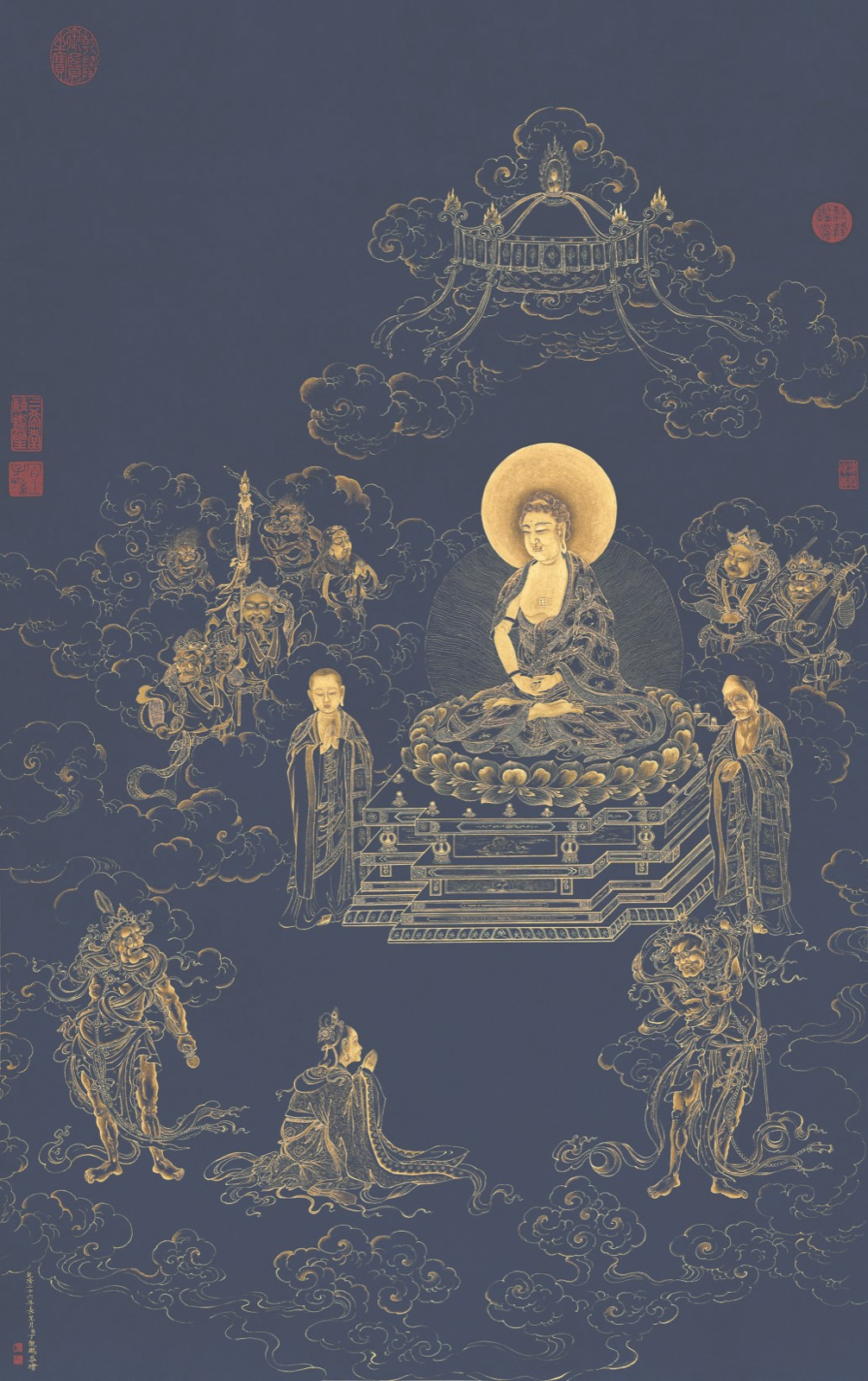
Quick answer: TK0241 uses gold-colored line against a deep blue field to separate a central haloed Buddha, lotus throne, canopy, monks, guardians, donor, clouds, seals, and inscription. The archive calls the image Amitayus Buddha, but the usual red, crowned longevity type is not visible; identity, medium, date, authorship, and provenance remain uncertain.
A gold-line Buddhist painting on blue ground asks the eye to work differently from a fully colored thangka. Instead of relying on large blocks of red, green, white, and orange, TK0241 builds its assembly through luminous contour, changes in line density, isolated gold-filled areas, and a few red seal impressions. The result is quiet at first glance but increasingly complex as the figures emerge from the dark field.
The English filename identifies the image as “Amitayus Buddha” and preserves the catalogue number TK0241. That title should remain attached to the archive record, yet it is not sufficient proof of identity. The central figure does not visibly match the familiar Tibetan type of a red, crowned Amitayus holding a prominent longevity vase. A responsible reading therefore begins with composition and technique, then separates the archival name from what can be confirmed visually.
What does gold line on a blue ground do?
Gold-colored line on a blue ground makes illumination, not local color, the main organizing principle. Fine contours define robes, clouds, faces, jewelry, architecture, and lotus petals. Broader or brighter gold areas draw attention to the central body, halo, and selected figures, while the blue field supplies both background and shadow.
The medium itself cannot be established from the digital image. “Gold line” describes appearance, not verified material. The marks could reproduce gold pigment, metallic ink, yellow pigment, printed line, or digitally adjusted color. Likewise, the deep blue could belong to paper, silk, another prepared support, a reproduction, or later image processing. Material claims require an object record or examination.
How does contrast establish sacred hierarchy?
Contrast establishes sacred hierarchy by giving the central seated Buddha the brightest body, the largest halo, and the most stable position. The figure sits on a lotus above a stepped throne at the vertical center of the lower two-thirds. A circular gold halo and a darker radiating aureole isolate the head and torso from the surrounding clouds.
Above, a large canopy floats in an open field of cloud scrolls. Its suspension ribbons and symmetrical roof point back toward the Buddha. Below, a kneeling donor or devotee faces the throne. Two standing monastic figures flank the central platform, while guardian-like and attendant figures appear within clouds at the sides. These relationships create a clear route: donor, throne, Buddha, canopy.
Can the central Buddha be confirmed as Amitayus?
The central Buddha cannot be confirmed as Amitayus from the visible image alone. The archive title is a useful lead, and the figure is peaceful, haloed, seated on a lotus, and shown with hands near the lap. However, a diagnostic longevity vase is not clearly legible, and the body is not presented as the standard red, crowned, jeweled Amitayus type familiar in many Tibetan paintings.
This difference does not prove the filename is wrong. Buddhist subjects can vary by region, lineage, period, medium, and later reproduction. A vessel or attribute may also be stylized, obscured, or too small to read in the available digital copy. The appropriate catalogue statement is: “Archive title: Amitayus Buddha; central seated Buddha visible; precise iconographic identification uncertain.”
For comparison, the TANGKAWORLD Amitayus guide explains the combined red body, crown, ornaments, meditation posture, and longevity vase that support the more common identification. Comparison should clarify the evidence gap in TK0241, not force it into a familiar template.
How should the surrounding figures be described?
The surrounding figures should be described first by position, dress, posture, and action. Two standing figures beside the throne wear long monastic robes and have shaven or closely cropped heads. Several cloud-borne beings have animated faces, armor-like dress, crowns, or held implements. Two large lower figures appear guardian-like, and a richly dressed person kneels in reverence at the bottom center.
These visible categories are useful even when names are uncertain. “Standing monastic attendant at the left of the throne” can be checked by another researcher. A guessed historical monk’s name cannot. Similarly, “cloud-borne guardian holding a long object” preserves the evidence without turning resemblance into identification.
The figures also demonstrate how the composition joins serenity and protection. The Buddha and monks are still and frontal; the cloud figures twist, gesture, and move. Their energy forms a protective perimeter around the central teaching or devotional encounter.
| Visible evidence | Safe statement | Claim requiring verification |
|---|---|---|
| Haloed Buddha seated on lotus and stepped throne | Central seated Buddha | Confirmed Amitayus identity |
| Gold-colored contours on dark blue | Gold-line appearance on blue ground | Actual gold pigment, ink, support, or technique |
| Two robed, shaven-headed standing figures | Monastic attendants | Specific historical monks |
| Cloud-borne armed or crowned beings | Guardian-like and attendant figures | Exact deity or protector names |
| Red seals and a lower vertical inscription | Visible seal impressions and text | Reading, ownership, authorship, date, or authenticity |
What do the red seals and inscription prove?
The red seals and inscription prove only that seal-shaped marks and written characters are visible in this digital image. Multiple red impressions occupy the margins, and a vertical line of text appears near the lower left. They provide potential research evidence, but they should not be transcribed, translated, or assigned to a person without a clear, high-resolution reading.
A seal can represent an artist, collector, institution, owner, studio, reproduction mark, or later addition. It may also have been copied along with the image. Position and color alone do not authenticate it. The same caution applies to the inscription: a date-like or name-like pattern must be read accurately before it supports chronology or authorship.
How should a digital archive preserve this tonal image?
A digital archive should preserve separation among the blue field, fine gold contours, bright halo, and red seals without replacing the source. A practical workflow is:
- Keep the CMYK source read-only. Record TK0241, dimensions, color mode, file size, and checksum before creating derivatives.
- Create a separate RGB web copy. Convert for browser display without overwriting the original or claiming perfect color fidelity.
- Protect fine linework. Avoid heavy compression, aggressive sharpening, or enlargement that invents detail around faces, seals, and inscriptions.
- Watch the dark field. Excess contrast can crush blue cloud boundaries into black; excess brightness can flatten the sacred hierarchy.
- Retain the complete composition. Do not crop away marginal seals, lower inscription, canopy, donor, or guardian figures.
- Verify the public media. Confirm the uploaded URL, dimensions, RGB mode, accurate ALT text, and visually intact contours before deleting only the temporary copy.
This workflow records technical evidence without pretending to reconstruct the original object. The source file is a modern archival artifact with its own color space and compression history; the painting or print it reproduces may have a different material history.
Frequently asked questions
Is TK0241 definitely painted with real gold?
No. The digital image has a gold-line appearance, but material composition cannot be confirmed from pixels. Object examination or a reliable technical record is required to distinguish gold pigment, metallic ink, yellow paint, print processes, and later digital adjustment.
Why not accept the Amitayus filename as proof?
A filename preserves prior metadata but does not show where that metadata came from. TK0241 lacks several clearly visible attributes of the common crowned red Amitayus type, so the archive title should be retained while the precise identification remains uncertain.
Can the red seals identify the artist or collector?
Possibly, but not without accurate transcription and comparison. A seal-shaped mark may be original, copied, later, institutional, or decorative. It should be treated as evidence to investigate, not as an automatic signature.
What is the best way to study the assembly?
Begin with the central Buddha and throne, move upward to the canopy, then map the monks, cloud figures, lower guardians, kneeling devotee, seals, and inscription. This route separates compositional hierarchy from uncertain personal names.
Conclusion
TK0241 shows how a restricted blue, gold, and red palette can create a complete sacred world. Line density, brightness, scale, and placement lead the viewer from donor to throne, Buddha, and canopy, while monks and guardian-like figures establish a wider assembly. The archive title “Amitayus Buddha” remains important metadata, but the visible image supports caution rather than certainty.
Sources and editorial method
This article is based on direct visual and technical analysis of TANGKAWORLD image TK0241. It separates observable composition, file characteristics, and archival wording from religious identification and uncertain historical attribution. No seal or inscription was assigned a reading, and gold appearance was not treated as verified material. For a broader method, consult How to Read a Thangka and the TANGKAWORLD Learn center.
Prepared and reviewed by the TANGKAWORLD editorial team
Last reviewed: August 11, 2026.

