How Offerings Frame Amitayus: Reading the Lower Register in TK0595
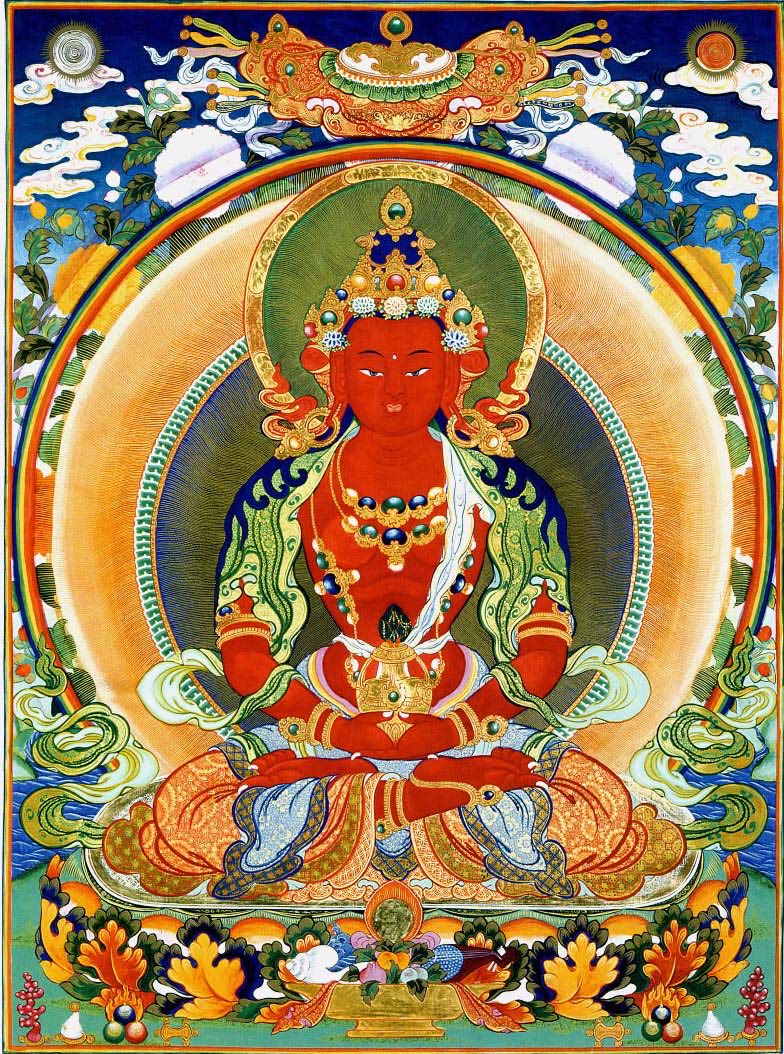
Quick answer: In TK0595, the lower offering register prepares the eye to meet Amitayus. A central tray, fruit-like and jewel-like forms, paired flame-shaped ornaments, lotus supports, and flowing textiles create a threshold beneath the seated Buddha. These objects support a longevity setting, but individual identities should remain descriptive when attributes are unclear.
A thangka is often identified by its central figure, yet its meaning is not confined to the deity’s face, hands, or attributes. In TK0595, Amitayus occupies the calm center of a densely ornamented field. He is red, crowned, richly jeweled, and seated in meditation while holding a vase associated with long life. Below him, however, an active band of offerings creates the visual foundation for the encounter. Reading that lower register reveals how the painting turns devotion into a carefully staged movement of attention.
This article focuses on that movement rather than attempting a definitive historical attribution. The English archive title identifies the subject as “Amitayus Buddha” and associates the image with Yonghe Temple, but a filename is not a verified museum record. The visible evidence supports the identification of Amitayus; it does not by itself establish a collection, date, artist, workshop, lineage, or place of production. Those historical details should remain uncertain until documentary evidence is available.
What is an offering register in a thangka?
An offering register is the organized zone of gifts, ritual objects, flowers, vessels, jewels, or symbolic abundance placed beneath or around a sacred figure. “Register” does not necessarily mean a hard horizontal border. In TK0595, the lower zone is integrated into the throne and lotus structure, so it works more like a layered threshold than a separate strip.
How does the lower register guide the eye?
The lower register guides the eye by concentrating bright, paired forms around a central axis and then directing that axis upward. At the bottom of TK0595, a low central support or tray is surrounded by rounded, leafy, floral, jewel-like, and flame-shaped forms. Draped textiles and cloudlike contours connect those objects to the lotus seat above.
The movement can be read in four stages. First, the eye encounters the compact gifts and vessels along the bottom edge. Second, their paired arrangement creates left-right stability. Third, the central support aligns with the lotus and the folded legs of Amitayus. Finally, the gaze reaches the longevity vase resting in his lap. The result is a compositional ascent: offering, support, lotus, body, vase, face, and halo.
Which offerings are clearly visible in TK0595?
Several categories of offering are visible, although not every individual item can be named securely from this image alone. The safest description begins with form and position. A central low platform or tray supports a clustered display. Rounded and fruit-like shapes sit among leafy or floral elements. Paired red-orange forms rise like flames or jewels, while small vessels or containers appear toward the lower corners.
It would be tempting to assign every shape to a fixed canonical list, but resemblance is not proof. Stylized painting, scale, color changes, and the resolution of a digital reproduction can obscure an object’s defining attribute. Unless a symbol has a diagnostic outline and context, a descriptive label such as “jewel-like form,” “small vessel,” or “floral offering” is more responsible than a confident ritual name.
| Visible evidence | Safe description | Claim needing verification |
|---|---|---|
| Red crowned figure holding a vase in meditation | Amitayus with a longevity vase | Specific lineage, consecration, or ritual use |
| Clustered forms on a central lower support | Offering display with floral, fruit-like, vessel, and jewel-like elements | Exact name of every ritual object |
| Two circular forms in the upper field | Celestial or sun-and-moon-like discs | Precise symbolic identity without a clearer source |
| “Yonghe Temple” in the archive filename | An archival association recorded in the filename | Verified present or former collection history |
How do the offerings connect to the longevity vase?
The offerings connect to the longevity vase through alignment, repetition, and scale. The vase is the most important object held by Amitayus, but it does not appear in isolation. It sits directly above the lower display, near the painting’s vertical center. The abundant forms below visually prepare for the concentrated vessel above.
This relationship helps distinguish iconographic identification from broader interpretation. The red body, royal ornaments, meditative posture, and vase together strongly support Amitayus. The surrounding offerings reinforce a world of abundance and auspicious aspiration, but they should not be treated as separate proof of a specific historical ceremony. Visible composition can establish how the image works; documentary evidence is needed to establish how, where, and by whom it was used.
For readers learning deity identification, the central attribute should remain primary. TANGKAWORLD’s guide to Amitayus and longevity symbols explains how the vase, red body, ornaments, and posture work together. TK0595 adds another lesson: once the deity is identified, the lower register can show how the painting frames that identity for devotional viewing.
What do the halos and upper celestial field add?
The halos and upper field complete the upward movement begun by the offerings. Behind Amitayus are layered circular halos, including a vivid outer band with rainbow-like color. Clouds, flowers, scrolling forms, and two circular celestial or sun-and-moon-like discs occupy the space above. A jeweled canopy-like form crowns the composition.
These elements expand the figure’s presence without disrupting the central axis. The lower register is dense and materially abundant; the upper field is spacious, radiant, and atmospheric. Between them sits Amitayus, joining the two zones. The contrast makes the painting legible from a distance while rewarding close inspection of ornaments and minor forms.
The paired upper discs echo the paired objects below without making the composition mechanically mirrored. For a general method of moving from central figure to surrounding evidence, see How to Read a Thangka: A Beginner’s Guide.
How should a cataloguer record uncertain offering objects?
A cataloguer should separate observation from interpretation and document uncertainty at the object level. A practical workflow is:
- Record position first. Note whether an item is central, paired, in a corner, on a tray, or attached to the throne structure.
- Describe visible form and color. Use terms such as rounded, flame-shaped, leafy, floral, vessel-like, or jewel-like before assigning a ritual name.
- Identify diagnostic attributes. Look for a distinctive silhouette, handle, spout, ribbon, animal, seed, flower, or other feature that would support a narrower identification.
- Compare without collapsing differences. Related thangkas can suggest possibilities, but one painting should not be used to overwrite ambiguous evidence in another.
- Preserve the uncertainty note. If resolution or stylization prevents confirmation, retain the descriptive term and explain why the precise identity remains uncertain.
Frequently asked questions
What identifies Amitayus in TK0595?
The strongest visible combination is the red body, jeweled crown and ornaments, meditative seated posture, and vase held at the lap. Together these features support Amitayus, the Buddha associated with immeasurable life. The identification should not be changed to Amitabha merely because the two figures are closely related in Buddhist traditions.
Are all the lower objects standard longevity offerings?
No precise list can be confirmed from the image alone. The lower zone clearly presents abundance through vessels, flowers, fruit-like and jewel-like forms, but several objects are stylized or small. They should be catalogued descriptively unless a diagnostic attribute or reliable record supports a specific ritual name.
Does the filename prove that Yonghe Temple owns the thangka?
No. The filename preserves an archival association with Yonghe Temple, but it is not a verified accession record. Present ownership, earlier provenance, artist, date, workshop, and school remain uncertain unless they can be supported by reliable collection documentation.
Why should an archival crop preserve the lower register?
The lower register contains compositional and iconographic evidence that a portrait-only crop would lose. It shows how gifts, supports, textiles, and lotus forms connect the viewer’s space to Amitayus. Preserving it also allows future researchers to compare object types and workshop habits more responsibly.
Conclusion
TK0595 demonstrates that the lower edge of a thangka can carry central meaning. Its offering display creates balance, establishes a devotional threshold, and leads the eye toward Amitayus and his longevity vase. Careful viewing also sets a limit: visible shapes may be described closely, while uncertain ritual names and historical claims should remain open. That combination of attention and restraint makes the image more useful for viewers, cataloguers, and future research.
Sources and editorial method
This article is based on direct visual analysis of the TANGKAWORLD image TK0595. It distinguishes visible evidence—color, posture, vase, offerings, halos, and composition—from religious identification and from uncertain historical attribution. The Amitayus identification follows the combined iconographic evidence visible in the image. The filename’s Yonghe Temple association is recorded but not treated as verified provenance. For broader context, consult the linked TANGKAWORLD Learn center and the relevant guides cited above.
Prepared and reviewed by the TANGKAWORLD editorial team
Last reviewed: August 9, 2026.

