How Should You Record an Uncertain Buddha Hand Gesture? TK1145
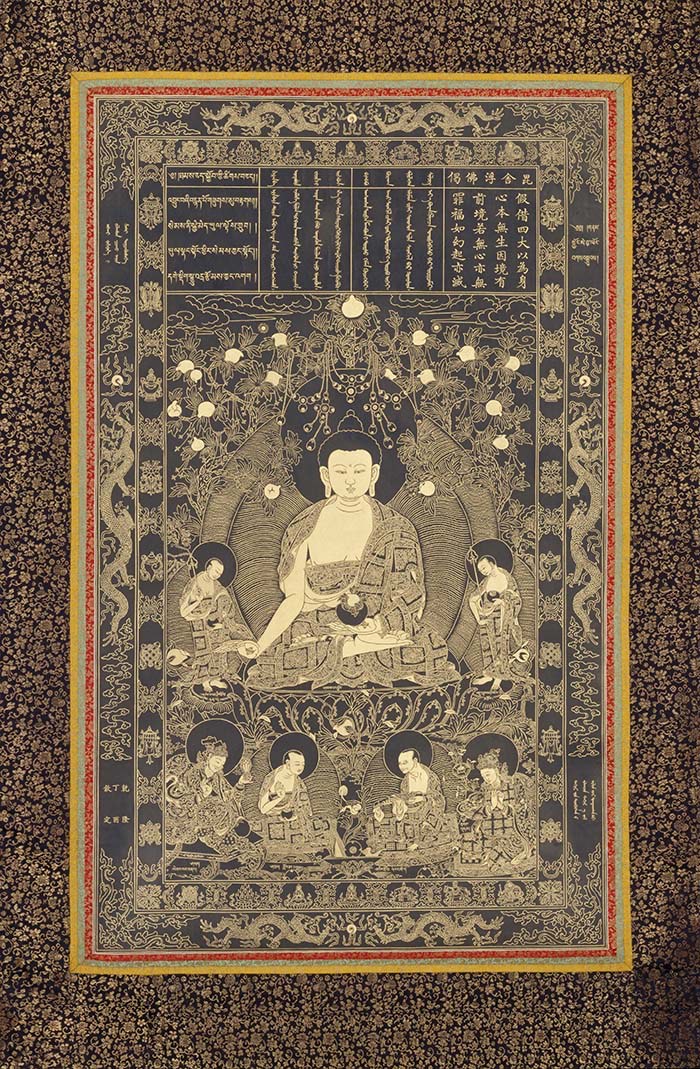
Quick answer: Record an uncertain Buddha hand gesture by describing side, height, wrist angle, palm visibility, finger direction, contact point, and nearby objects before naming a mudra. In TK1145, the Buddha’s proper right hand extends sideways and downward, but the 700-pixel image does not securely establish a standard gesture or identity.
An uncertain Buddha hand gesture should be treated as a set of visible relationships, not a name waiting to be guessed. TK1145 shows a central seated Buddha beneath a flowering canopy. The proper right arm reaches toward the figure’s side, while the other hand rests near the lap and a dark bowl-shaped form. Two standing attendants and four lower haloed figures complete the assembly.
The archive filename links the image with the Seven Buddhas of the Past and Viśvabhū Buddha. That label is useful metadata, but the extended hand cannot independently confirm it. A gesture record must remain valid even if the filename is later corrected, the text is retranslated, or a higher-resolution image changes the reading.
What is actually visible in the Buddha’s extended hand?
The proper right hand is visible as a pale form extending sideways and slightly downward from the forearm. It is positioned above the lotus base and near the inward-facing hand of the standing figure on the viewer’s left. The wrist, palm surface, and individual fingertips are not sharp enough for a confident mudra name.
This is different from saying that no information is available. The arm is not raised at shoulder height, the hand is not held directly before the chest, and the fingers do not visibly form a compact interlocking configuration. Those negative observations narrow the description without turning uncertainty into certainty.
Why use “proper right” instead of “left side of the image”?
“Proper right” identifies the figure’s own right side, which appears on the viewer’s left in a frontal image. This convention prevents mistakes when researchers compare photographs, mirror images, diagrams, and catalogue descriptions.
A complete first record for TK1145 might read: “Central Buddha’s proper right forearm descends diagonally toward the side; hand extends near knee level; palm orientation and fingertip positions uncertain; no secure contact with ground visible.” That statement can be checked directly against the file.
Which details should be recorded before naming a mudra?
Record the geometry, contact, and context before assigning a traditional term. The following fields separate what the image shows from what a researcher might later infer.
| Field | TK1145 observation | What remains uncertain |
|---|---|---|
| Side | Proper right arm and hand | None at the whole-image level |
| Height | Near the knee and upper lotus zone | Exact depth relative to the throne |
| Direction | Sideways and slightly downward | Whether the palm turns up, down, or inward |
| Fingers | Several pale projections are visible | Exact finger separation and curvature |
| Contact | No secure ground contact can be seen | Whether the hand touches robe, support, or another form |
| Nearby figure | Standing attendant appears close to the hand | Whether the proximity is compositional or interactive |
| Other hand | Near the lap and a dark bowl-shaped form | Object type, grip, and relationship to the extended hand |
Is this an earth-touching gesture?
An earth-touching reading is possible only as a comparison, not a secure identification. In a clear earth-touching gesture, the proper right hand normally descends over or beside the knee with fingers directed toward the ground. TK1145 shares the lowered placement, but the hand extends more laterally in this reproduction and does not visibly contact the ground.
The safer phrase is “lowered, outward-extended proper right hand” or “earth-touching-like placement, exact mudra uncertain.” The TANGKAWORLD guide to the earth-touching gesture provides a clearer comparison example and explains why posture, throne, attributes, and context must be assessed together.
Could the gesture show giving, teaching, or interaction?
Giving, teaching, and interaction are hypotheses that require visible finger configuration or contextual support. An open lowered hand may suggest generosity in some images, while teaching gestures usually depend on recognizable finger relationships. TK1145 does not preserve enough detail to choose among these meanings confidently.
The nearby standing figure creates an apparent visual relationship, but proximity is not proof of exchange. The two forms may overlap because the composition is dense. No distinct object can be seen passing between them. Describe the spatial arrangement first and reserve narrative language for stronger evidence.
How does the bowl-shaped form affect the interpretation?
The bowl-shaped form adds context but does not name the extended hand. It appears near the Buddha’s lap and the other hand, with a dark rounded body and pale upper detail. It may be a vessel, but exact form and contents remain uncertain at this resolution.
A researcher should create separate records for the two hands and the object. Combining them too early encourages circular reasoning: the bowl is used to name the Buddha, the proposed Buddha name is then used to name the gesture, and the gesture is finally cited as proof of the original identification.
Why does image resolution change the confidence level?
Resolution changes which anatomical details can be inspected. The TK1145 source is 700 × 1069 pixels, and the hand occupies only a small part of that frame. Compression and pale linework against a dark patterned ground reduce the stability of finger edges.
Upscaling cannot restore missing information. It may make pixels larger or sharpen an assumed boundary, but it cannot reveal a palm line or fingertip that the source did not capture. The high-resolution thangka study guide explains how to distinguish inspectable detail from invented clarity.
A seven-step workflow for documenting an uncertain Buddha hand gesture
Use a repeatable workflow so another researcher can review the same evidence.
- Preserve the source file. Record filename, TK number, dimensions, checksum, orientation, and folder position.
- Name the anatomical side. Use proper right or proper left, then add viewer-left or viewer-right if helpful.
- Describe the arm path. Note shoulder height, elbow bend, forearm direction, and relation to the torso.
- Describe the hand geometry. Record wrist angle, palm visibility, finger direction, separation, and curvature.
- Test contact. Ask whether the hand clearly touches earth, knee, robe, throne, object, or another figure.
- Record nearby evidence separately. Map vessels, flowers, attendants, captions, and the other hand without using them to force a conclusion.
- Assign a confidence phrase. Choose confirmed, probable, possible, or descriptive only, and state what evidence would improve the result.
The broader guide to reading a thangka shows how gesture fits within a whole-image sequence that also considers scale, placement, dress, attributes, attendants, and inscriptions.
What should remain uncertain about TK1145?
The exact mudra remains uncertain, as do the identity of the central Buddha and the names of the six surrounding figures. The Viśvabhū Buddha association comes from the archive filename, not from a completed transcription or a verified catalogue record.
The upper panel visibly contains Tibetan, Chinese, and additional vertical-script columns, but the exact scripts, readings, and relationship between columns have not been established here. Medium, date, artist, workshop, school, patron, collection, and provenance are also uncertain.
Frequently asked questions
Can one hand gesture identify a Buddha?
Sometimes a clear gesture strongly supports an identification, but it should be checked with posture, attributes, color, attendants, inscriptions, and reliable records. A blurred or shared gesture should never carry the full identification alone.
Is “mudra uncertain” a useful catalogue entry?
Yes, if it follows a precise visual description. “Proper right hand lowered beside knee; palm and fingers unclear” is searchable, reviewable evidence. A bare question mark without observations is much less useful.
Should researchers trace the fingers to make them clearer?
A tracing can be a separate analytical layer, but it must never replace the source. Mark uncertain boundaries, record the tracing method, and avoid drawing a conventional mudra where the pixels do not support one.
Does the filename prove that TK1145 depicts Viśvabhū Buddha?
No. The filename preserves prior metadata. Confirmation requires an independent transcription, a verified series sequence, distinctive iconographic evidence, or a reliable catalogue record tied to this exact image.
Conclusion
TK1145 demonstrates that uncertainty can produce a better record than a confident guess. Side, height, direction, contact, palm visibility, finger shape, and nearby objects turn a blurred hand into structured evidence. That evidence can later support comparison, transcription, and identification without locking the archive into an unsupported mudra name.
Sources and editorial method
This article is based on direct visual analysis of TANGKAWORLD TK1145. The central hand, arm path, lap object, surrounding figures, text zones, and series layout were recorded as visible evidence. Named mudras and the Viśvabhū Buddha association are treated as hypotheses or archive metadata unless independently confirmed. Related TANGKAWORLD guides provide their own Sources and further reading sections.
Prepared and reviewed by the TANGKAWORLD editorial team.
Last reviewed: August 29, 2026.
Explore more Thangka art at TANGKAWORLD. Visit the TANGKAWORLD home page, continue with the Thangka learning center, or download the complete Thangka image collection.

