How Surface Damage Can Match Buddhist Art Files: TK0226
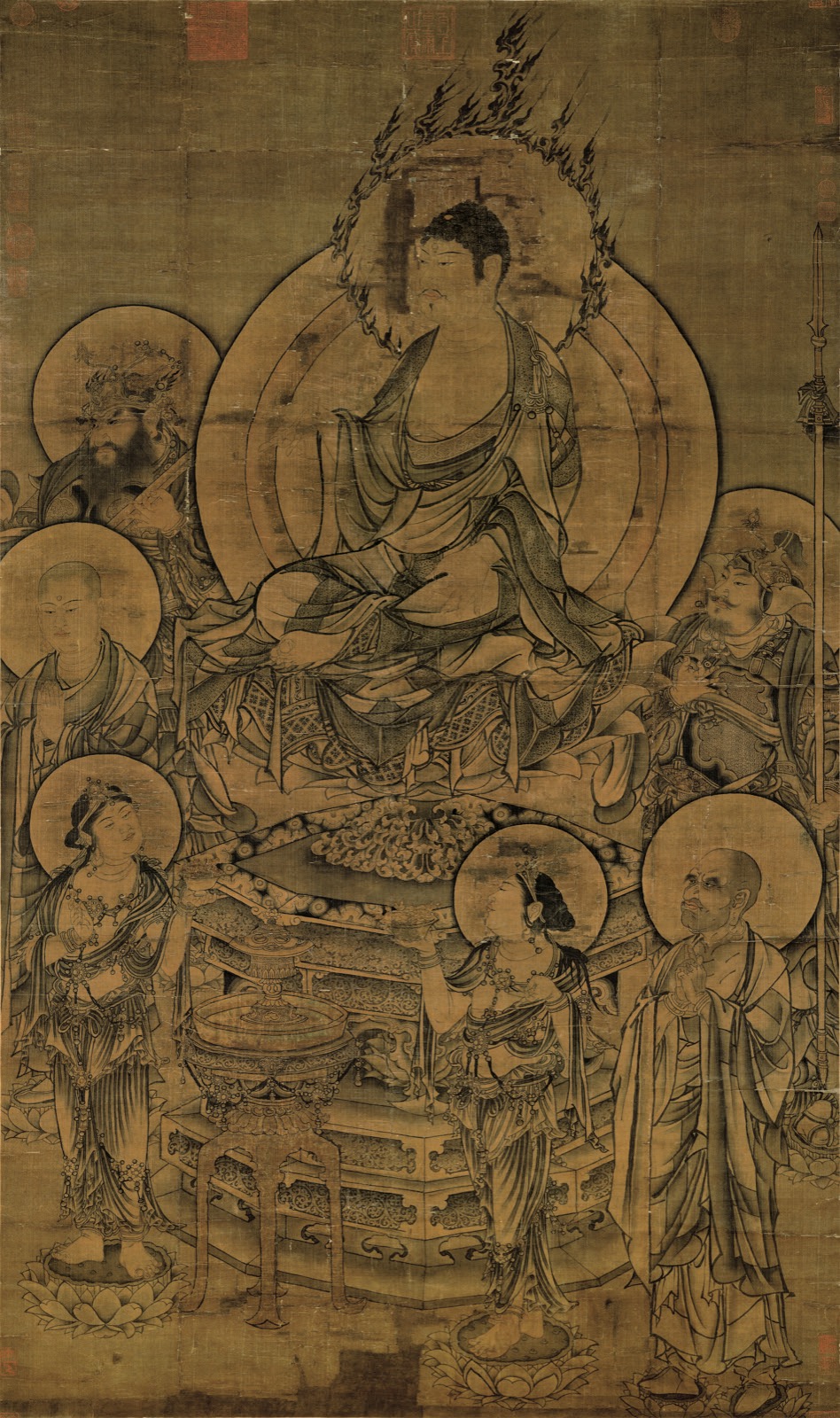
Quick answer: A condition fingerprint uses the particular pattern of tears, stains, creases, seals, abrasion, and crop edges to compare Buddhist art files. In TK0226, those landmarks closely match TK0225, suggesting a shared image source. They do not, by themselves, prove the files depict the same physical object or establish its attribution.
Two digital files can look like the same Buddhist painting for several different reasons. One may be a resized copy of the other, both may descend from a common scan, or two photographs may record one physical object at different times. Less often, related compositions may simply follow the same model. The useful question is therefore not “Are these pictures similar?” but “Which visual details are too particular to be explained by shared iconography alone?”
TK0226 presents a monumental seated Buddha within a circular halo and flame-like aureole. Plain-robed monastic figures, jeweled attendants, and guardian-like figures surround the throne. The raised hand is compatible with a teaching gesture, so “Buddha preaching assembly” is a reasonable subject description. The file name proposes historical information, but a name is not an authenticated object record; those claims remain uncertain.
What is a Buddhist painting condition fingerprint?
A condition fingerprint is the combined pattern of accidental physical and reproductive features visible in an image. Subject, pose, and throne type may be repeated by many artists. A crooked crease crossing one shoulder, an irregular abrasion through a halo, and a cluster of red seals in the same locations are much less likely to recur independently.
No single mark should decide the comparison. A red seal might be copied, a border may be trimmed, and a stain can disappear after retouching. Confidence comes from a constellation of landmarks distributed across the entire picture. The strongest match joins large structural features with small, irregular details that have no iconographic reason to occupy exactly the same positions.
Which landmarks connect TK0226 with TK0225?
The two files align in composition and in many non-iconographic details. Both show the same proportions for the central Buddha, halo, throne, monastic rows, jeweled attendants, outer figures, platform, and tall staff-like form. More importantly, the visible interruptions to the painted surface appear in corresponding places.
Abrasion across the sacred center
Pale rectangular and linear losses interrupt the dark halo, the Buddha’s face and torso, and parts of the throne. These are not expected elements of a preaching scene. When the shapes, angles, and intersections of such losses correspond, they act like a map of the same damaged surface or of a reproduction made after that damage occurred.
Creases, seals, and lower-platform wear
Vertical and horizontal crease-like lines cross the pictorial field. Red seals occupy matching zones, while scuffed areas along the layered platform and lower register repeat in position and outline. Matching seal placement is useful for alignment, but it does not authenticate an artist. A seal can be later, copied, misread, or unrelated to authorship.
Crop and proportion
TK0225 and TK0226 have nearly identical aspect ratios even though their source pixel dimensions differ. Web derivatives normalized to the same dimensions also show very high overall pixel correspondence. This supports a close digital relationship, but the measurement cannot reveal which file came first or whether both descend from an earlier reproduction.
| Evidence | What it supports | What it cannot prove |
|---|---|---|
| Same figures and architecture | Shared composition | Same physical object |
| Matching irregular damage | Likely shared image or object history | Direction of copying |
| Same seal locations | Precise image alignment | Artist attribution |
| Different dimensions and color | Distinct digital derivatives | Distinct paintings |
Why does a close match not prove one physical object?
A digital image records only one stage in a longer chain. A book plate, transparency, museum photograph, scanner file, edited master, and web JPEG can all introduce their own crop, color shift, dust, sharpening, and compression. Two files may match because they reproduce the same photograph, even when the original object is unknown.
Conversely, a later photograph of the same painting could show new cracks or a different mount. Digital repair could remove old damage. For that reason, “likely related files” is a safer conclusion than “the same object” until dimensions, medium, inscriptions, acquisition history, and a traceable catalogue record can be compared.
How should researchers compare near-duplicate art files?
A reliable workflow preserves evidence first and interprets it second. The following sequence works for Buddhist paintings, manuscript leaves, sculpture photographs, and printed reproductions.
- Preserve both originals. Do not rename, overwrite, crop, or color-correct the source files. Create clearly labelled working copies.
- Record technical facts. Note the TK number, absolute source path, pixel dimensions, file size, color profile, modification date, and cryptographic hash.
- Normalize only working copies. Scale copies to the same pixel dimensions without stretching. Document the software and settings used.
- Align stable landmarks. Begin with the halo edge, throne corners, prominent hands, seals, and architectural axes.
- Map accidental details. Compare cracks, losses, stains, folds, holes, dust, clipped borders, and retouching across several regions.
- Separate color from geometry. Scanner profiles and editing can change color dramatically while leaving shapes aligned.
- Test alternative explanations. Ask whether a shared workshop model, published plate, or modern resampling could account for the match.
- Write a confidence statement. State what is visible, what the pattern suggests, and what documentary evidence is still missing.
What can file metadata add to the visual evidence?
Metadata can document the digital objects even when it cannot identify the historical painting. TK0225 and TK0226 have different source pixel dimensions, so they are not byte-for-byte copies. Their near-identical proportions and visual landmarks nevertheless suggest that one may be a resampled derivative or that both share an earlier image source.
Embedded scanner or caption fields are leads, not proof. They may describe the reproduction equipment, a publication workflow, or a previous cataloguer’s note. Preserve them, but do not convert them into claims about the painting’s artist, dynasty, current collection, or ownership history.
How does condition evidence improve iconographic research?
Condition mapping prevents duplicate files from being mistaken for independent witnesses. If ten web images all descend from one scan, they do not provide ten separate confirmations of an attribution. Grouping them correctly helps researchers count sources, trace circulation, and select the least altered file for close study.
It also protects iconographic description from restoration artifacts. A pale gap near a hand may be damage rather than an attribute; a sharpened edge may resemble a ritual object that was never painted. Reading the preaching assembly remains valuable, but the condition layer explains which visible forms deserve caution.
Frequently asked questions
Can matching damage prove that two files show the same painting?
Matching damage across many distant areas is strong evidence of a shared object or reproduction source, but it is not absolute proof. A published photograph can be copied repeatedly, carrying the same damage pattern into unrelated digital files.
Are different pixel dimensions evidence of different artworks?
No. Resizing, scanning, cropping, and export settings routinely create files with different dimensions. Compare aspect ratio, landmarks, damage, seals, and borders before deciding whether the underlying image differs.
Do matching seals confirm the named artist?
No. Seal position helps align images, but attribution requires legible transcription, comparison with documented impressions, provenance, and specialist study. A copied or later seal can appear on a reproduction without validating authorship.
Which file should be kept when two images match?
Keep both source files. Designate a preferred research master only after comparing resolution, compression, crop, color profile, and metadata. Link the records as probable variants instead of deleting one as a redundant duplicate.
Conclusion
TK0226 shows why surface condition can be more diagnostic than subject matter. Its irregular abrasions, creases, seals, crop, and lower-platform wear closely correspond with TK0225, supporting a shared image history. The responsible conclusion stops there: the direction of copying, physical object identity, artist, date, school, collection, and provenance remain uncertain. A documented condition fingerprint turns a seeming duplicate into evidence about how Buddhist art images circulate.
Sources and editorial method
This article is based on direct visual analysis of TANGKAWORLD images TK0226 and TK0225, plus comparison of file dimensions, aspect ratios, and normalized web derivatives. Visible evidence, religious identification, digital-source inference, and uncertain historical attribution are kept separate. For the broader visual method, see How to Read a Thangka; for responsible close inspection, consult Study Thangka Iconography with High-Resolution Images and the TANGKAWORLD Learn center.
Prepared and reviewed by the TANGKAWORLD editorial team. Last reviewed: August 15, 2026.

