How Symmetry Organizes an Amitayus Thangka: A Visual Path Through TK1264
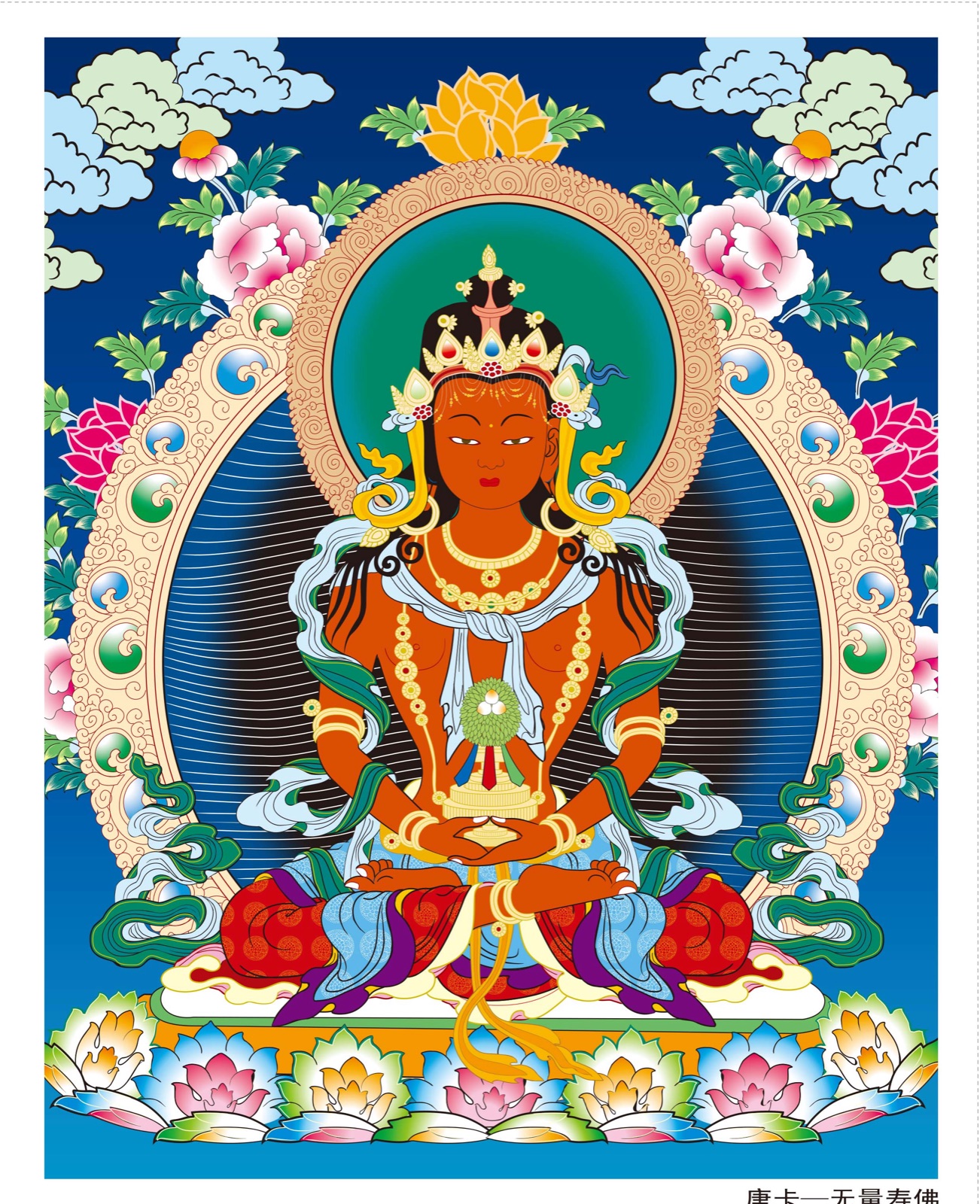
Quick answer: TK1264 uses strong bilateral symmetry to guide attention from the outer flowers and scrolling halo toward Amitayus’s face, ornaments, joined hands, and longevity vase. The design is not perfectly mirrored: small shifts in scarves, jewels, and foliage keep the image lively while preserving a calm, meditative center.
An Amitayus thangka symmetry study asks a different question from a basic identification guide. Instead of stopping once the red body, jeweled crown, meditation posture, and longevity vase establish Amitayus, it follows the route created by the image. TK1264 is especially useful because its crisp graphic treatment makes the compositional system easy to see. Large curves frame the body, paired ornaments repeat across the vertical axis, and the hands gather the design around the vase.
This reading is based on visible evidence in the TANGKAWORLD image. It does not assign the work to an artist, period, monastery, school, or collection. The source title preserves “Amitayus Buddha” and the archive number TK1264, but those words are not a verified museum record. The modern-looking outlines and smooth color fields describe the reproduction we can inspect; they do not by themselves prove when or how an underlying design was made.
Where does the composition begin?
The composition begins at the broad outer frame, not at a single isolated symbol. Pale clouds occupy the upper corners, flowering branches spread inward, and a large ornamental arch encloses the central figure. These elements create a visual threshold. Before the viewer studies the crown or vase, the eye meets a balanced sacred setting built from repeated curves and paired forms.
The outer zone is spacious but not empty. Deep blue behind the clouds and flowers gives the pale and pink forms room to register. The arch then narrows that wide field into an oval around Amitayus. This nested structure—background, floral field, arch, halo, body—moves attention inward in stages. It is a useful reminder that Buddhist iconography is often carried by placement as well as by attributes.
How does symmetry establish a calm center?
Symmetry establishes calm by repeatedly balancing weight across an imaginary line through the crown, face, chest, vase, hands, and crossed legs. The large left and right sides of the arch answer one another. Earrings, shoulder ornaments, necklaces, bracelets, scarves, sleeves, and lotus petals appear as pairs. The seated posture supplies an especially stable base because both knees extend laterally while the hands meet at the center.
This does not mean every contour is mechanically identical. The pale scarves bend differently around the shoulders, foliage varies, and individual jewels shift slightly. Those differences matter. Exact digital mirroring can feel static; controlled variation allows the gaze to move while the central axis remains unmistakable. The result is visual steadiness rather than rigid duplication.
The vertical axis
The strongest axis begins with the lotus-like finial above the halo. It descends through the high crown ornament, the central jewel, the forehead, the nose, the necklace pendant, the leafy top of the vase, and the joined thumbs. Each element reinforces the next. Even when the eye wanders toward a flower or scarf, this chain invites it back.
The horizontal anchors
Several horizontal levels cross the central line: the crown, eyes, shoulders, hands, knees, and lotus base. These anchors keep the tall composition from becoming a simple downward chute. They let the viewer pause at distinct zones, compare left and right details, and then continue toward the vase.
Why is the longevity vase the visual destination?
The vase becomes the destination because posture, gesture, and ornament converge around it. Amitayus holds the vessel in both hands within the lap. The forearms form a shallow bowl beneath it, while the necklaces and long garment lines descend toward it from above. A green leafy form and pale rounded elements rise from its mouth, creating a compact focal point against the red-orange body.
The object is therefore not merely one item in a crowded picture. It occupies the intersection of the vertical axis and the meditative hand position. The face is the first human focus, but the composition redirects attention to what the figure holds. For identification, the vessel joins the crown, jewelry, red body, and seated posture. For composition, it functions as the hinge that binds the upper and lower halves.
How do crown and jewelry control the reading speed?
The crown and jewelry slow the reading by breaking large areas into small, repeatable units. Teardrop-shaped crown panels, strings of beads, circular pendants, and arm ornaments reward close inspection. Their repetition creates rhythm without competing with the face. The most concentrated detail lies above and around the eyes, so attention lingers at the expression before descending.
Ornament also distinguishes the celestial presentation of Amitayus from the simpler monastic dress commonly associated with Amitabha. That comparison helps identification, but the visual function is equally important: gold and jewel-like accents mark turning points throughout the composition. Because the current image uses smooth, saturated color and sharp outlines, these accents appear unusually legible. The exact material of any historical source—paint, textile, print, or digital redraw—remains uncertain from this file alone.
What role do scarves and curved lines play?
The scarves prevent the central symmetry from becoming motionless. Pale blue and white bands loop from the shoulders, cross the torso, wrap the arms, and sweep outward near the knees. Green-edged fabric forms repeat those curves at a larger scale. Together they create a circulation pattern around the upright body.
Curves also connect otherwise separate zones. The scrolls of the arch echo the loops of the scarves; the arch echoes the halo; the halo echoes the crown and lotus petals. This visual rhyme makes the composition coherent. A viewer can follow shape before knowing any religious term, which is one reason formal analysis is valuable alongside iconographic identification.
How should a viewer study TK1264 step by step?
A disciplined viewing sequence separates observation from interpretation and makes the composition easier to remember.
- Start at the outer corners. Record clouds, flowering branches, deep blue ground, and the balance of large light shapes.
- Trace the arch. Follow its scrolls upward to the lotus-like finial and notice how it encloses the halo.
- Find the central axis. Move from crown to face, necklace, vase, hands, crossed legs, and lotus base.
- Compare paired details. Examine earrings, shoulder ornaments, scarves, bracelets, knees, and petals without assuming perfect mirroring.
- Locate the visual destination. Observe how hands and garment lines converge on the longevity vase.
- Record uncertainties. Keep artist, date, workshop, school, collection, and provenance open until supported by documentation.
Visible evidence and uncertain history
The visible evidence supports an Amitayus identification: a peaceful red-orange central figure sits cross-legged, wears a jeweled crown and ornaments, and holds a vase in both hands. The crisp edges, uniform color fields, and graphic outlines also support describing this file as a highly finished digital image or reproduction. They do not establish whether the composition copies an older painting, was drawn for modern printing, or has been altered from another source.
| Evidence | Reasonable conclusion | Still uncertain |
|---|---|---|
| Crown, jewelry, red body, vase | Amitayus is a strong identification | Exact ritual lineage |
| Paired arch, ornaments, and posture | Bilateral balance structures the image | Workshop design rules |
| Sharp outlines and smooth color | The accessible file has a graphic reproduction quality | Date and production method |
Frequently asked questions
Is TK1264 perfectly symmetrical?
No. Its main architecture is bilaterally balanced, but scarves, foliage, jewels, and smaller contours vary. Those differences create movement while the crown-to-vase axis preserves stability.
Why look at composition if the figure is already identified?
Identification tells us who is represented; composition explains how the image directs attention and creates a devotional focus. The two methods answer related but different questions.
What is the main focal point: the face or the vase?
The face attracts attention first, but the central ornaments, arms, and hands lead the gaze toward the longevity vase. The design gives both elements a connected role rather than forcing a single isolated focus.
Can this image prove an artist, date, or monastery?
No. Visual analysis can describe the figure, layout, and reproduction qualities, but an attribution requires inscriptions, a reliable catalogue, provenance records, or other traceable documentation.
Conclusion
TK1264 demonstrates how symmetry can organize a complex Amitayus image without freezing it. The arch, halo, crown, face, jewelry, hands, vase, crossed legs, and lotus form a nested path toward the center. Paired elements establish calm; small variations keep the eye active. Reading that structure adds a compositional layer to the better-known iconographic signs of Amitayus while preserving uncertainty about the image’s historical origin.
Sources and editorial method
This article is based on direct visual analysis of the TANGKAWORLD image TK1264. Visible features are separated from religious identification, and both are separated from uncertain historical attribution. For the iconographic foundation and its “Sources and further reading,” consult the TANGKAWORLD Amitayus identification guide. For a broader observation method, see How to Read a Thangka and the Learn center.
Prepared and reviewed by the TANGKAWORLD editorial team. Last reviewed: August 7, 2026.

