How to Compare Near-Duplicate Thangka Files: TK1142 vs TK1141
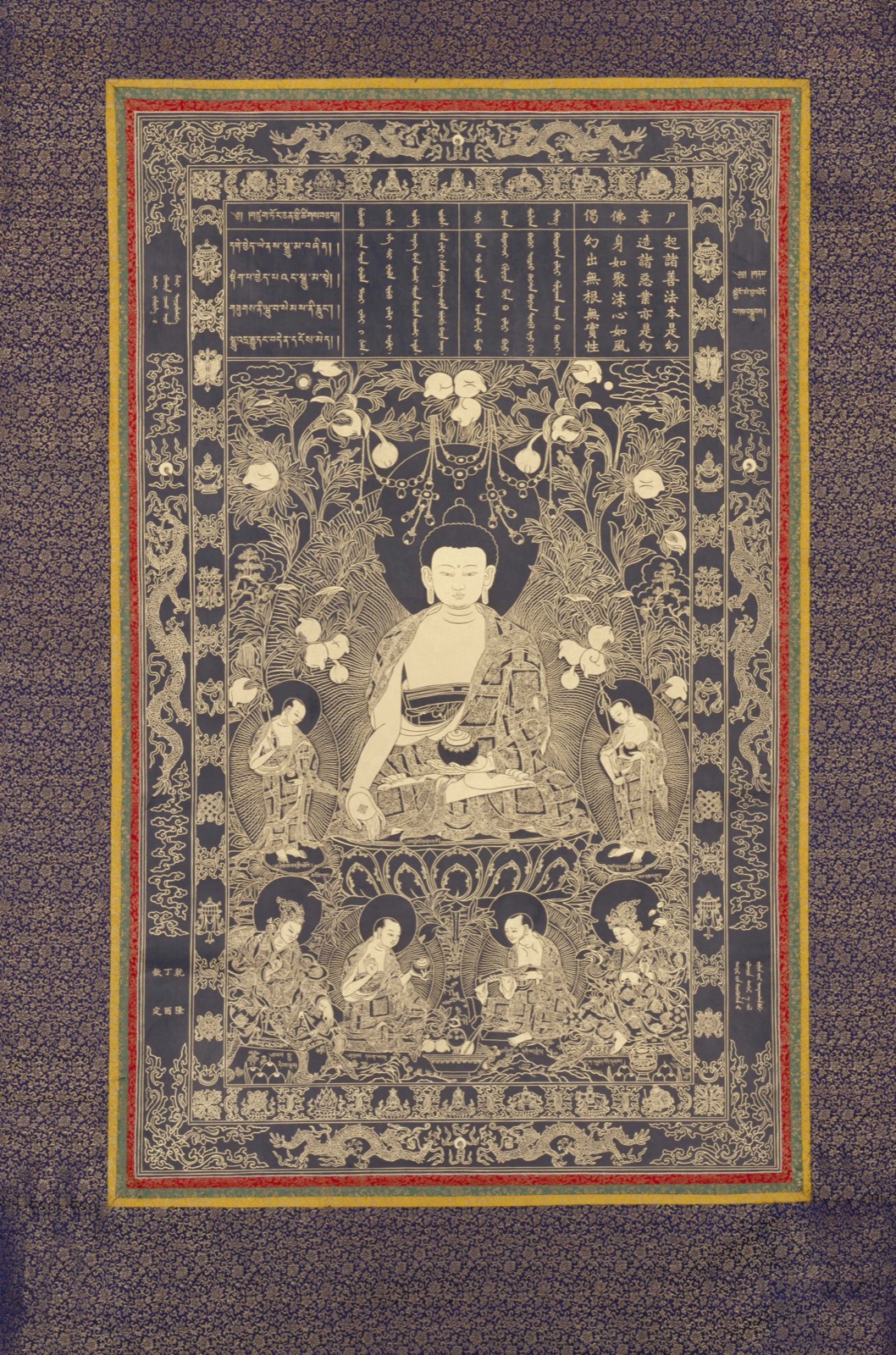
Quick answer: Higher resolution changes what can be inspected, not what can automatically be concluded. TK1142 preserves the same or closely related multiscript Buddhist composition as TK1141 at 3427 × 5179 pixels instead of 700 × 1058, making small inscriptions and linework more legible while leaving identity, translation, medium, date, and provenance uncertain.
To compare near-duplicate thangka files responsibly, turn visual resemblance into a testable observation. TK1142 offers a strong case because the archive also contains TK1141, a 700 × 1058-pixel file with nearly the same proportions and closely aligned imagery. The larger TK1142 source has more than twenty times as many pixels, yet that increase does not produce twenty times as much historical certainty.
Instead, the larger file changes the scale at which questions can be asked. Letter strokes, garment patterns, border motifs, figure labels, and the separation between linework and photographic texture become easier to inspect. Questions about the named Buddha, the languages represented, the physical technique, or the work’s origin still require evidence beyond pixel dimensions.
What makes TK1142 a high-resolution archive variant?
TK1142 is a high-resolution archive variant because its 3427 × 5179-pixel source closely follows the composition, proportions, and visual details of the smaller TK1141 file. Both show a pale gold-like design on a dark patterned ground, a central seated Buddha, two standing attendants, four lower seated figures, an upper multiscript panel, dragons, a floral canopy, and layered ornamental borders.
A comparison at the same display size shows the major lines and zones aligning closely. Small tonal and edge differences remain, which may come from separate resizing, compression, sharpening, color adjustment, or capture history. This supports a shared or closely related digital-image source, but it does not by itself prove that both files reproduce the same physical object or that either file is the earliest record.
The archive filename assigns both files to the Seven Buddhas of the Past and Sikhin Buddha. That repeated label is a useful clue about cataloguing history, not independent confirmation. Two filenames copied from one another do not create two separate pieces of identity evidence.
What additional evidence becomes inspectable?
The larger file makes fine structure easier to separate from compression noise. In the upper panel, horizontal Tibetan lines, vertical Chinese characters, and several additional vertical-script columns can be examined with more stable edges. The small side and corner text zones also become better candidates for numbered research crops.
Figure details improve as well. The central Buddha’s robe pattern, bowl-shaped form near the lap, lowered proper right hand, lotus petals, and radiating halo lines are easier to distinguish. The standing attendants and four seated figures below retain more facial, garment, hand, and attribute detail. These observations may guide later identification, but none alone securely names every figure.
Ornament also becomes research evidence rather than background decoration. Repeated dragons, cloud forms, floral sprays, auspicious emblems, border units, and tiny labels can be compared across files. A broken line or distinctive motif can help test whether two reproductions share the same underlying image.
What does higher resolution still not prove?
Higher resolution does not prove identity, translation, material, date, authorship, school, collection, or provenance. Pixels record visible information within a particular photograph or scan. They do not reveal the reverse, fiber structure, pigments, inscriptions outside the crop, mounting history, or documentary chain of ownership.
| Evidence in TK1142 | What it can support | What it cannot prove alone |
|---|---|---|
| 3427 × 5179-pixel source | Finer visual inspection and larger research crops | Authenticity or historical importance |
| Close alignment with TK1141 | Shared or closely related digital-image history | Same physical object or earliest source |
| Tibetan and Chinese text zones | Multiscript documentation and transcription planning | Complete translation or named identity |
| Additional vertical columns | Evidence that more scripts may be present | Exact script or language without specialist review |
| Visible figure attributes | Confidence-ranked iconographic questions | Sikhin Buddha from the filename alone |
| Detailed borders and surface | Digital file matching and crop comparison | Physical medium or workshop attribution |
The safest principle is simple: resolution raises the ceiling of observation, while conclusions still depend on the quality and independence of the supporting evidence. The TANGKAWORLD high-resolution iconography guide applies this distinction across central figures, attributes, inscriptions, and surrounding registers.
How should TK1141 and TK1142 be compared?
Compare the two files through a reproducible sequence rather than by switching rapidly between enlarged screens.
- Record each original independently. Preserve the exact filename, TK number, pixel dimensions, color mode, file size, checksum, and archive path.
- Match orientation and proportions. Confirm that neither file has been rotated, mirrored, stretched, or cropped differently.
- Normalize only a working copy. Resize a copy of TK1142 to the TK1141 display size while keeping both originals untouched.
- Map stable landmarks. Compare the top panel corners, Buddha’s eyes and hands, lotus edges, attendant halos, dragons, and border intersections.
- Mark added legibility. List characters, line breaks, textile patterns, and figure attributes that become clearer only in TK1142.
- Mark persistent uncertainty. Record characters and objects that remain unresolved despite the extra pixels.
- Separate image history from object history. Treat matching pixels as evidence about reproductions, not automatic proof of provenance.
- Cite the exact file used. A transcription or detail claim should name TK1142 and identify the crop, not merely say “the thangka.”
How does higher resolution help inscription research?
Higher resolution helps inscription research by preserving more of the letter boundaries, spacing, punctuation, and column structure needed for responsible transcription. It can reveal whether a mark is probably a character, a divider, damage, or ornament. It also allows a crop to include enough neighboring context for a specialist to assess reading direction and panel function.
It does not remove the need for language expertise. The additional vertical columns in TK1142 should remain unidentified until their forms, repeated sequences, and reading order are examined by qualified readers. “Multiscript” remains more accurate than forcing the image into a bilingual label.
Optical character recognition may produce candidates from the larger source, but every candidate must be checked against the pixels. Raw OCR output, human transcription, normalized text, translation, and interpretation should remain separate records. Enlargement can clarify captured strokes; it cannot restore strokes that were never photographed.
Why preserve both the small and large files?
Both files preserve useful evidence about digital circulation. TK1141 may reflect a web-ready derivative, while TK1142 retains more source detail. The smaller file documents how the image may have been distributed, compressed, or displayed; the larger file supports closer research and future derivatives.
Deleting the smaller copy because a larger one exists would erase part of the archive’s reproduction history. Conversely, treating the large JPEG as a lossless master would also be misleading. JPEG compression remains present, and the physical object or an uncompressed preservation file may contain information not visible here. The TANGKAWORLD JPG versus TIF guide explains why format, dimensions, and actual captured detail must be evaluated together.
How should researchers cite TK1142?
Cite TK1142 as the exact digital source used for a visual claim. Include its archive title, TK number, original dimensions, file format, checksum when appropriate, access date, and the crop coordinates for any transcription or detail. If TK1141 is also consulted, list it separately as a comparison variant.
Keep the archive identification in quotation marks or qualify it as filename metadata until supporting evidence is verified. A careful note might state: “Archive filename identifies the work with the Seven Buddhas of the Past and Sikhin Buddha; precise figure identification remains uncertain.” This preserves the research lead without converting it into fact.
Frequently asked questions
Is TK1142 simply an enlarged copy of TK1141?
No. TK1142 contains far more source pixels and shows finer detail, while the two files also have small tonal and edge differences. They are closely related variants, but their exact capture and processing history remains uncertain.
Does TK1142 prove that the central figure is Sikhin Buddha?
No. The filename preserves that identification, but confirmation requires a reliable transcription, a securely positioned name label, iconographic agreement, or a verified catalogue record.
Can the larger file identify every script?
No. Tibetan and Chinese are visibly present, but the additional vertical columns still require specialist review. More pixels improve inspection without replacing paleographic or linguistic expertise.
Which file should be used for publication?
Use a web-optimized derivative of TK1142 for online display while preserving the untouched source. Cite the original dimensions and keep TK1141 as a separate archive variant rather than overwriting it.
Conclusion
TK1142 shows the real value of higher resolution: it converts more details into inspectable evidence while leaving unsupported claims unsupported. Its relationship to TK1141 helps distinguish reproduction history from object history, and its clearer inscriptions invite better documentation rather than faster guessing. The larger file strengthens research when every observation remains tied to an exact source, crop, and confidence level.
Sources and editorial method
This article is based on direct visual and file-level comparison of the TANGKAWORLD TK1142 and TK1141 archive images. Pixel dimensions, proportions, major compositional alignment, visible inscriptions, figures, and ornaments are treated as observable evidence. The shared-image relationship is described cautiously, while exact transcription, additional script names, figure identities, medium, date, artist, school, collection, and provenance remain uncertain. Related TANGKAWORLD guides provide broader methods and route readers to their Sources and further reading sections.
Prepared and reviewed by the TANGKAWORLD editorial team.
Last reviewed: August 25, 2026.
Explore more Thangka art at TANGKAWORLD. Visit the TANGKAWORLD home page, continue with the Thangka learning center, or download the complete Thangka image collection.

