How to Document a Multiscript Thangka Inscription Without Guessing: TK1141
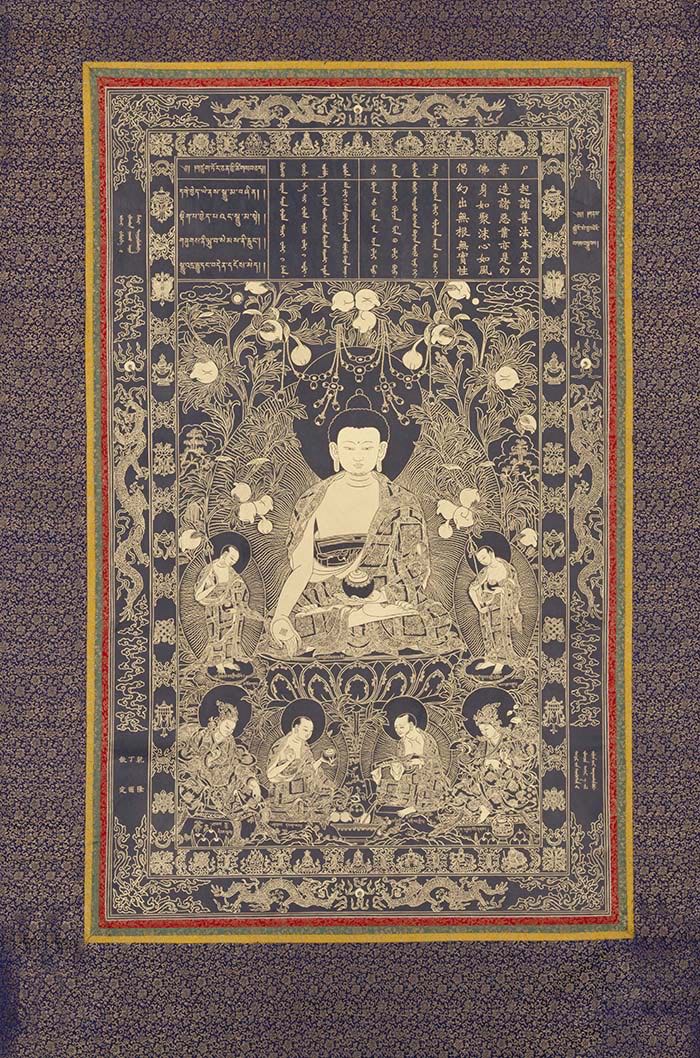
Quick answer: Document a multiscript thangka inscription before translating it. For TK1141, record the Tibetan and Chinese text zones, additional vertical scripts, line direction, panel boundaries, neighboring figures, orientation, resolution, and uncertain characters. Do not infer a Buddha’s name from the filename alone; preserve exact crops and seek qualified transcription.
Knowing how to document thangka inscriptions is different from knowing how to translate them. TK1141 contains several visually distinct text zones above and beside a gold-line Buddhist assembly. Tibetan and Chinese are visible, while other vertical columns require specialist identification. The responsible first task is to map the inscription system without inventing readings.
The archive filename supplies the English title Seven Buddhas of the Past — Sikhin Buddha. That title is useful evidence about prior cataloguing, but it is not a substitute for a transcription. A reliable record keeps the filename, the image evidence, the script map, and any future translation as separate layers.
What inscription zones are visible in TK1141?
TK1141 has a large rectangular inscription panel across the upper portion of the inner image. The left section contains horizontal lines that appear Tibetan. The right section includes vertical Chinese characters. Between them are several narrow vertical columns in scripts that should remain unidentified here until a qualified reader confirms them.
Additional short text blocks appear along both side borders and near the lower corners. Their scale is smaller than the main panel, and some characters are softened by the 700 × 1058-pixel source. These marginal zones may serve different purposes from the top panel, so they should receive separate crop numbers rather than being merged into one transcription.
Decorative frames, flowers, dragons, and repeated motifs surround the text. A transcription crop should include a small amount of this context because borders help establish orientation, panel limits, and the relationship between a label and a figure.
Why should documentation come before translation?
Documentation preserves what the image actually contains. Translation already involves decisions about script, reading order, damaged characters, names, formulaic language, and religious terminology. If those decisions are made before the text zones are mapped, a plausible translation can become detached from the pixels that supposedly support it.
A good documentation record answers basic questions first: Where does the text begin and end? Is it horizontal or vertical? Which direction might it be read? Are columns separated by rules or decorative motifs? Which characters are clear, partial, repeated, or missing? The TANGKAWORLD high-resolution study workflow applies the same evidence-first principle to figures and attributes.
How can scripts be identified without overclaiming?
Start by naming only what can be recognized confidently. In TK1141, the upper-left block visibly uses Tibetan letterforms, and the upper-right block visibly contains Chinese characters. The central vertical columns differ from both. Their precise script names remain uncertain in this article.
“Multiscript” is safer than “bilingual” because it describes the presence of more than two writing systems without forcing every column into a language label. Script and language are also not identical: one script can represent more than one language, and a multilingual object may repeat the same title, dedication, or formula in parallel.
Do not use visual resemblance alone to label an unfamiliar vertical script. Compare complete letter sequences, punctuation, column structure, and securely catalogued parallels. A specialist may eventually identify the columns, but the working record should preserve the earlier uncertain state.
What can the inscription say about the central Buddha?
An inscription may provide a name, epithet, prayer, dedication, or sequence position, but its function must be established through transcription. The archive title associates TK1141 with the Seven Buddhas of the Past and Sikhin Buddha. The visible central figure alone does not securely prove that individual identity.
The Buddha sits on a lotus throne beneath a flowering canopy. The proper right hand lowers toward the knee in an earth-touching-like position, while the left hand rests at the lap near a bowl-shaped form. Two standing figures flank the throne, and four haloed seated figures occupy the lower register. These features support a Buddhist assembly but do not uniquely identify Sikhin.
The inscription and iconography should therefore be tested together. A translated name gains strength if its label position, reading order, and figure relationship are clear. Conversely, a familiar hand gesture should not be used to “correct” an unread inscription. For the broader visual sequence, see How to Read a Thangka.
Transcription, translation, and interpretation are separate outputs
| Research layer | What it records | What it must not assume |
|---|---|---|
| Image inventory | File, TK number, dimensions, orientation, checksum, crop coordinates | Identity or meaning |
| Script map | Text zones, line direction, column count, clear and damaged areas | Language for uncertain scripts |
| Transcription | Characters or syllables as read, with uncertainty marks | Fluent meaning |
| Translation | Meaning in another language, with notes on alternatives | Historical truth beyond the text |
| Iconographic interpretation | Relationship between text, figures, gestures, and sequence | Date, patron, artist, or provenance without evidence |
| Catalogue conclusion | Confidence-ranked identity and documented history | Certainty created by the filename alone |
Why OCR should not be the first authority
Optical character recognition can generate candidates, but TK1141 is a difficult OCR source. The characters are small, pale against a dark ground, bordered by ornament, and compressed within a moderate-resolution photograph. Vertical layout and multiple scripts add further ambiguity.
If OCR is used, preserve its raw output separately and never silently repair it into a polished passage. Every proposed character should point back to a numbered crop. Human review is essential, especially for proper names, transliterated Buddhist terms, repeated formulas, and characters that resemble decoration.
Resolution is also a hard boundary. Enlarging the image can make pixels easier to inspect, but it cannot restore strokes that were never captured. A future higher-resolution photograph may change the transcription, which is why the source dimensions and checksum belong in the research record.
An eight-step workflow for documenting thangka inscriptions
- Preserve the source record. Save the exact filename, TK number, dimensions, color mode, checksum, and archive path.
- Confirm orientation. Use figures, borders, and text direction to detect rotation or mirroring.
- Map every text zone. Number the main panel, side blocks, corner notes, seals, and reverse inscriptions separately.
- Create contextual crops. Include the nearest figure or border before making tighter character crops.
- Classify scripts cautiously. Record Tibetan and Chinese where clear; mark other vertical scripts uncertain until reviewed.
- Transcribe before translating. Keep uncertain, missing, or damaged characters visible in the transcription apparatus.
- Compare text with iconography. Test whether names, labels, gestures, and figure positions agree.
- Record reviewer and date. Preserve who read each script, what reference was used, and when the conclusion changed.
What else should remain uncertain in TK1141?
The physical medium cannot be confirmed from this photograph. Pale gold-like lines on a dark patterned field could be painted, woven, embroidered, printed, or produced through another textile technique. Surface examination, reverse views, fiber analysis, or a reliable collection record would be needed to name the medium confidently.
The dragons, floral canopy, border emblems, halos, garments, and inscription layout may eventually support regional or courtly attribution, but style alone is not enough. Date, artist, workshop, patron, collection, and provenance remain uncertain. The image can be described precisely without turning those open questions into facts.
Frequently asked questions
Can the filename prove that TK1141 depicts Sikhin Buddha?
No. It preserves a prior archive identification, but proof requires a reliable transcription, a securely positioned name label, iconographic agreement, or documented catalogue history.
Is TK1141 bilingual or multilingual?
It is safer to call it multiscript. Tibetan and Chinese are visibly present, while additional vertical columns differ in form and require specialist identification before their languages are named.
Can AI or OCR translate the inscription accurately?
It may assist with candidates, but the source resolution, multiple scripts, vertical layout, ornament, and small characters create serious error risks. Qualified human transcription and crop-level verification remain necessary.
Does an inscription establish provenance?
Not automatically. It may record a name, dedication, patron, place, or date, but the text itself must be authenticated and connected to the object’s documented history.
Conclusion
TK1141 demonstrates why inscription work should begin with a map, not a translation. Its Tibetan, Chinese, and additional vertical-script zones can be documented accurately even while several readings remain unresolved. Separating source record, script map, transcription, translation, iconography, and provenance protects the image from confident but untraceable claims.
Sources and editorial method
This article is based on direct visual analysis of the TANGKAWORLD TK1141 source and web image. Visible text zones, scripts, figures, gestures, borders, and resolution limits are separated from unverified transcription and historical attribution. The archive title is preserved as prior metadata, while exact script identification beyond visible Tibetan and Chinese, figure names, medium, date, artist, school, collection, and provenance remain uncertain. Related TANGKAWORLD guides route readers to their Sources and further reading sections.
Prepared and reviewed by the TANGKAWORLD editorial team.
Last reviewed: August 24, 2026.
Explore more Thangka art at TANGKAWORLD. Visit the TANGKAWORLD home page, continue with the Thangka learning center, or download the complete Thangka image collection.

