How to Identify Amitayus’s Longevity Attendants: A Confidence Guide to TK0553
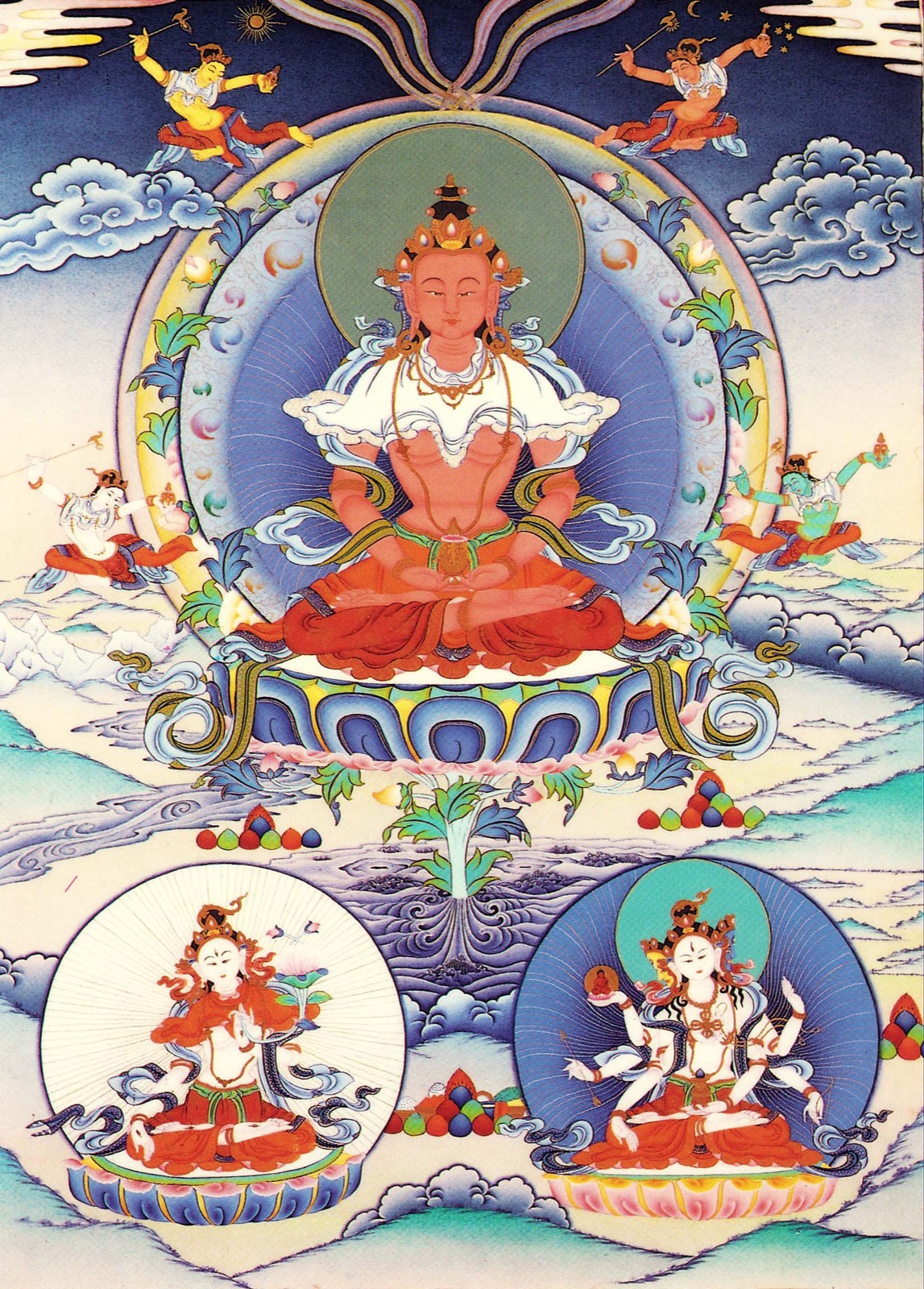
Quick answer: In TK0553, Amitayus is secure because the large red, crowned figure holds a longevity vase in meditation. The two smaller lower deities are probably White Tara and Ushnishavijaya, forming a longevity assembly, but their reduced, stylized attributes justify moderate rather than absolute confidence. Historical date, workshop, lineage, and provenance remain uncertain.
Identifying the central figure in a thangka can be easier than naming everyone around it. TK0553 places a large, peaceful Amitayus at the center of a circular sacred field. Two smaller deities sit below, while four animated celestial figures move through clouds around the upper half. The composition strongly suggests an assembly concerned with long life, yet not every small attribute is equally legible.
This makes TK0553 a useful case study in confidence-based iconographic reading. Instead of treating every name as either certain or unknown, the method separates high-confidence identification, probable identification, and unresolved detail. The English archive title names only “Amitayus Buddha.” It does not document the two lower figures, and it provides no verified date, artist, workshop, ritual context, collection, or provenance.
Why is the central Amitayus identification secure?
The central Amitayus identification is secure because several diagnostic features agree. The largest figure has a red-orange body, a jeweled crown, necklaces, arm ornaments, celestial garments, and a peaceful seated posture. Both hands rest at the lap around a small vase. That combination is more dependable than color or position alone.
The vase is especially important. Amitayus is the Buddha of immeasurable life and is commonly shown in an ornamented form holding the longevity vase in meditation. The vessel is small in TK0553, but its placement at the center of the body is clear. The circular halos, lotus seat, and frontal stillness reinforce the figure’s sacred priority without independently naming him.
This high-confidence reading also prevents a common catalogue error. Although Amitayus is closely related to Amitabha, the crowned and jeweled body with a longevity vase should be called Amitayus, not Amitabha. TANGKAWORLD’s Amitayus identification guide explains that distinction in detail.
Are the two lower deities White Tara and Ushnishavijaya?
The two lower deities are probably White Tara and Ushnishavijaya, but the identification should remain qualified. These deities are frequently grouped with Amitayus as major longevity figures. Their placement beneath a dominant Amitayus makes that interpretation coherent, and each lower figure preserves attributes that point in the expected direction.
The lower-left deity is pale, peaceful, fully seated, and associated with a lotus. Those features are consistent with White Tara. However, the seven-eye system that normally provides the strongest White Tara evidence is not reliably countable in this reproduction. The eyes may be too small, stylized, or obscured. “Probable White Tara” is therefore more responsible than an unqualified label.
The lower-right deity is pale and multi-armed, and one raised hand supports a small seated Buddha figure. These features are consistent with Ushnishavijaya, a major longevity deity whose complex iconography may include multiple faces and arms. Here, the exact face and arm count is not fully legible. The figure’s attributes and its place in the trio support a probable identification, not absolute certainty.
| Figure or feature | Visible evidence | Supported reading | Confidence |
|---|---|---|---|
| Large central deity | Red-orange body, crown, jewelry, meditation posture, vase | Amitayus | High |
| Lower-left deity | Pale peaceful body, full seated posture, lotus | Probable White Tara | Moderate; seven eyes are not clearly countable |
| Lower-right deity | Pale body, multiple arms, small seated Buddha in one hand | Probable Ushnishavijaya | Moderate; full face and arm system is unclear |
| Four surrounding figures | Dynamic poses, clouds, flower-, jewel-, or light-like objects | Celestial offering or attendant figures | Descriptive only |
How does visual hierarchy support the longevity assembly reading?
Visual hierarchy supports the longevity assembly reading by making Amitayus the stable source around which the other figures operate. He is much larger than every attendant, occupies the vertical axis, and sits inside the widest circular halo. The lower deities are important but smaller, each enclosed by a separate disc and lotus seat.
Context must not replace attributes, however. A figure does not become White Tara merely by standing near Amitayus. The correct procedure is to combine context with body color, posture, hands, eyes, flowers, faces, and held objects. If those details conflict with the expected type, the group label must be reconsidered.
What role do the four celestial attendants play?
The four celestial attendants activate the otherwise calm composition. Two occupy the upper corners, and two appear at the sides of Amitayus’s halo. Their bodies lean, turn, and gesture across a dark blue cloud field. Several hold small flower-, jewel-, sun-, moon-, or light-like forms, although the exact ritual identity of each object is uncertain.
Their movement frames the central stillness. Amitayus and the lower deities sit in meditation, while the surrounding figures appear to approach, present, or celebrate. Curving rainbow bands descend from the top, and sun, crescent, star, cloud, water, lotus, and jewel-like motifs extend the environment beyond a simple portrait.
These details can be described without forcing names. “Celestial attendant holding a star-like form” preserves more visual information than a guessed deity label. It also leaves the record open for later comparison with a clearer version, inscription, or lineage source.
How should a catalogue express iconographic confidence?
A catalogue should express confidence separately for each identification rather than assigning one confidence level to the whole image. A practical workflow is:
- Start with visible facts. Record color, scale, position, posture, number of visible arms, flowers, vessels, halos, and other held forms.
- Find diagnostic combinations. A single red body is weak evidence; a red crowned figure holding a longevity vase in meditation is much stronger.
- Use compositional context as support. A known longevity grouping can increase confidence, but it should not override missing or contradictory attributes.
- State what is not legible. For TK0553, the seven eyes, full arm count, and complete face system cannot be confirmed reliably from the available image.
- Choose calibrated wording. Use “identified as” for strong evidence, “probable” or “consistent with” for moderate evidence, and a plain descriptive label when attributes remain unresolved.
- Keep historical claims separate. Iconography does not prove a date, school, workshop, ritual commission, collection, or provenance.
This approach turns uncertainty into useful data. A future researcher can see exactly which feature supported a name and which feature still needs checking. It is more informative than either false certainty or a blanket “unidentified” label.
What historical claims remain uncertain?
The painting’s date, artist, workshop, school, lineage, original location, ritual use, collection history, and provenance remain uncertain. The smooth outlines, bright color, and even surfaces visible in the digital file may reflect the source object, a scan, a printed reproduction, digital processing, or some combination of these. Style alone cannot resolve that history.
The safest archive statement is therefore layered: TK0553 depicts Amitayus with two probable longevity attendants in a celestial landscape; White Tara and Ushnishavijaya are supported but not fully confirmed; historical attribution is undocumented. Readers can compare the lower-left figure with the TANGKAWORLD White Tara guide and use How to Read a Thangka for a broader visual method.
Frequently asked questions
What are the three long-life deities in Tibetan Buddhist art?
Amitayus, White Tara, and Ushnishavijaya are commonly presented as three major longevity deities. Their grouping provides useful context, but each figure should still be identified through its own visible attributes rather than by proximity alone.
Why is White Tara only probable in TK0553?
The lower-left figure is pale, peaceful, fully seated, and associated with a lotus, all of which fit White Tara. Her diagnostic seven eyes are not clearly countable at this scale, so the identification should remain probable until a clearer source confirms them.
What supports the Ushnishavijaya reading?
The lower-right figure is pale, multi-armed, and holds a small seated Buddha, attributes consistent with Ushnishavijaya. The complete system of faces, arms, and implements is not fully legible, which limits confidence.
Does a longevity assembly prove the painting’s ritual use?
No. Iconography can show that the composition concerns longevity, but it cannot by itself establish whether the image served initiation, meditation, healing, commemoration, temple display, or private devotion. Ritual use requires documentary or contextual evidence.
Conclusion
TK0553 rewards a layered reading. Amitayus is securely identified through his scale, ornaments, meditation posture, and longevity vase. The two lower figures are probably White Tara and Ushnishavijaya, while the four surrounding figures are best retained as celestial attendants unless clearer attributes emerge. Confidence labels preserve both the strength and the limits of the visible evidence.
Sources and editorial method
This article is based on direct visual analysis of the TANGKAWORLD image TK0553. It separates visible evidence from religious identification and from uncertain historical attribution. Deity names were evaluated through combined attributes, scale, placement, and longevity-group context; small or unclear features were not silently reconstructed. The linked TANGKAWORLD guides provide broader iconographic context and their own Sources and further reading sections. Visit the TANGKAWORLD Learn center for additional guides.
Prepared and reviewed by the TANGKAWORLD editorial team
Last reviewed: August 10, 2026.

