How to Identify Figures in a Buddha Preaching Assembly: TK0225
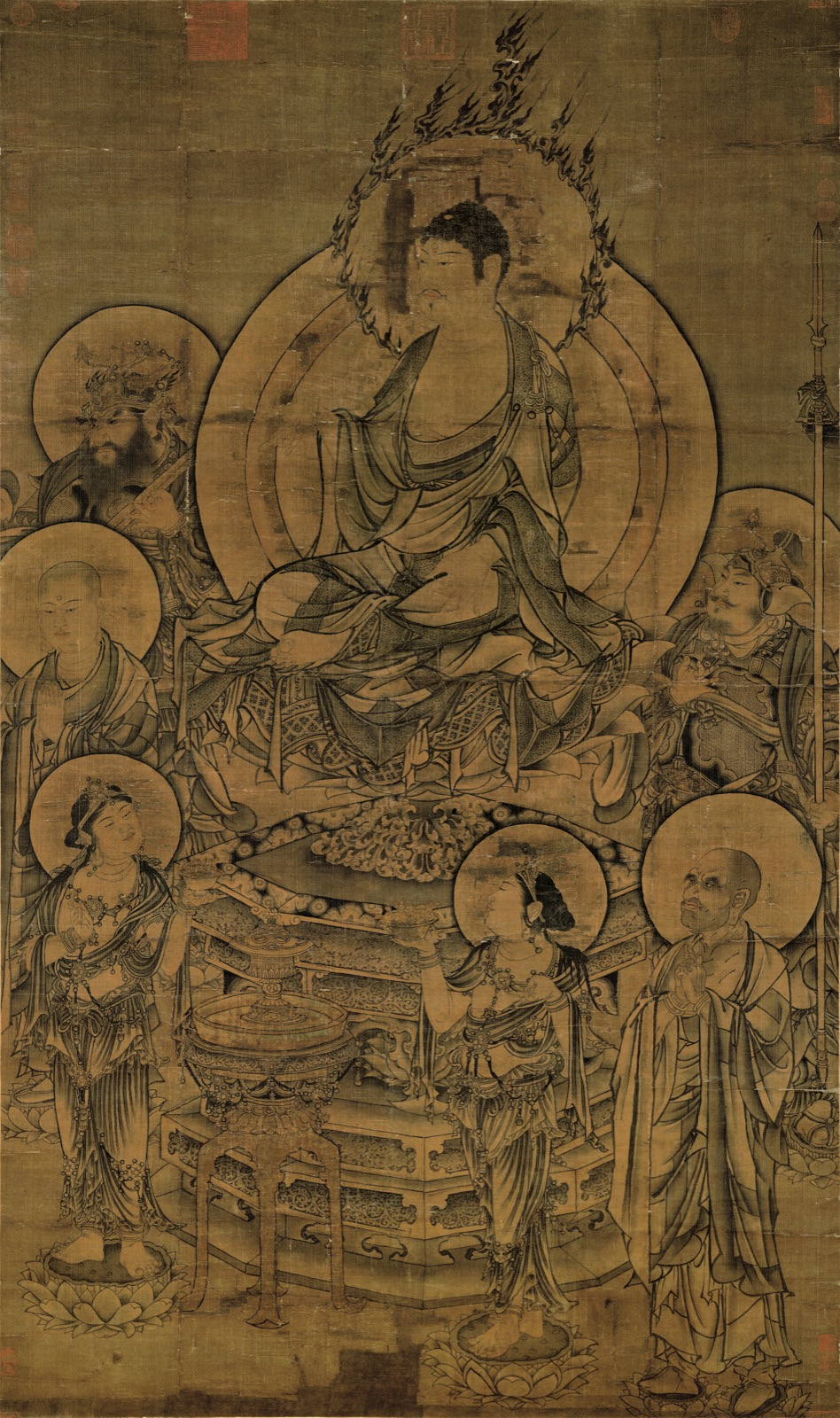
Quick answer: To identify figures in a Buddha preaching assembly, start with dress, adornment, posture, halo, position, and relation to the central teacher. In TK0225, plain robes indicate monastic figures, jewelry and lotus pedestals suggest bodhisattva-like attendants, and armor or weapons indicate guardian-like roles. Exact individual names remain uncertain.
A Buddha preaching assembly is not simply a crowd around a sacred figure. Costume, scale, posture, halos, pedestals, and direction of attention divide the gathering into recognizable roles. TK0225 makes those differences especially visible: a monumental seated Buddha occupies the center, while monks, richly adorned attendants, and forceful guardian-like figures form distinct zones around him.
The archive title supplies the subject “Buddha Preaching the Dharma,” but it does not identify every participant. The most reliable reading therefore begins with categories rather than names. “Monastic figure,” “bodhisattva-like attendant,” and “guardian-like figure” accurately record visible evidence while leaving room for later inscriptional or documentary research.
What is visible in the TK0225 preaching assembly?
TK0225 visibly presents a large seated Buddha on an elaborate layered platform. A circular halo fills much of the upper center, and a flame-like outline rises around the head. One hand is lifted near the chest in a teaching-like gesture, while layered monastic robes fall across the body and seat.
Several smaller haloed figures surround the Buddha. At least two wear comparatively plain monastic robes and have closely cropped or shaved heads. Two lower attendants wear jewelry, scarves, and elaborate hair or crowns, and they stand on lotus pedestals. More forceful figures occupy the upper sides: one is bearded and richly dressed, while another appears armored beside a tall weapon or ceremonial standard.
How does the painting establish the central Buddha?
The central Buddha is established through scale, axis, halo, elevated seat, and the orientation of surrounding figures. He is substantially larger than every companion, occupies the vertical center, and sits within the broadest circular halo. The ornamental platform creates a physical and visual threshold beneath him.
Size here expresses sacred hierarchy rather than ordinary perspective. The smaller figures are not necessarily farther away. Their bodies, faces, and gestures turn toward the center, so the composition reads as an audience arranged around teaching.
The raised hand supports the archive title’s preaching theme, but the exact mudra should not be named from this reproduction alone. Finger positions are not fully clear at web scale, and several teaching gestures can resemble one another when linework is worn. “Teaching-like gesture” is the responsible visible description.
How can monastic figures be recognized?
Monastic figures are suggested by shaved or closely cropped heads, unornamented robes, restrained posture, and the absence of crowns or jewelry. In TK0225, one youthful-looking monk appears at the left of the central platform, while a larger older-looking monastic stands at the lower right with hands joined in reverence.
Plain dress distinguishes these figures from the jeweled attendants nearby. Their robes wrap in broad, simple folds rather than forming necklaces, armlets, crowns, or streaming scarves.
Age, facial features, or placement may eventually help identify particular disciples, but they are not sufficient here. A bald head does not prove a named arhat, and joined hands do not establish a specific biography. The safest record is “haloed monastic attendant” unless a matching text or reliable object record provides more.
What suggests bodhisattva-like attendants?
Jewelry, elaborate hair, scarves, fine garments, and lotus pedestals suggest bodhisattva-like status. The two prominent lower attendants in TK0225 wear necklaces and layered ornaments, and their bodies have a graceful, courtly presentation unlike the plain-robed monks.
One stands at the lower left and turns inward; another stands nearer the center-right and extends an arm toward the throne. Both have circular halos and lotus supports. These clues place them in a celestial, adorned category, but they do not reveal names by themselves. No decisive lotus, vase, sword, book, or small crown image is clear enough in the web derivative to support a confident identity.
“Bodhisattva-like attendant” is therefore more accurate than guessing Avalokiteshvara, Manjushri, Maitreya, or another figure. Jewelry is a category clue, not a unique name tag.
How are guardian-like roles indicated?
Guardian-like roles are indicated by forceful faces, armor or courtly protective dress, facial hair, and weapons or standards. TK0225 places such figures toward the outer upper sides rather than directly below the Buddha. Their stronger profiles and equipment contrast with the quiet monks and elegant lower attendants.
The upper-left figure appears bearded and richly equipped, while the upper-right figure wears an ornate headdress or armor beside a tall pointed object. These details support a protective or guardian-like function. They do not securely identify heavenly kings, generals, or named protectors, because the relevant implements and inscriptions are not sufficiently legible.
Position strengthens the reading. Guardians often define an assembly’s boundary, while intimate disciples and bodhisattva attendants gather closer to the teaching center. That is a compositional pattern, not an absolute rule, so attributes must still be checked.
Which visual clues distinguish the figure groups?
The groups can be distinguished by combining several clues rather than relying on one feature.
| Figure group | Visible clues in TK0225 | Safe description | What remains uncertain |
|---|---|---|---|
| Central Buddha | Largest scale, monastic robe, large halo, elevated seat, teaching-like hand | Central Buddha preaching the Dharma | Exact Buddha identity and mudra |
| Monastic figures | Shaved or close-cropped heads, plain robes, restrained gestures | Haloed monastic attendants | Names, rank, lineage, and biography |
| Jeweled attendants | Crowns or styled hair, necklaces, scarves, lotus pedestals | Bodhisattva-like attendants | Individual deity identities |
| Guardian-like figures | Armor or protective dress, facial hair, forceful expression, weapon or standard | Protective members of the assembly | Exact guardian names and attributes |
Halos appear around several categories, so a halo alone does not mean “Buddha.” In this image, halo size and placement help organize rank, but dress, seat, gesture, and scale carry the identification further.
A seven-step method for reading an unfamiliar assembly
A repeatable sequence prevents premature naming:
- Find the visual center. Locate the largest halo, throne, axis, and direction of surrounding gazes.
- Describe the central figure without naming it. Record robe, hair, hands, seat, halo, and visible attributes.
- Group figures by dress. Separate monastic robes, jeweled celestial clothing, armor, and lay garments.
- Compare supports and posture. Note lotus pedestals, standing positions, kneeling bodies, and proximity to the throne.
- Inspect implements at high resolution. A sword, book, vase, lotus, staff, or standard may narrow an identity, but only if clearly visible.
- Record condition limits. Mark abrasion, folds, crop, darkening, and missing lines before declaring an attribute absent.
- Assign confidence levels. Separate visible role, probable religious category, archive title, and unverified historical attribution.
The TANGKAWORLD beginner’s guide to reading a Thangka expands this observation-first approach. For tiny attributes, seals, and surface evidence, use the high-resolution iconography study guide.
What can the archive title confirm?
The archive title can confirm how TK0225 is catalogued, but not the painting’s complete history. “Buddha Preaching the Dharma” agrees with the central teacher and surrounding audience visible in the image. It does not provide an artist, secure date, school, collection, provenance, object number, or the names of the attendants.
The adjacent sorted archive file TK0226 carries additional Song-period and artist wording, but that metadata must not be transferred automatically to TK0225. Even closely related digital variants can preserve different crops, reproductions, captions, or source histories. Each file needs its own evidence trail.
Frequently asked questions
Is the central Buddha definitely Shakyamuni?
The image shows a central preaching Buddha, but the reproduction does not provide enough independent evidence to name Shakyamuni with certainty. A verified catalogue record or readable inscription is needed.
Does every jeweled figure represent a bodhisattva?
No. Jewelry and celestial garments support a bodhisattva-like category, but deities, courtly attendants, and other sacred figures can share those features. Attributes and context must agree.
Why do monks and guardians also have halos?
Halos mark sacred or elevated status across several figure types. Their size, shape, and position help establish hierarchy, but they do not identify a figure without dress, posture, implements, and context.
Can seals prove the painting’s date or ownership?
Not by themselves. Seals must be transcribed, matched to documented impressions, and studied on the same physical object. A digital reproduction may preserve seals without preserving their source history.
Conclusion
TK0225 shows how a preaching assembly becomes readable through visual roles. The central Buddha is established by scale, axis, halo, and throne. Plain robes distinguish monastic attendants; jewelry and lotus pedestals suggest bodhisattva-like companions; armor, facial hair, and a tall implement indicate guardian-like roles. These categories make the image useful without inventing names or historical facts that the file cannot prove.
Sources and editorial method
This article is based on direct visual analysis of TANGKAWORLD image TK0225. It separates visible evidence—scale, dress, jewelry, posture, halos, pedestals, implements, seals, and condition—from religious role categories and uncertain individual or historical attribution. The English archive title is retained; exact figure names, date, artist, school, collection, and provenance remain unverified. Related source-led methods appear in the TANGKAWORLD Learn center.
Prepared and reviewed by the TANGKAWORLD editorial team
Last reviewed: August 14, 2026.

