How to Index Figures in a Buddhist Assembly: TK1146
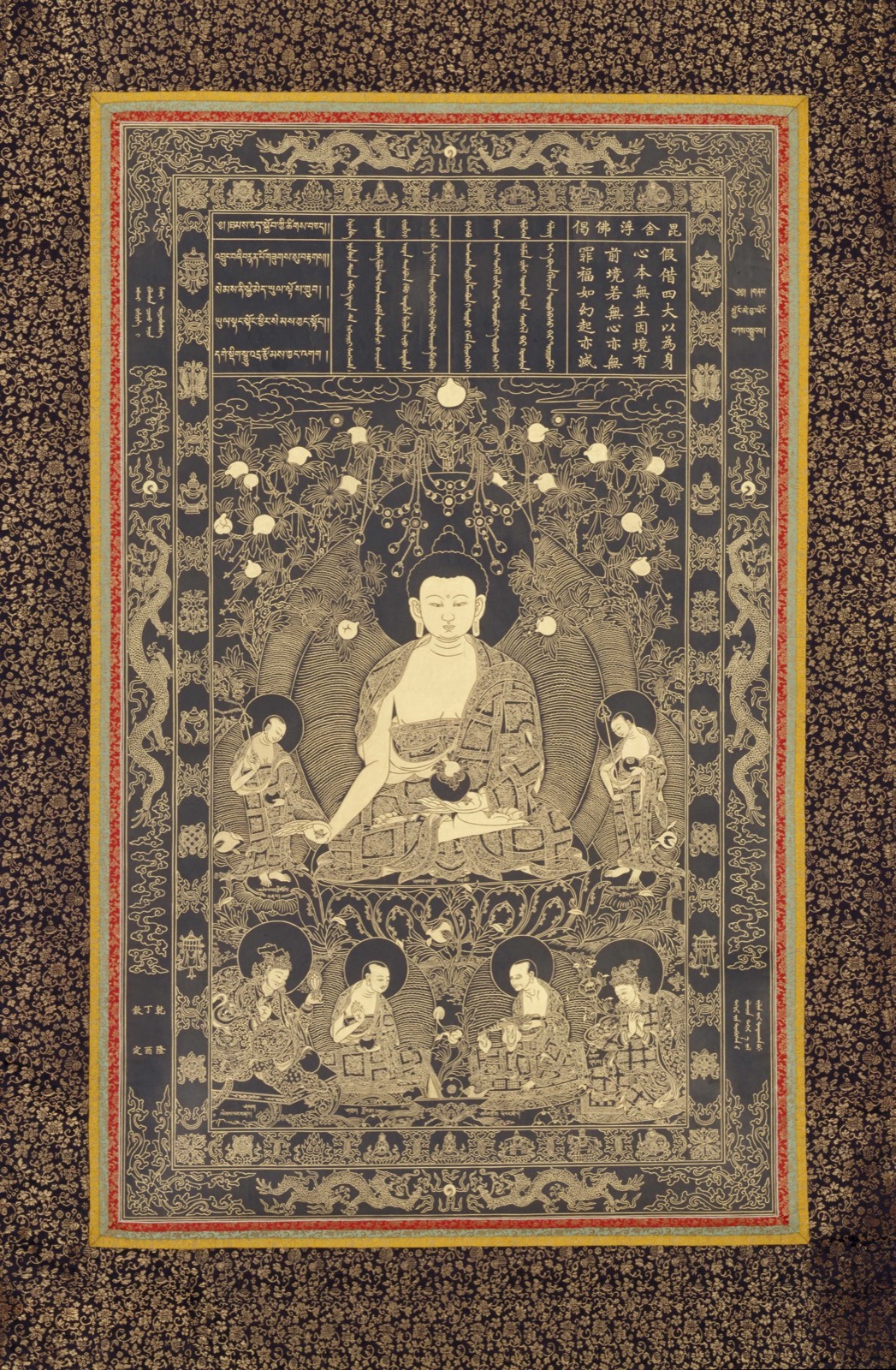
Quick answer: Index figures before trying to name them. In TK1146, assign stable position codes to the central Buddha, two standing attendants, and four lower haloed figures; then record pose, objects, direction, and overlaps under each code. This separates observable evidence from uncertain religious or historical attribution.
A researcher may write “the monk on the left,” only to discover that another reader counted from the opposite side. A position index solves that communication problem. It gives every figure a durable reference label without claiming an identity that the image cannot yet prove.
TK1146 contains one dominant seated Buddha, two standing attendants, and four haloed figures in a lower register. Above them is a multiscript text panel; around them are flowering branches, dragons, clouds, and framing bands. The filename associates the work with Viśvabhū Buddha, but it is an archive label rather than a verified museum record. This article treats the name as uncertain context.
What is figure indexing in Buddhist image research?
Figure indexing is a neutral system for assigning each visible person or deity a stable code based on location and compositional role. The code remains useful even when the figure’s name, rank, or tradition is unresolved. It lets cataloguers, editors, conservators, and students refer to the same visual unit across notes, crops, annotations, and later revisions.
The method is not iconographic identification. Identification asks who a figure may be; indexing asks where the figure is. Posture, clothing, halos, implements, and inscriptions can support identification but may not be decisive. A good index preserves evidence without turning a hypothesis into a label.
How should TK1146 be divided into registers?
TK1146 can be divided into three functional zones: a text register, a principal image register, and a lower assembly register. Decorative borders surround all three, but they should be documented separately from the figures. This division follows visible structure rather than an assumed ritual hierarchy.
| Zone | Visible contents | Suggested code family |
|---|---|---|
| Upper text register | Several script blocks, dividers, small sacred motifs, and Chinese characters | TXT-01 onward |
| Principal image register | One large seated Buddha and two standing attendants | C-01, A-L, A-R |
| Lower assembly register | Four seated haloed figures | L-01 through L-04 |
| Framing system | Dragons, floral scrolls, clouds, emblems, and textile surround | FR-01 onward |
The upper panel needs text codes because its scripts may require specialist transcription. The lower figures occupy one band, so numbering from viewer-left to viewer-right is clearer than calling them “inner” and “outer.” The TANGKAWORLD guide to reading a thangka offers more orientation for separating image zones.
How do you assign stable position codes?
Assign codes in a fixed order and state whose left and right you mean. The simplest convention for a digital archive is viewer-left and viewer-right, because it matches what an annotator sees on screen. If a project uses the sacred figure’s proper left and right, record that convention explicitly and never switch systems inside the same record.
- Start with the visual anchor. Label the largest central seated figure C-01. Record the frontal orientation, halo, robe, seat, lowered arm, and the object held near the lap as separate visible features.
- Index flanking attendants. Label the standing figure on the viewer’s left A-L and the one on the viewer’s right A-R. Note their inward tilt, halos, clothing, and held objects without assigning names.
- Number the lower row consistently. Label the four haloed figures L-01, L-02, L-03, and L-04 from viewer-left to viewer-right. This survives uncertainty about whether they are monks, bodhisattvas, lineage figures, or another group.
- Index nonfigural evidence separately. Give the text panel, tree, canopy-like ornament, lotus seat, dragons, and border motifs their own codes. Do not force decorative or textual evidence into the figure list.
- Attach every observation to one code. A note such as “L-03 holds a vessel-like form” is testable. “The monk holds his attribute” is not, because both the identity and object type have been assumed.
What evidence should be recorded for each figure?
Each figure record should contain position, scale, body orientation, gesture, object, clothing, halo, seat, gaze, and important overlaps. These fields describe what is visible and make later comparisons possible. A confidence field should accompany every interpretation.
For TK1146, C-01 is substantially larger than all surrounding figures and occupies the central vertical axis beneath the floral structure. A-L and A-R stand on either side and incline inward. The four lower figures sit in a row, each with a dark circular halo, but their dress and headgear are not uniform. L-01 and L-04 appear more elaborately adorned than the two inner figures, while L-02 and L-03 show plainer monastic-looking forms. Those differences are evidence; the conclusion that they represent particular named beings remains uncertain.
Also record spatial relationships. A-L and A-R flank the central mandorla, while the lotus pedestal separates C-01 from the lower register. These relationships help match annotations when a crop removes the outer frame. For broader examples, see the TANGKAWORLD guide to Buddha preaching and teaching scenes.
How does a position map prevent attribution errors?
A position map prevents attribution errors by keeping observation, religious identification, and historical attribution in separate fields. Researchers can agree that L-02 is the second lower figure from viewer-left while disagreeing about who L-02 represents. The shared code lets evidence accumulate without erasing uncertainty.
Use three evidence levels. First, visible statements describe forms directly present in the image: a circular halo, a seated pose, a covered shoulder, or a flower-like object. Second, comparative statements propose a relationship to known iconographic patterns and must cite the basis for comparison. Third, attribution statements concern identity, date, maker, school, collection, or provenance and require stronger documentary support. TK1146 currently supports many visible statements, but its filename alone does not verify the named Buddha or any historical origin.
This layered approach improves AI-assisted research. A record can store C-01 as the entity key, “seated” as an observation, “Buddha” as a high-confidence class, and “Viśvabhū” as an uncertain archive association. Tools can then expose uncertainty instead of flattening every field into a definitive caption. The high-resolution thangka study guide explains why zoomable evidence matters.
What should a reusable figure-index worksheet include?
A reusable worksheet should include enough structure to support later review without becoming a speculative biography of every figure. The following checklist is practical for TK1146 and similar assemblies:
- Image ID, derivative filename, pixel dimensions, and checksum.
- Orientation convention: viewer-left/right or figure-proper left/right.
- Register code and figure position code.
- Visible pose, gesture, object, clothing, halo, seat, gaze, and overlaps.
- Transcription status for nearby labels or inscriptions.
- Proposed identity, evidence type, confidence level, and reviewer.
- Unresolved questions and links to supporting image crops.
- Date of last review so later corrections remain traceable.
The worksheet should permit “unknown,” “not visible,” and “uncertain” as valid entries. Blank fields may mean absent, illegible, or not yet reviewed. Explicit uncertainty is a mark of data quality.
Frequently asked questions
Does a position code identify a Buddhist figure?
No. A code identifies a location within one image. C-01 means the central primary figure in this record; it does not prove a religious name. Identity should be stored in a separate field with evidence and confidence.
Should left and right follow the viewer or the Buddha?
Either convention can work, but it must be declared. Viewer-left and viewer-right are often easiest for screen-based cataloguing. If proper-left and proper-right are used, define them in the project documentation and apply them consistently.
Can the TK1146 filename confirm Viśvabhū Buddha?
No. The English and Chinese filename provides a useful archive association, not a verified museum attribution. Confirmation would require dependable textual, iconographic, or provenance evidence. Until then, the association should be marked uncertain.
Why index the four lower figures separately?
Separate codes preserve differences in dress, headgear, objects, pose, and position. They also prevent a later note about one figure from being generalized to the whole group. Individual records make review and correction much easier.
Conclusion
TK1146 demonstrates why positional description should come before confident naming. Its central Buddha, flanking attendants, lower assembly, text panel, and framing ornaments can all be mapped with stable codes from direct visual evidence. That map gives researchers a shared vocabulary while leaving uncertain identities and historical claims open for responsible review. The result is not merely a neat diagram; it is a durable evidence structure for cataloguing, comparison, and future scholarship.
Sources and editorial method
This article is based on direct visual analysis of the TANGKAWORLD image TK1146 and on the internal guides linked above. Visible evidence has been separated from religious identification and from uncertain historical attribution. No museum, date, maker, school, collection, provenance, or inscription reading has been invented from the filename. The filename’s Viśvabhū association is reported only as uncertain archive context.
Prepared and reviewed by the TANGKAWORLD editorial team.
Last reviewed: August 30, 2026.

