How to Read a Buddhist Handscroll: The Viewing Path in TK0210
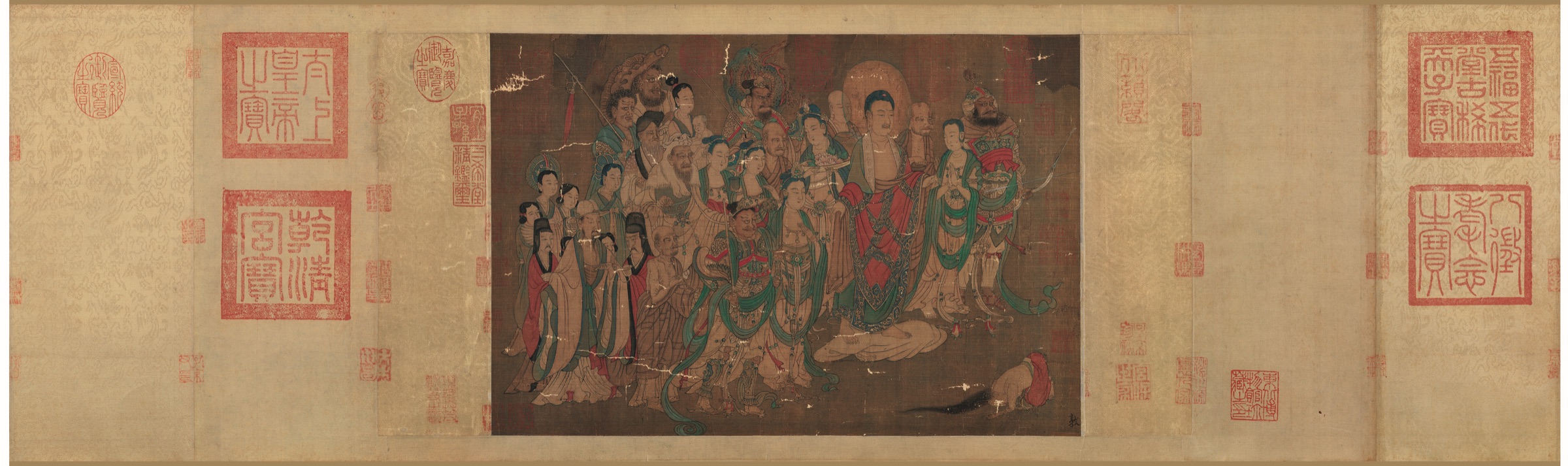
Quick answer: To read a Buddhist handscroll, follow the transitions between mounting, empty space, seals, figure clusters, and isolated actions instead of treating the image as one fixed tableau. TK0210 concentrates a standing Buddha and assembly in the center while a kneeling figure on the right creates a narrative approach. Historical attribution remains uncertain.
A handscroll asks for a different kind of attention from a vertical hanging painting. Its length distributes meaning across time and space. Even when a digital scan reveals the entire object at once, the viewer can reconstruct a gradual route: enter through the mounting, notice later seals, approach an isolated action, encounter the sacred assembly, and then leave through another field of cloth or paper.
TK0210 is especially useful for learning how to read a Buddhist handscroll. The dark painted center is surrounded by broad pale mounting sections covered with red impressions. Within the picture, a tall haloed Buddha stands among a crowded retinue. A small kneeling figure occupies the lower right, separated from the main assembly by open ground. That spacing turns a static group portrait into a possible narrative encounter.
What is visibly present in TK0210?
TK0210 visibly combines three layers: a horizontal mounting, a dark rectangular painted field, and later-looking seal impressions distributed across both. The central field holds many figures in overlapping rows. The largest sacred figure stands slightly right of center with a circular halo, elongated body, monastic robe, and one hand raised near the chest.
Jeweled and courtly figures, plain-robed figures, and forceful guardian-like attendants cluster around the Buddha. Some carry long staffs, weapons, or standards. At the lower right, a separate kneeling person bows toward the group. Surface losses and pale cracks interrupt the dark field. These observations can be made without deciding the name of every participant.
Why does handscroll format change the reading?
A handscroll is designed for progressive viewing rather than permanent full display. In many East Asian traditions, the viewer opens a section at the right and advances toward the left while rolling the viewed portion. The physical action limits how much is visible at once and makes sequence part of interpretation.
Where should the eye begin in this Buddhist handscroll?
The most useful visual route begins at the right mounting and moves toward the painted encounter. The pale right field contains large red seals and scattered smaller impressions. It creates a long interval before the dark picture begins. That interval is not empty in the digital object: mounting joins, discoloration, pattern, and seals record how the image was framed and encountered over time.
At the edge of the painted field, the kneeling figure becomes the first isolated action. The body is low, the back curves forward, and a red garment or cloth gathers around the lower form. The figure faces the standing Buddha and crowd. Because open dark ground separates this person from the assembly, the viewer experiences the distance as an approach.
The kneeling figure creates narrative tension
The kneeling figure gives the scene a before-and-after quality. The pose suggests reverence, petition, offering, or receiving instruction, but the exact act is uncertain at this resolution. The filename proposes a Dipankara prediction subject, which may make the figure relevant to a known Buddhist narrative. That proposal remains a research lead rather than a verified identification.
It would be premature to name the kneeling person as a specific past-life figure solely from the filename. Secure identification would require readable inscriptions, a traceable object record, or comparison with a documented version of the same scroll. The visible claim is narrower: one individual bows at the threshold of a large sacred assembly.
The crowded center slows the eye
After the open interval, the dense assembly arrests movement. Overlapping halos, heads, robes, scarves, weapons, and gestures force the viewer to pause. The largest Buddha provides hierarchy, but the crowd prevents an immediate one-figure reading. Some attendants turn inward; others face outward or glance across the group, producing several secondary paths.
How do empty space and crowding work together?
Empty space makes the crowded assembly legible as an event. The right side gives the kneeling person room to act; the center compresses many witnesses around the Buddha. This contrast creates rhythm: interval, approach, encounter, concentration.
The pale mounting fields extend that rhythm beyond the painted scene. Their breadth makes the dark panel feel like an image revealed inside a larger material object. When a web crop removes the mounting, it also removes evidence about scale, handling, seals, and the dramatic transition into the picture.
| Visible feature | Viewing effect | Limit of interpretation |
|---|---|---|
| Wide pale mounting | Creates entry and departure intervals | Mounting date is uncertain |
| Isolated kneeling figure | Establishes approach and narrative tension | Identity and action are uncertain |
| Dense central assembly | Slows the eye and establishes hierarchy | Most individual names are unverified |
| Red seals across several zones | Adds a later history of viewing and ownership claims | Seal readings and authenticity are unverified |
What do the many red seals contribute?
The seals make the object’s later life visually impossible to ignore. Large square impressions occupy both outer mounting fields, while smaller seals appear near joins, borders, and within the painted area. They form a second network laid over the sacred image.
A seal can indicate collecting, cataloguing, appreciation, or administration, but shape and placement alone do not identify its owner. Some impressions may be later, repeated, copied, or transferred through a reproduction. They should first be mapped as visible landmarks. Transcription and authentication require specialized comparison and a reliable source record.
How is this handscroll different from a vertical thangka?
The crucial difference is not religious value but viewing structure. A vertical thangka usually establishes a complete field that can be seen at once, often organized around a central deity, lineage, mandala, or narrative registers. A handscroll unfolds laterally and can distribute attention through successive episodes, gaps, and clusters.
How can researchers study a handscroll scan responsibly?
A repeatable workflow keeps material evidence, visible interpretation, and historical attribution separate.
- Preserve the source. Keep the original filename, TK number, color profile, dimensions, file size, and checksum unchanged.
- Record the full object. Do not begin with a crop of the central figures; include mounting, joins, borders, repairs, inscriptions, and seals.
- Create a viewing map. Divide the scroll into right mounting, kneeling-figure interval, assembly, left transition, and left mounting.
- Simulate progressive viewing. Examine overlapping windows from right to left while retaining the complete overview for reference.
- Describe before naming. Record pose, dress, halo, object, direction, and spacing before assigning an identity.
- Map later interventions. Note seals, repairs, cracks, stains, cropping, retouching, and color shifts separately from the painted narrative.
- Test the filename. Treat Dipankara, Southern Song, and story labels as leads requiring a matching documentary source.
- State confidence. Distinguish visible facts, plausible religious interpretation, and uncertain historical attribution in the final record.
Frequently asked questions
Should a Buddhist handscroll always be read from right to left?
Right-to-left progressive viewing is common for East Asian handscrolls, but the surviving mounting, inscriptions, and documentary record should confirm orientation. A digital file may also be reversed, cropped, or assembled incorrectly.
Does the kneeling figure prove that TK0210 shows Dipankara’s prediction?
No. The pose is compatible with a reverential narrative encounter, and the filename proposes a Dipankara subject, but a secure episode identification needs inscriptions or a traceable record for the same object.
Can the large red seals identify the collection?
Not without transcription and comparison. Seal placement is useful evidence, but impressions may be later, copied, unclear, or associated with different owners. The available file does not verify the current collection.
Why keep the wide mounting in a web image?
The mounting preserves scale, joins, seal placement, condition, and the approach to the painted field. Cropping it away makes the figures larger but removes evidence essential to understanding the handscroll as a material and sequential object.
Conclusion
TK0210 teaches that a Buddhist handscroll is read through intervals as much as figures. Pale mounting, red seals, open ground, a kneeling person, and a compressed sacred assembly create a route from material threshold to narrative encounter. The archive title “Dipankara Buddha” is preserved, while individual identities, Southern Song date, artist, collection, and provenance remain uncertain. Reading the sequence carefully produces useful knowledge without turning an inherited filename into false certainty.
Sources and editorial method
This article is based on direct visual analysis of the complete TANGKAWORLD TK0210 image and its full-width web derivative. Visible structure, religious interpretation, later material evidence, and uncertain historical attribution are kept separate. For a broader observation framework, see How to Read a Thangka; for close digital study, consult Study Thangka Iconography with High-Resolution Images and the TANGKAWORLD Learn center.
Prepared and reviewed by the TANGKAWORLD editorial team. Last reviewed: August 16, 2026.

