Is That Myrobalan? Reading Medicine Buddha’s Plant in TK0572
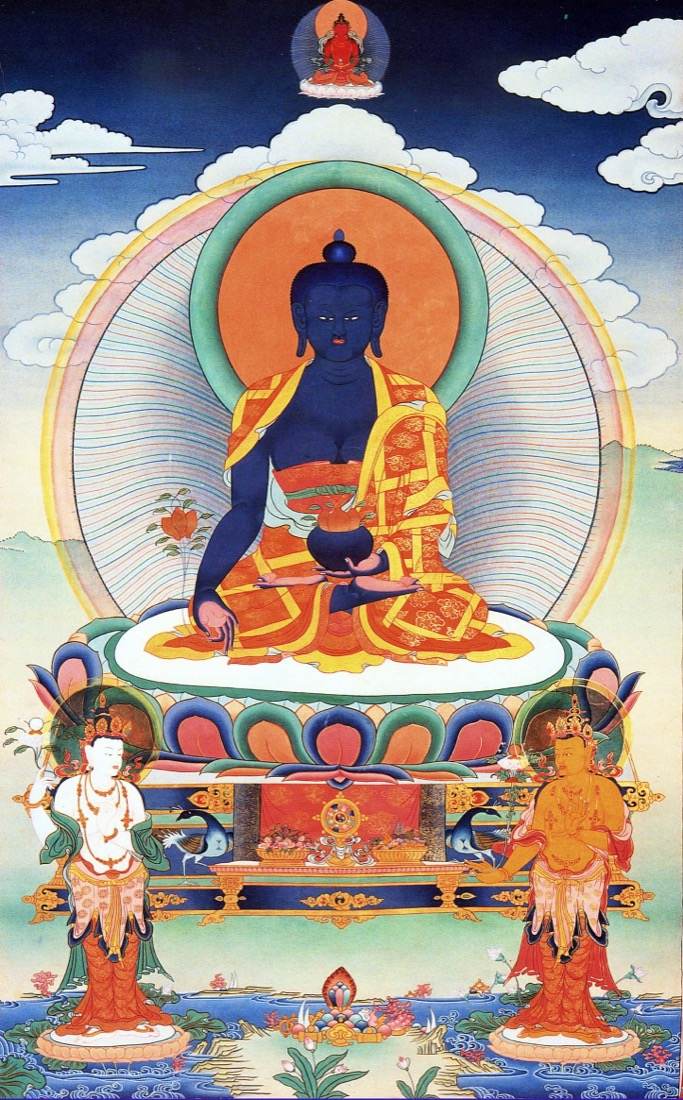
Quick answer: The leafy branch and orange-red fruit beside Medicine Buddha in TK0572 are traditionally read as the healing plant often called myrobalan. The painting supports that iconographic interpretation, but it cannot verify a botanical species by appearance alone. The blue body, monastic robes, bowl, hand position, and full composition provide the stronger identification.
The Medicine Buddha myrobalan plant is one of the most frequently named botanical attributes in Tibetan Buddhist art, yet it is easy to overstate what a painting proves. TK0572 presents a useful case: a dark blue Buddha extends one hand near a fruit-bearing branch while the other supports a bowl. The subject is visually coherent, but the branch remains stylized rather than botanically diagnostic.
A responsible reading therefore operates on two levels. Religious iconography can identify the branch’s healing function and traditional name, while visual analysis records its actual shape, color, and placement. Botanical species, medicinal preparation, date, workshop, and provenance need evidence beyond the image.
What plant details are visible in TK0572?
A slender stem rises beside the Buddha’s extended proper right hand, which appears on the viewer’s left. Small green leaves are spaced along the stem, and an orange-red, lobed fruit or flower-like form appears near its upper section. The stem is close enough to the hand to function as an attribute, although the fingers do not display every contour clearly.
A second orange-red form appears above the dark bowl held in the proper left hand. It may represent fruit, medicine, a flower, or another offering. The two forms should not automatically be treated as identical. One belongs to a visible leafy branch; the other emerges from or rests above a vessel. Recording their separate locations prevents a traditional label from flattening different painted objects into one.
The central figure is dark blue, seated cross-legged on a white disc and multicolored lotus, and dressed in orange-red monastic robes. An orange head halo, green outer ring, and radiating body aureole establish the sacred center. These features provide the context in which the branch is read.
Why is the branch called myrobalan?
In Medicine Buddha iconography, the extended hand is traditionally associated with a medicinal plant commonly called myrobalan or haritaki in English-language descriptions. The plant signifies healing activity and complements the bowl held in meditation. That traditional association explains why viewers search for a stem, leaves, or fruit near the lowered hand.
“Myrobalan” is therefore an iconographic identification: it names the role the plant plays in the sacred image. It does not mean that a painter supplied a scientific botanical illustration. The TANGKAWORLD Medicine Buddha identification guide places the plant within the larger group of blue body, monastic dress, bowl, posture, and supporting figures.
Can the painting verify a botanical species?
No. TK0572 does not provide enough naturalistic botanical detail to establish a species from the image alone. The leaves are small and generalized; the orange-red form is stylized; and scale, growth habit, surface texture, and reproductive structures are not rendered as a scientific specimen would require.
Color is also symbolic and compositional. An orange fruit may have been chosen to stand clearly against blue skin, dark ground, and pale landscape. Its painted hue cannot safely be converted into a claim about ripeness, variety, or chemical properties. Even a high-resolution scan would reveal brushwork more clearly without supplying a verified botanical record.
The best caption language is therefore layered: “leafy branch with orange-red fruit, traditionally identified as myrobalan.” That sentence preserves direct observation and religious interpretation while leaving the exact species uncertain.
Why the full attribute cluster matters
The plant becomes persuasive because it belongs to a coherent Medicine Buddha composition. The dark blue body is prominent, the figure wears monastic robes, the left hand rests in meditation with a bowl, and the right hand extends downward near the branch. No single feature carries the entire identification.
This matters because bowls, blue figures, lotuses, and healing plants can each appear in more than one Buddhist context. When several independent features agree, confidence rises. When they conflict—as dress, face, or companion objects sometimes do—the archive title should be tested rather than repeated. For a general sequence of looking, consult How to Read a Thangka.
Plant, bowl, and hand: three different kinds of evidence
| Feature | Direct observation | Interpretive value |
|---|---|---|
| Leafy branch | Green leaves and an orange-red lobed form beside the lowered hand | Supports the traditional healing-plant attribute |
| Dark bowl | Round vessel resting above the open meditation hand | Supports Medicine Buddha when combined with other signs |
| Form above the bowl | Separate orange-red object with a small green element | Contents uncertain; should not be equated automatically with the branch |
| Right hand | Lowered near the plant stem | Connects the branch to the central figure |
| Blue body | Deep blue skin across face, torso, arms, and legs | Strong contextual evidence, not sufficient alone |
| Monastic robes | Orange-red patterned garments without a jeweled crown | Consistent with a Buddha rather than a princely bodhisattva |
What do the attendants and offerings add?
Two crowned, standing bodhisattva-like figures flank the lower throne. The pale figure on the viewer’s left holds a long stem or object, while the golden figure on the right presents a flower-like attribute. Their balanced placement supports an organized sacred assembly, but their individual names cannot be confirmed from this image alone.
Between them are a Dharma wheel, flower offerings, vessels, rounded fruits, two water birds, and a patterned altar cloth. Water and lotus growth fill the lowest register. These details reinforce abundance, devotion, and a healing environment without identifying the plant species held by the central Buddha.
A small red seated figure appears above the main aureole. It is crowned or ornamented and sits in meditation, but the scale is too small for a secure name. It may provide lineage or compositional context; calling it Amitayus, Amitabha, or another figure without corroborating evidence would be uncertain.
A seven-step method for reading a medicinal plant attribute
- Locate the complete stem. Trace it from the hand or seat to its leaves and fruit rather than studying an isolated colored shape.
- Separate nearby objects. Distinguish the branch from anything inside the bowl, on the throne, or among the offerings.
- Record visible morphology. Note leaf number, fruit shape, color, and stem position without assigning a species.
- Check the hand relationship. Determine whether the figure holds, touches, or merely appears beside the plant.
- Build the attribute cluster. Compare body color, robes, bowl, posture, halo, attendants, and inscriptions.
- Use documented comparisons. Prefer securely identified collection records and specialist guides over visually similar thumbnails.
- State two confidence levels. Give one confidence level for religious identification and another for botanical identification.
For digital study, the high-resolution iconography workflow helps researchers inspect attributes while keeping observation, comparison, and provenance claims separate.
Frequently asked questions
What does the myrobalan plant symbolize in Medicine Buddha art?
It signifies healing activity and medicinal knowledge within the religious image. The branch works together with the bowl and the Buddha’s compassionate posture; it should not be reduced to a decorative flower.
Is the orange-red object in TK0572 definitely myrobalan fruit?
Its traditional iconographic role supports that reading, but its exact botanical species is uncertain. The stylized form lacks enough naturalistic detail for a scientific identification from the painting alone.
Does the bowl contain the same plant?
The image does not prove that. A separate orange-red form appears above the bowl, but its identity and relationship to the leafy branch are unclear. They should be documented as distinct visible objects.
Why is TK0572 more securely identified as Medicine Buddha than a bowl alone would allow?
The blue body, monastic robes, seated posture, bowl, lowered hand, and fruit-bearing branch agree as an attribute cluster. Their convergence is stronger than any one sign considered independently.
Conclusion
TK0572 supports a Medicine Buddha identification through a consistent cluster of visual signs. Its leafy branch with orange-red fruit is appropriately described as the plant traditionally called myrobalan, but that religious identification should not be mistaken for botanical proof. Separating iconography from species-level certainty makes the caption more accurate, useful, and open to future research.
Sources and editorial method
This article is based on direct visual analysis of the TANGKAWORLD TK0572 image at full and web resolution. Visible color, form, location, and hand relationships are separated from traditional religious identification. The myrobalan name is used as an iconographic convention; botanical species, attendant identities, upper figure, date, artist, school, collection, and provenance remain uncertain. Related TANGKAWORLD guides provide the comparative method and direct readers to their Sources and further reading sections.
Prepared and reviewed by the TANGKAWORLD editorial team.
Last reviewed: August 21, 2026.
Explore more Thangka art at TANGKAWORLD. Visit the TANGKAWORLD home page, continue with the Thangka learning center, or download the complete Thangka image collection.

