Is This Maitreya? How to Audit a Buddhist Image Label: TK0548
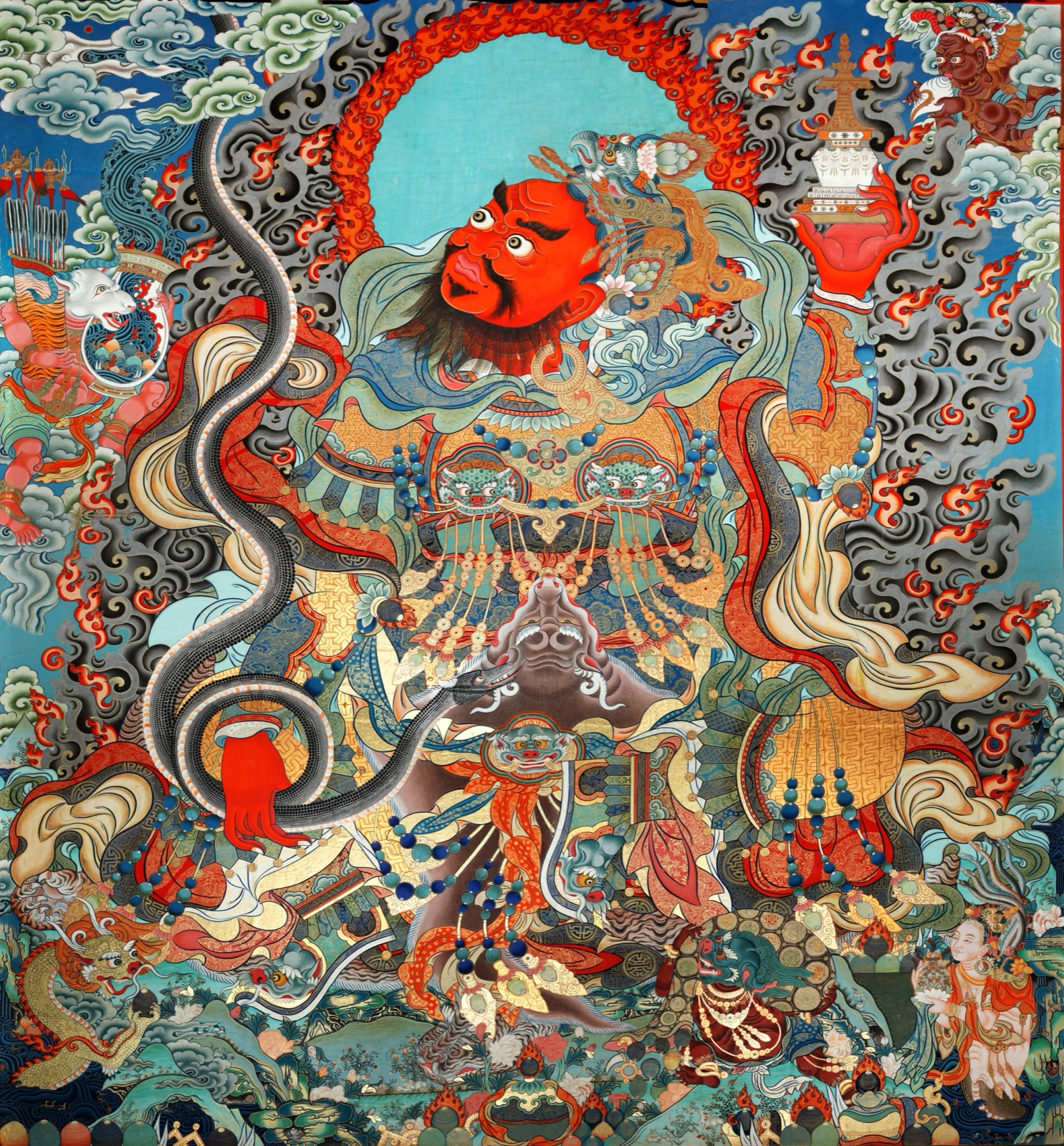
Quick answer: TK0548 should not be identified as Maitreya from its filename alone. The image centers a red-faced wrathful figure holding a stupa, crossed by a large serpent and surrounded by flames, smoke, animal-headed attendants, and offerings. Those visible clues conflict with common peaceful Maitreya forms, so the subject should remain uncertain pending a verified record.
A confident filename can become more persuasive than the picture it describes. Once a subject name enters an archive, later captions, alt text, blog posts, and search results may repeat it until an uncertain label looks like established fact. TK0548 demonstrates why a Buddhist image label should be tested against visible evidence before publication.
The inherited English title is retained because it records how the file arrived: Maitreya — Mural. Retaining a title is not the same as endorsing it. The correct catalogue response is to preserve the supplied wording, document the conflict, and place the religious subject in an uncertain state until stronger evidence appears.
What is clearly visible in TK0548?
TK0548 clearly shows a monumental red-faced figure with bulging eyes, black facial hair, a large open mouth, elaborate crown or headdress, richly patterned garments, jewelry, and armor-like layers. One raised red hand supports a multi-tiered stupa or pagoda-shaped object. A long dark serpent crosses the body and coils around the lower left.
Red flames and dense black-and-gray smoke form a turbulent aureole. Animal and hybrid heads appear around the central body and on the costume. A bow, arrows, weapons, cloud banks, landscape forms, jewel-like ornaments, vessels, fruit or round offerings, and several smaller human or guardian-like figures occupy the edges and lower register.
These are direct observations. They establish a wrathful or protective visual mode, ceremonial abundance, and a complex retinue. They do not, on their own, supply a secure deity name, mural location, date, artist, school, temple, or collection.
Why does the Maitreya label need review?
The label needs review because the dominant visible attributes do not provide a straightforward match with common Maitreya forms. Maitreya may appear as a jeweled bodhisattva or as a monastically robed Buddha. A stupa in the headdress, a water flask, teaching gestures, and specific seated postures can support identification in documented contexts.
TK0548 instead emphasizes a red wrathful face, armor-like dress, a large hand-held stupa, a serpent cutting across the body, fire, smoke, weapons, animal-headed forms, and a protective assembly. None of these details makes Maitreya impossible in every regional or narrative context, but the combination creates enough conflict that the filename cannot be repeated as fact.
The related TANGKAWORLD guide to Maitreya in Buddhist art explains the main visual forms and identification clues. TK0548 serves a different purpose: it shows what to do when an inherited title and the visible evidence fail to converge.
Does the stupa prove the figure is Maitreya?
No single stupa proves Maitreya. A small stupa can be important in Maitreya identification when it appears in a recognized headdress, lotus, or documented composition. In TK0548, the object is large, architectural, and elevated on the figure’s open palm. Its scale and placement must be interpreted with the rest of the image.
Stupas, reliquaries, pagodas, and tower-like forms occur in several Buddhist settings. The correct question is not “Which deity sometimes has a stupa?” but “Which documented iconographic system combines this particular stupa with this face, body, dress, serpent, attendants, and environment?” The available file does not answer that question.
Why not replace the label with another deity name?
Replacing one unsupported name with another would repeat the same error. The figure has traits that may remind viewers of wrathful protectors, directional kings, wealth deities, generals, or local guardian traditions. Resemblance is a starting point for comparison, not a final identification.
A secure alternative name would require converging evidence: a readable inscription, a matching documented mural, a temple inventory, a published iconographic chart for the same ensemble, or an institutional object record with the exact composition. Until then, “unidentified wrathful Buddhist figure; archive title says Maitreya” is more useful than a confident guess.
| Record element | Current evidence | Editorial action |
|---|---|---|
| English title | Filename says “Maitreya — Mural” | Preserve as supplied title, not verified identity |
| Central figure | Red-faced, wrathful, richly armed and adorned | Describe visible category; keep name uncertain |
| Held object | Large multi-tiered stupa or pagoda form | Record shape and placement before interpretation |
| Support | File calls it a mural; image shows no wall context | Mark physical support and site uncertain |
| Historical metadata | No traceable record included | Do not assert date, artist, temple, or collection |
Can the image be confirmed as a mural?
The current file cannot confirm the physical support. Its tight crop contains no wall edge, architectural setting, plaster texture, room view, or scale reference. Smooth color and detailed linework may come from mural photography, a painted panel, a scroll, or another reproduction process.
The word “Mural” should therefore remain part of the archive title while the medium field reads “uncertain from available digital file.” Camera metadata can describe how a photograph was made, but it does not identify the photographed support. A verified location image or catalogue entry is needed.
How should an archive audit a doubtful Buddhist subject label?
A good audit makes the uncertainty explicit without discarding the original record.
- Freeze the source record. Preserve the exact filename, TK number, dimensions, color profile, file size, timestamps, and checksum.
- Write a neutral visual description. Record face, body color, posture, hands, held objects, dress, weapons, attendants, setting, and condition without naming the figure.
- Extract the claimed identity. Store “Maitreya — Mural” as supplied metadata with its source and confidence level.
- Build an attribute matrix. Compare the visible combination—not one isolated object—with documented iconographic forms.
- Search for an exact composition. Match figure arrangement, stupa, serpent, bow, attendants, flames, offerings, crop, and damage rather than relying on a similar red face.
- Test the medium separately. Verify whether the source is a mural, panel, textile painting, print, or digital reproduction.
- Record competing hypotheses privately. Keep possible comparisons as research leads, not public titles.
- Publish the confidence statement. Separate supplied title, visible evidence, probable category, and unresolved identity.
What should the public catalogue say now?
The public record should be specific about the image and cautious about the name. A suitable description is: “Large red-faced wrathful Buddhist figure holding a stupa, surrounded by serpent, flames, smoke, weapons, animal-headed forms, attendants, and offerings. Archive title identifies Maitreya and a mural format; subject and support remain uncertain.”
This wording is more searchable than “unknown image” because it contains concrete attributes. It is also safer than repeating “Maitreya mural” as settled truth. Search systems can extract the uncertainty along with the visual description, reducing the chance that an inherited mistake becomes a new circular citation.
How can future evidence resolve the conflict?
The conflict can be resolved by finding a source that matches the same composition. Useful evidence would include a temple or museum catalogue, inscription transcription, location photograph, conservation report, field survey, publication plate, or archive accession record. The match should include the central face, hand-held stupa, serpent path, costume, attendants, and lower offerings.
A generic page about Maitreya is not enough. The goal is object-level or ensemble-level documentation. When a reliable record is found, preserve its exact attribution wording—such as identified as, attributed to, locally called, or formerly identified as—rather than simplifying every qualification into “is.”
Frequently asked questions
Is TK0548 definitely not Maitreya?
No. The available image creates a substantial mismatch with common Maitreya forms, but absence of a straightforward match is not proof of impossibility. The correct status is uncertain pending documentation.
Could the stupa identify the figure by itself?
No. The stupa is an important clue, but its size, position, accompanying serpent, wrathful form, dress, attendants, and setting must agree with a documented iconographic system.
Why keep an apparently wrong filename?
The filename preserves the archive’s history and may lead back to a lost source. Keep it unchanged in the source record, but distinguish supplied metadata from the current editorial identification.
Should the image be moved to the unidentified folder?
Not automatically. It can remain in sequence with a visible uncertainty flag, a neutral description, and an audit note. Reclassification should follow a documented collection policy rather than an irreversible guess.
Conclusion
TK0548 is valuable precisely because the label is difficult. The supplied title says Maitreya — Mural, while the image foregrounds a red wrathful figure, large stupa, serpent, flames, smoke, weapons, animal-headed forms, and offerings. Those clues justify an audit, not a replacement guess. Preserving the title, documenting the mismatch, and keeping subject and support uncertain creates a record that future evidence can correct.
Sources and editorial method
This article is based on direct visual analysis of the complete TANGKAWORLD TK0548 image and comparison with the site’s documented Maitreya visual guide. Visible attributes, supplied metadata, religious hypotheses, and uncertain historical attribution are kept separate. For the broader method, see How to Read a Thangka, the high-resolution iconography study guide, and the TANGKAWORLD Learn center.
Prepared and reviewed by the TANGKAWORLD editorial team. Last reviewed: August 17, 2026.

