Ritual Choreography in Pure Land Art: Processions and Offerings in TK0191
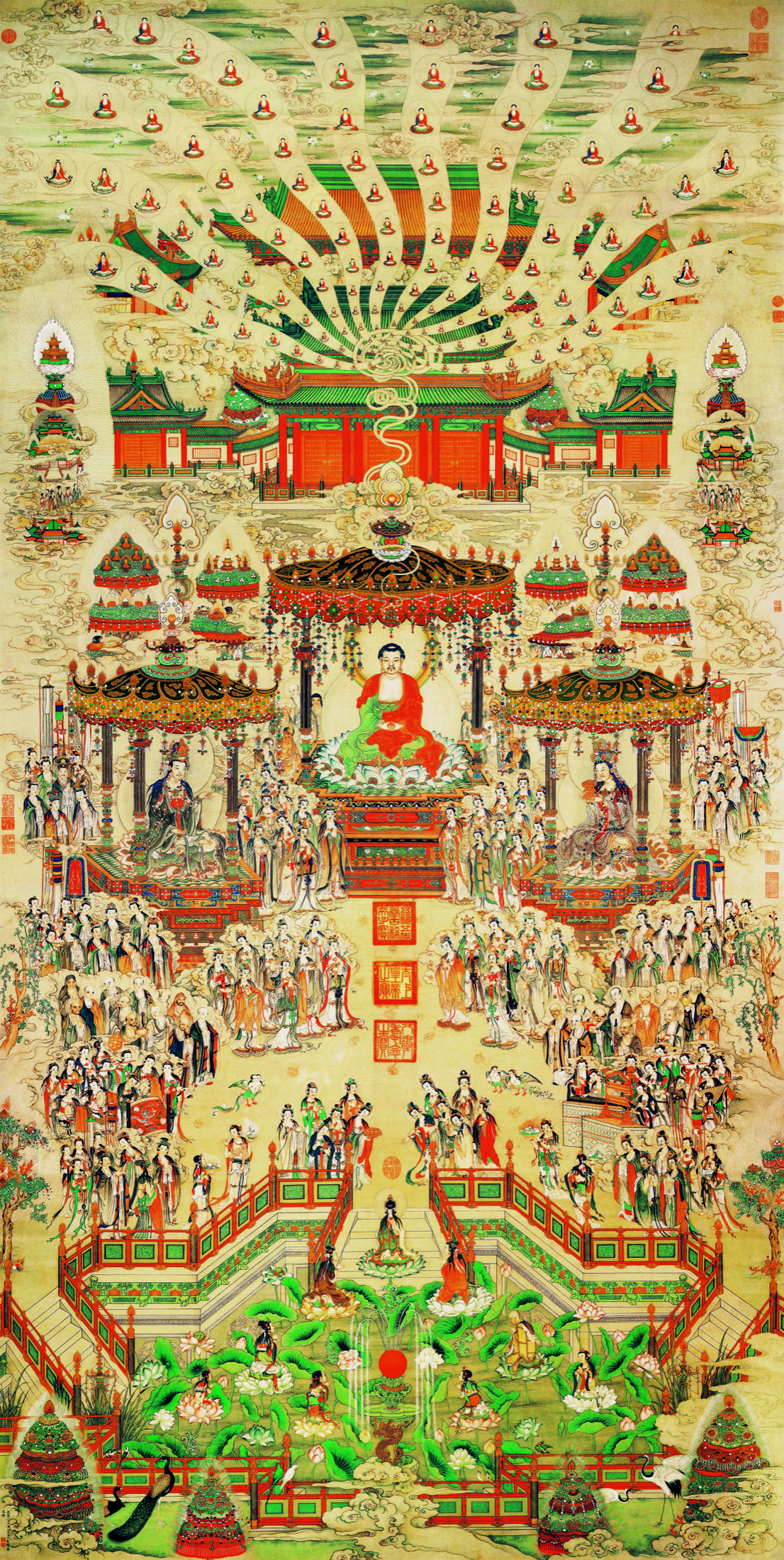
Quick answer: Ritual choreography in Pure Land art is the visual organization of approach, offering, attention, and assembly. TK0191 uses facing directions, paired groups, terraces, canopies, lotus births, and processional paths to show many beings participating in Amitabha’s realm without requiring a single continuous narrative.
Ritual choreography in Pure Land art describes how a painting arranges bodies and actions so the viewer can recognize worship, welcome, offering, and communal presence. TK0191 is filled with figures, yet they do not behave like a random crowd. Some face the central Buddha, some carry or present objects, some gather under canopies, and others appear beside lotus blossoms, birds, clouds, or architectural thresholds.
The painting therefore rewards a question different from “Who is every person?” Instead ask: What is each group doing, where is it positioned, and how does its direction connect it to Amitabha? This approach is especially useful when small attributes are unclear. It lets visible movement and social organization remain meaningful without inventing names.
What is ritual choreography in a Buddhist painting?
Ritual choreography is the patterned arrangement of posture, gaze, gesture, procession, and offering. The word does not mean that TK0191 records one historical ceremony. It describes how the image makes collective devotion legible. Painted figures can appear seated, standing, approaching, presenting, receiving, listening, or witnessing, and their relationships create an implied sequence of action.
In TK0191, Amitabha sits at the stable center while other bodies turn, gather, and move around him. This contrast is important. The Buddha’s stillness provides the focus; the surrounding activity shows how a sacred community responds. Architecture then separates types of participation into terraces, pavilions, bridges, and lotus-filled zones.
How does the painting stage an approach to Amitabha?
The central approach begins in the lower lotus pond and continues through railings, stairs, open courts, and palace gates toward the enthroned Buddha. The path is not empty. Lotus-born figures, attendants, devotees, and offering groups occupy successive levels. Their placement turns the lower half of the composition into a series of arrivals.
The visual route is broader than one walkway. Groups at the left and right create parallel approaches, while the central zone repeatedly opens and narrows. Canopies mark pauses around important figures. Gates and railings define thresholds. Clouds soften the boundaries between one level and the next. The eye experiences a gradual inclusion in the assembly rather than an abrupt jump from ordinary space to the throne.
What role do offerings play?
Offerings make devotion visible by converting attention into action. TK0191 includes richly ornamented tables, floral arrangements, vessels, lamps, banners, and objects held or presented by attendants. Not every small item can be named from the web copy, but their placement is clear: gifts cluster near important figures and along routes of approach.
An offering does more than decorate sacred space. It identifies a relationship between giver, recipient, and community. Figures who hold objects face inward or stand near a group’s leading edge. Large displays create visual pauses before the central throne. Repetition suggests abundance, while symmetry prevents the objects from overwhelming the Buddha.
Researchers should describe form before assigning a ritual term. “Round vessel on a raised table” is safer than a specific liturgical label when details are too small. This preserves evidence and makes later comparison possible.
How do paired groups create a sacred community?
Paired and mirrored groups make the assembly feel inclusive and ordered. The left and right sides contain ornamented figures, monastic-looking figures, attendants, and other devotees arranged in corresponding clusters. They are not exact duplicates. Differences in dress, age, posture, and objects give each cluster its own identity while maintaining balance.
This structure allows many social and religious roles to coexist. Some figures appear princely, others monastic, and others courtly or youthful. Those broad visual categories are observable, but they should not be converted into ethnic, historical, or biographical identities without textual evidence. The painting’s strongest claim is collective participation: different types of beings share orientation toward the sacred center.
Why are stillness and movement mixed?
Stillness marks contemplation and authority, while implied movement marks response. Amitabha remains seated and frontal. Flanking sacred figures are also relatively stable beneath canopies. Around them, standing bodies turn, hands extend, garments curve, and groups form diagonal or lateral rhythms.
The image does not use sequential panels like a modern comic. Instead, multiple phases of participation appear simultaneously. A lotus-born figure can indicate emergence; a standing attendant can indicate readiness; an offering bearer can indicate presentation; a seated group can indicate reception or listening. The viewer assembles these states into a devotional cycle.
How do gaze and body direction guide the viewer?
Gaze and body direction function like invisible arrows. Figures turned toward Amitabha reinforce the central focus even when they stand far to the side. Groups that face one another create local conversations, while figures at thresholds connect separate zones. The result is a network of attention.
At web scale, the pupils of many figures are too small to read. Use head angle, torso orientation, foot placement, hand gesture, and the direction of carried objects instead. When several clues point the same way, the group’s orientation becomes clearer. When they conflict, record the action as uncertain.
What do the lotus pond and birds contribute?
The lotus pond provides a setting for emergence, welcome, and sensory richness. Large leaves and blossoms fill the lower field, and small figures appear on or near lotus supports. Peacocks, cranes, and other birds animate the boundary between garden, water, and sacred architecture.
How should you analyze the choreography step by step?
Use a repeatable sequence that prioritizes actions over guessed names.
- Locate Amitabha. Establish the stable center before reading surrounding activity.
- Trace approach routes. Follow pond, railings, stairs, courts, gates, and throne.
- Mark thresholds. Note where bridges, canopies, clouds, or architecture divide one type of participation from another.
- Group bodies by action. Separate seated, standing, approaching, presenting, and witnessing figures.
- Record orientation. Use head, torso, feet, hands, and objects to determine where attention flows.
- Describe offerings. Record visible shape, placement, and bearer before assigning a ritual name.
- Compare left and right. Identify mirrored roles as well as meaningful differences.
- Preserve uncertainty. Keep individual identities and historical attribution open when evidence is insufficient.
Which observations are secure?
Action-based analysis still needs confidence levels. Visible relationships are stronger than undocumented names.
| Observation | Evidence | Confidence |
|---|---|---|
| Collective orientation | Many bodies and groups turn toward the central Buddha | Directly visible |
| Offering activity | Vessels, flowers, lamps, tables, banners, and presented objects | Strong general reading |
| Specific ritual identities | Small attributes and grouped figures | Uncertain without inscriptions or texts |
| Ding Guanpeng and Qing attribution | Archive filename and visible seals | Unverified historical claim |
How should the archive attribution be handled?
The English title should be preserved because it records the archive’s inherited claim. It should not be converted into verified authorship. Matching the image to a documented object would require dimensions, medium, inscriptions, seals, crop, mounting, condition, collection history, and the exact wording used by a traceable source.
Frequently asked questions
Does TK0191 depict one historical ceremony?
Not necessarily. The image combines many forms of approach, offering, welcome, and assembly in a sacred realm. “Ritual choreography” describes their visual organization, not a claim that the painting documents one dated event.
Can every offering object be named?
No. Small objects should first be described by shape, color, position, and bearer. A precise liturgical name requires enough visual detail or a reliable text, inscription, or catalogue record.
Why analyze groups before individuals?
Group posture and orientation remain visible even when tiny attributes are unclear. This produces useful evidence without turning clothing, facial appearance, or proximity into unsupported personal identities.
Does the English title prove Ding Guanpeng painted TK0191?
No. The title preserves an attribution claim, but verification requires a traceable record matching the same object through dimensions, medium, seals, inscriptions, mount, condition, and provenance.
Conclusion
TK0191 presents Pure Land as a community in action. Amitabha’s stillness anchors processions, offering groups, lotus-born figures, attendants, birds, and mirrored assemblies. By following body direction, thresholds, carried objects, and patterns of gathering, viewers can understand how the painting stages devotion without guessing every name. The method respects both the richness of the image and the limits of its undocumented historical metadata.
Sources and editorial method
This article is based on direct visual analysis of the TANGKAWORLD TK0191 image. It distinguishes visible action, religious identification, compositional interpretation, and uncertain historical attribution. The source filename is preserved as a research lead, not treated as a verified museum record. For a broader method and linked institutional references, consult How to Read a Thangka: A Beginner’s Guide and the TANGKAWORLD Learn center.
Prepared and reviewed by the TANGKAWORLD editorial team. Last reviewed: August 6, 2026.

