What Can a 700-Pixel Buddhist Image Prove? TK1234
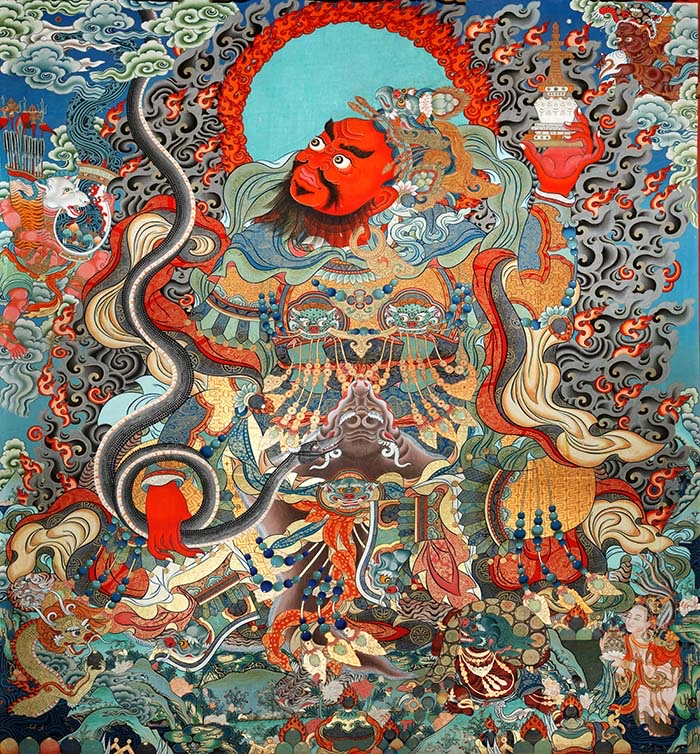
Quick answer: A 700-pixel Buddhist image can support broad observations about composition, color, pose, major attributes, and relationships between digital variants. It usually cannot support tiny inscription readings, precise object identification, material diagnosis, attribution, or provenance. TK1234 should therefore guide research questions, not settle its inherited Maitreya and mural labels.
Image resolution changes what a researcher can responsibly claim. A small file may preserve an entire composition clearly enough to map its visual hierarchy, yet remove the minute evidence needed to identify a deity, read an inscription, distinguish paint from a photographic artifact, or connect the picture to a historical object.
TK1234 is a useful case because it is not merely a generic thumbnail. It is a complete 700 × 754 pixel view of the same elaborate composition preserved at much higher resolution in TK0548. That relationship lets us ask a practical question: how does image resolution affect Buddhist art identification, and where should confidence stop?
What is clearly visible in TK1234?
At 700 pixels wide, the main visual structure remains legible. A monumental red-faced figure dominates the center. The figure has bulging eyes, dark facial hair, an elaborate headdress, richly patterned garments, and a raised hand supporting a multi-tiered stupa- or pagoda-like object. A large dark serpent crosses the body, while another serpentine form rises along the right.
Flames and black-gray smoke create a forceful background. Animal- or hybrid-headed forms, weapons, attendants, small human figures, vessels, and round offerings crowd the lower and side registers. These visible features justify describing the image as a complex wrathful or protective Buddhist composition.
They do not securely identify the central figure. The archive title says Maitreya — Mural, but the unusual combination of a wrathful red face, large hand-held stupa, serpents, fire, smoke, armor-like clothing, and guardian-like retinue does not straightforwardly match common peaceful Maitreya forms. The name remains supplied metadata rather than a verified conclusion.
Why does 700 × 754 count as limited research resolution?
Resolution is limited when the pixels available for a detail are too few to distinguish meaningful form from compression, sharpening, or interpolation. TK1234 contains 527,800 pixels in total, but most individual faces, implements, ornaments, and possible inscriptions occupy only a small fraction of that area.
The whole figure can be recognized, yet a tiny object may be represented by a few colored blocks. Enlarging the file makes those blocks bigger; it does not restore missing brushwork. This is why a large on-screen display is not the same as a high-resolution source. The related TANGKAWORLD guide on studying thangka iconography with high-resolution images explains how detail availability changes the research task.
Which observations remain reliable at low resolution?
Broad, repeated, and high-contrast features are the strongest evidence. In TK1234, the central red face, the raised architectural object, the looping serpents, the flame-and-smoke field, and the general distribution of attendants remain clear. Their shapes occupy enough pixels to survive resizing.
Low resolution can also support composition-level comparison. Researchers can align the central face, stupa, serpent paths, garment edges, lower offering groups, and surrounding figures across files. Matching many independent landmarks is more persuasive than matching a single red face or one attribute.
| Research question | What TK1234 supports | Required caution |
|---|---|---|
| Overall composition | Strong: central figure, retinue, flames, smoke, serpents | Describe structure without naming every figure |
| Major attributes | Moderate: raised stupa-like form and weapons | Use shape-based wording when function is uncertain |
| Small faces and objects | Weak: color and approximate position | Do not force names from enlarged pixels |
| Medium and condition | Insufficient: no wall context or material detail | Keep “mural” and physical support uncertain |
| Historical attribution | None: no traceable object record | Do not assert date, artist, site, or collection |
What claims become unsafe when pixels are scarce?
Tiny attributes become unsafe first. A vessel, jewel, weapon, flower, miniature figure, or animal head may lose the contour that separates it from a look-alike. Finger positions can become impossible to read, so a specific mudra should not be assigned from a hand-shaped patch. Fine inscriptions, seal characters, and textile motifs are even more vulnerable.
Material judgments are also weak. A 700-pixel JPEG cannot reliably establish whether the photographed support is wall plaster, cloth, paper, a painted panel, a print, or a reproduction. It cannot show enough weave, fibers, pigment loss, joins, craquelure, or architectural context. Camera metadata describes the photograph, not the photographed object.
Compression can create false edges around high-contrast lines and smooth subtle tonal transitions. Repeated saving can also alter color. The TANGKAWORLD JPG versus TIF guide provides a broader framework for separating convenient access files from preservation-oriented masters.
How does TK1234 relate to TK0548?
TK1234 and TK0548 show the same composition, but they are different digital files. TK0548 measures 8000 × 8616 pixels, while TK1234 measures 700 × 754. After resizing the larger image to the smaller dimensions, an RGB pixel comparison produced a correlation of approximately 0.9695. The width scale is exactly 0.0875, and the height scale is nearly identical.
This is strong evidence of a shared image lineage or common source, especially when combined with matching figure placement, serpent paths, flames, offerings, and crop. It does not prove which file was made first, whether both came from an earlier master, or whether color and sharpening were changed during export. Correlation establishes similarity, not provenance.
The earlier TK0548 study focused on auditing a doubtful Maitreya label. TK1234 serves a separate purpose: deciding which observations survive a drastic reduction in pixels. The two records should remain linked without being collapsed into one filename or treated as two independent witnesses for the same religious identification.
How should researchers audit a low-resolution Buddhist image?
A resolution-aware audit separates accessible evidence from missing evidence.
- Preserve the source. Record the exact filename, TK number, dimensions, file size, timestamps, color space, and checksum without altering the file.
- Describe the full composition. Note dominant colors, central posture, major objects, attendants, landscape, flames, clouds, and offering zones before zooming.
- Measure important details. Check how many source pixels actually describe a hand, face, inscription, seal, or ritual object.
- Use confidence language. Separate clear forms, probable categories, unresolved details, and unsupported historical claims.
- Search for archive variants. Compare crop, landmarks, color, damage, and dimensions rather than relying on titles alone.
- Quantify similarity carefully. Use aligned dimensions and multiple metrics, then state that similarity does not prove direction of copying.
- Prefer the best file for detail work. Keep the smaller copy for access history, but consult the larger version before naming tiny attributes.
- Publish the limitation. Tell readers when resolution prevents a secure deity, medium, inscription, artist, date, collection, or provenance claim.
What should the catalogue record say?
A useful public description is: “Low-resolution complete view of a red-faced wrathful Buddhist figure holding a stupa-like object, crossed by serpents and surrounded by flames, smoke, weapons, attendants, animal-headed forms, and offerings. Archive title identifies Maitreya and a mural format; subject and support remain uncertain. Same composition as TK0548.”
This wording preserves the inherited title, names the visible evidence, identifies the digital relationship, and states the limitation. It is more informative than “thumbnail” and safer than presenting an uncertain deity or medium as fact. For a general observation-first method, consult How to Read a Thangka.
Frequently asked questions
Can enlarging TK1234 reveal missing iconographic details?
No. Enlargement can make existing pixels easier to inspect, but it cannot recreate reliable brushwork, inscriptions, or contours that were not captured. AI upscaling may help presentation, not primary evidence.
Does the 0.9695 correlation prove TK1234 was copied from TK0548?
No. It strongly supports a shared composition and related digital lineage. It does not establish the direction of copying or exclude an earlier common master.
Is TK1234 enough to identify the figure as Maitreya?
No. The filename supplies that label, but the visible wrathful form conflicts with common peaceful Maitreya imagery. Identification remains uncertain even when the higher-resolution variant is consulted.
Should a low-resolution duplicate be deleted from an archive?
Not automatically. It may preserve a distinct crop, color state, compression history, filename, timestamp, or circulation path. Keep it when the source policy permits, link it to related files, and state its research limits.
Conclusion
TK1234 shows that low resolution does not make an image useless; it changes the questions the image can answer. The file supports a clear composition-level description and a strong relationship to TK0548. It does not support tiny attribute readings, material diagnosis, or historical attribution. A responsible record preserves the variant, documents the pixel limit, and keeps Maitreya, mural support, date, artist, collection, and provenance uncertain.
Sources and editorial method
This article is based on direct visual analysis of the complete TANGKAWORLD TK1234 image and a dimension-normalized pixel comparison with TK0548. Visible evidence, digital-file measurements, religious identification, and uncertain historical attribution are treated as separate layers. Related editorial guidance includes the high-resolution iconography study guide, the JPG versus TIF guide, the Maitreya visual guide, and the TANGKAWORLD Learn center.
Prepared and reviewed by the TANGKAWORLD editorial team. Last reviewed: August 18, 2026.

