What Does a Canopy Mean in Buddhist Painting? Reading TK0257
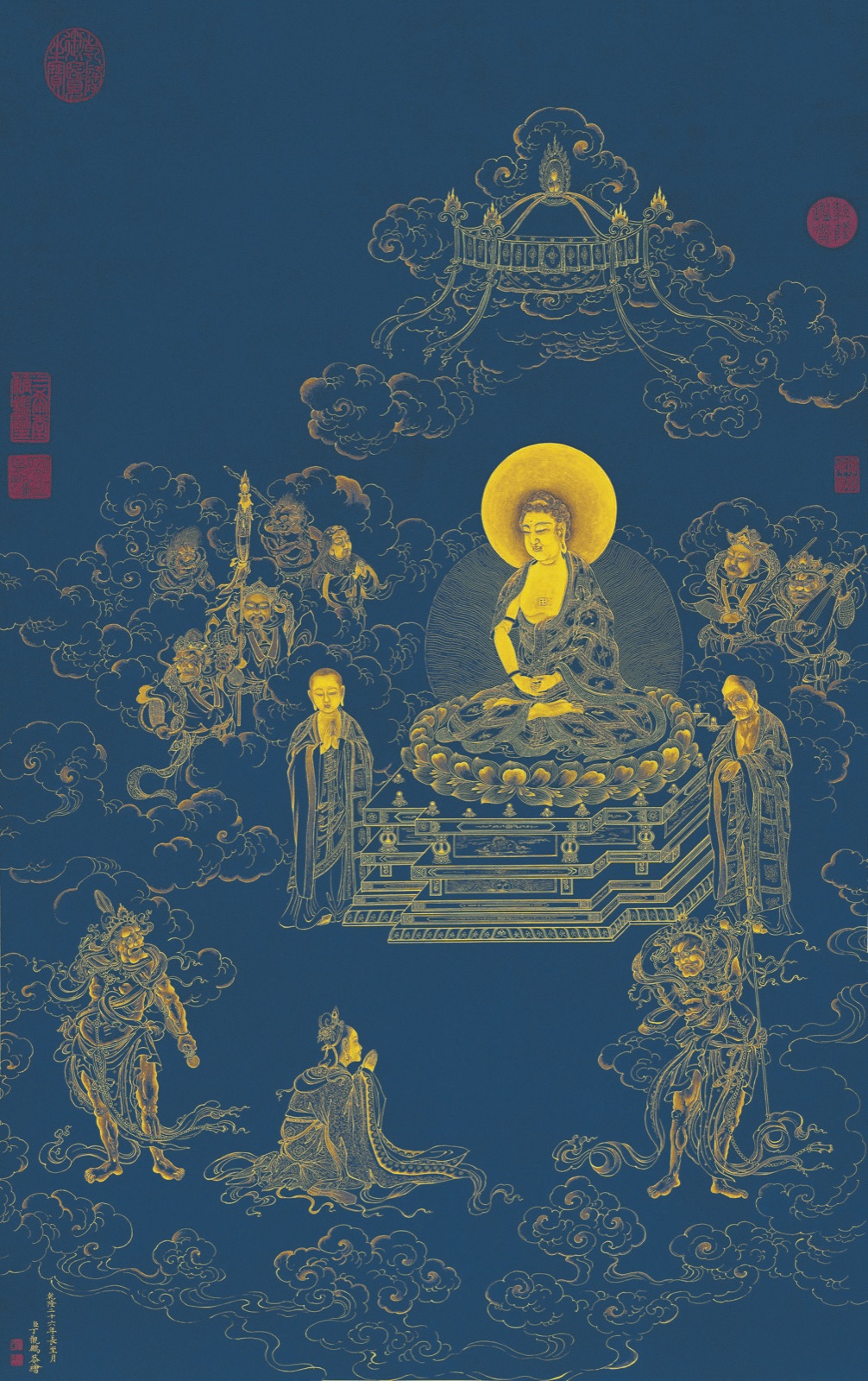
Quick answer: In Buddhist painting, a ceremonial canopy can mark honor, protection, and the sacred center of a composition. In TK0257, the canopy crowns the central Amitayus figure and completes a vertical path from kneeling devotee to throne to Buddha. Its form supports hierarchy, but does not prove identity, date, artist, or provenance.
A canopy in Buddhist painting is easy to treat as background decoration. In TK0257, however, it is one of the clearest tools of visual organization. The ornate form floats above the central seated figure, separates that figure from the upper field, and answers the throne below. It makes the sacred center legible before a viewer has read an inscription or identified an attribute.
What can the canopy itself tell us? The answer comes from direct visual evidence—shape, position, scale, alignment, and relationships within the image. The archive title identifies the central figure as Amitayus. Claims in the filename about date, artist, and collection remain uncertain research leads.
What kind of canopy is visible in TK0257?
TK0257 shows a roof-like ceremonial canopy centered above the Buddha. Its rounded upper structure, hanging rectangular valance, curling ribbons, corner ornaments, and jewel- or flame-like details create a compact architectural silhouette. Clouds surround and partly support the form, so it appears suspended in sacred space rather than fixed to an ordinary building.
The safest descriptive term is “ceremonial canopy.” “Baldachin-like” may help an English-speaking reader imagine an honorific covering above a throne, but it is a comparative word, not a verified historical label for this object. The canopy is also more elaborate than a simple umbrella shape. Its exact ritual name, material, and historical model remain uncertain.
Why is the canopy placed directly above the Buddha?
The canopy marks the figure below as the compositional focus. Its width echoes the throne zone, while its center aligns with the Buddha’s head and body. That alignment creates an unmistakable hierarchy: surrounding figures turn inward, but the canopy belongs to the central axis alone.
Honorific coverings occur in many courtly and religious settings, yet a painted canopy should first be read through its function inside the picture. Here it reserves visual space, frames the halo, and distinguishes the Buddha from attendants and guardians. It also creates a pause between the central figure and the smaller forms above. The result is not empty background; it is controlled separation.
The canopy may suggest honor and protection, but those concepts should not be stretched into a precise doctrinal claim without supporting text or a secure object record. Composition tells us how the image directs attention. It does not, by itself, identify a ceremony, commission, lineage, or liturgical use.
How does the canopy complete the painting’s vertical axis?
The canopy completes a visual path that begins near the bottom of TK0257. A richly dressed human figure kneels below the sacred assembly. Above that devotee stand guardian-like figures and the stepped throne. The lotus supports the seated Buddha, the halo concentrates attention around the upper body, and the canopy closes the sequence overhead.
This rising path can be read as devotee, threshold, throne, Buddha, and canopy. It helps the eye travel upward without requiring a literal narrative. The lower figure’s gesture directs devotion toward the center, while the canopy confirms where that attention culminates. The throne and canopy therefore operate as a pair: one elevates from below; the other honors from above.
Horizontal relationships reinforce the same structure. Two monastic-looking attendants flank the central seat, and guardian-like figures occupy the clouded sides. Their near-symmetry stabilizes the composition. Because the canopy is narrower and higher than the widest lower groups, the entire assembly gathers toward a single summit.
Is this a parasol, a baldachin, or a palace roof?
The visible evidence favors a suspended ceremonial canopy, although related forms can overlap. A practical comparison helps prevent a familiar English label from becoming a false identification.
| Possible form | Typical visual clue | Reading TK0257 |
|---|---|---|
| Parasol or umbrella | A radiating circular cover, often organized around a central shaft | The painted form appears more roof-like and enclosed; no clear shaft is visible |
| Ceremonial canopy | An honorific cover with a valance, ribbons, ornaments, or suspended presentation | This best fits the aligned, ornamented, cloud-borne structure |
| Baldachin-like structure | A canopy framing a throne or sacred figure | Useful as a visual comparison, but not verified historical terminology |
| Palace roof | A fixed architectural roof connected to walls, columns, or a building | No complete building surrounds the central figure, so this reading is less secure |
These categories are descriptive, not absolute. Artists can combine textile, architectural, and ritual forms. Damage, cropping, line density, or a digital reproduction may also hide supports. For TK0257, “ceremonial canopy” communicates what can be seen while leaving the exact design history open.
What do the clouds, ribbons, and ornaments contribute?
The surrounding details make the canopy feel active rather than mechanically fixed. Long ribbons curve away from its sides, clouds soften the boundary between object and atmosphere, and bright ornamental points punctuate the upper silhouette. These movements counterbalance the still, frontal seated figure below.
The contrast is important. Amitayus appears calm and stable; the canopy’s ribbons and clouds describe a more mobile environment. The eye senses ceremonial presence without needing to assume that every flame-like or jewel-like shape has one specific meaning. At the current web scale, several small upper details are not clear enough for confident iconographic naming.
Color also needs restraint. The file currently displays a saturated blue field, yellow-gold lines, and magenta-red seals. Those are valid descriptions of the digital image, not proof of original pigments or materials. The canopy’s role can be studied through structure even when the source file’s color history is uncertain.
Can the canopy identify Amitayus by itself?
No. A canopy signals status and centrality, but it is not an exclusive attribute of Amitayus. Identification should combine the archive title with posture, hand position, throne, halo, surrounding figures, inscriptions, and any legible attribute. In TK0257, both hands rest near the lap in a meditative position, but the small central object is not clear enough at web scale to describe with certainty.
The archive title “Amitayus Buddha” is retained because it provides useful catalog context. The painted canopy strengthens the reading of an exalted peaceful Buddha, yet it cannot independently distinguish Amitayus from every other enthroned Buddhist figure. It certainly cannot verify the Qing-period date, Ding Guanpeng attribution, Beijing collection, or provenance embedded in the filename.
For a broader observation-first method, see the TANGKAWORLD guide to reading a Thangka. The high-resolution image study guide explains how to examine small attributes, inscriptions, seals, and variant files without overstating what a reproduction proves.
A practical checklist for reading canopies in Buddhist art
Use the canopy as relational evidence rather than an isolated symbol:
- Describe the shape first. Note whether it is circular, roof-like, textile-like, architectural, fringed, ribboned, or supported.
- Find its centerline. Check which head, halo, throne, or group lies directly beneath it.
- Compare its scale. Ask whether it covers one figure, a pair, an entire assembly, or a palace setting.
- Trace the vertical axis. Follow the path from the lower register through the throne and central body to the canopy.
- Separate canopy from parasol. Look for a shaft, radiating umbrella form, valance, roof frame, ribbons, or architectural supports.
- Inspect clouds and cropping. They may conceal attachments or make a fixed structure appear suspended.
- Test the identification elsewhere. Use attributes, inscriptions, seals, and reliable records; never make the canopy carry the whole attribution.
Frequently asked questions
Does every Buddha in a painting have a canopy?
No. A canopy is one way to establish rank or sacred focus. Halos, thrones, scale, placement, attendants, and gestures can organize the same hierarchy without one.
Does a canopy always symbolize protection?
Protection is a reasonable broad association, but context matters. In TK0257, honor, centrality, and ceremonial framing are more directly visible than a specific protective doctrine.
Is the canopy in TK0257 part of a palace?
The image does not show a complete building around it. Because the structure is surrounded by clouds and aligned independently above the throne, a suspended ceremonial canopy is the more cautious reading.
Can the canopy confirm the painting’s date or artist?
No. Design may eventually help comparison, but a secure attribution requires stronger evidence such as a verified catalogue record, inscription analysis, seals, materials, provenance, and close study of the object.
Conclusion
In TK0257, the ceremonial canopy is a structural key. It marks the central Amitayus figure, balances the throne, gathers the assembly toward a vertical summit, and separates sacred focus from the surrounding field. Reading its visible form carefully adds meaning without converting resemblance into certainty. The canopy can explain hierarchy; it cannot alone prove identity, date, artist, collection, pigment, or provenance.
Sources and editorial method
This article is based on direct visual analysis of TANGKAWORLD image TK0257. It distinguishes observable composition—the roof-like canopy, valance, ribbons, clouds, alignment, figures, throne, seals, and inscription—from religious identification and uncertain historical attribution. The English archive title is retained, while the filename’s Qing date, Ding Guanpeng attribution, Beijing collection, materials, and provenance remain unverified. Related methods are available in the TANGKAWORLD Learn center.
Prepared and reviewed by the TANGKAWORLD editorial team
Last reviewed: August 13, 2026.

