Why Do Thangka Borders Matter? A Documentation Guide to TK1144
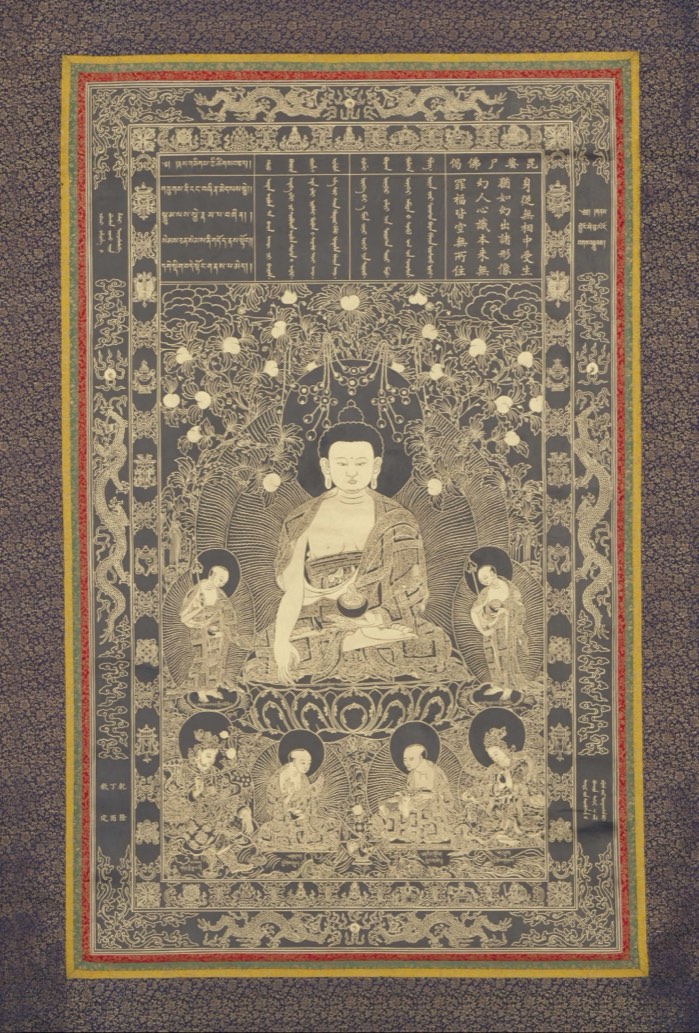
Quick answer: Thangka borders matter because they preserve evidence about orientation, completeness, text placement, repeated motifs, mounting, and digital cropping. In TK1144, the patterned surround, colored bands, dragon panels, auspicious emblems, and side inscriptions form distinct documentation zones. They should be recorded separately before any symbolic or historical interpretation is proposed.
Thangka border documentation begins with a simple rule: the frame is part of the evidence, not empty space around the sacred figure. TK1144 centers a seated Buddha beneath a flowering canopy, flanked by two standing attendants and four lower haloed figures. Yet much of the file’s research value lies outside that central assembly.
The image retains a broad dark patterned surround, narrow yellow, green, and red bands, pale line borders, dragons, cloud forms, auspicious motifs, side text, and an upper multiscript panel. These zones help a researcher describe what the digital file includes, compare related images, and detect later crops. They do not automatically reveal date, workshop, ownership, or religious meaning.
Why should a thangka border be documented before it is interpreted?
A border should be documented first because observation can be repeated, while interpretation depends on context that may be missing. A researcher can record that TK1144 shows paired dragons above and below, vertical motif bands at both sides, narrow colored strips, and a patterned outer field. Naming the function or history of those elements requires stronger evidence.
Which border zones are visible in TK1144?
At least six border-related zones can be distinguished in the current photograph. The boundaries are visual rather than material claims; a digital image cannot prove how every band was constructed on the physical object.
| Zone | Visible evidence | Documentation value |
|---|---|---|
| Outer patterned field | Dark blue or purple surface filled with small repeating gold-like forms | Records the full photographed surround and reveals later cropping |
| Colored bands | Narrow yellow, green, and red strips around the image | Helps describe sequence, width, continuity, and edge loss |
| Dragon frame | Paired dragons across the top and bottom with additional dragons at the sides | Provides orientation and strong landmarks for file comparison |
| Auspicious-motif bands | Repeated emblems, vessels, knots, wheels, lotuses, and related forms | Supports motif inventory without forcing unverified names |
| Side information fields | Small vertical text blocks and repeated ornamental units | Preserves possible labels, production notes, or ritual text for transcription |
| Inner picture boundary | Fine lines enclosing the upper text panel and central assembly | Separates informational, devotional, and framing spaces |
How do borders reveal whether a digital image is complete?
Borders reveal completeness by supplying a sequence of expected edges and corners. In TK1144, all four sides of the patterned surround are visible, followed inward by colored strips and the linework frame. The paired top and bottom dragon panels are present, and both vertical sides retain text and motif units.
This does not prove that the photograph captures every part of an original mounting. Fabric may extend beyond the frame, reverse inscriptions may exist, or earlier remounting may have changed the object. It does show that this file preserves more peripheral information than a crop ending at the central lotus or inner line boundary.
When comparing files, researchers should avoid the vague labels “full” and “cropped.” Instead, specify the outermost surviving zone: patterned surround, colored band, dragon frame, inner border, text panel, or image field. That vocabulary makes comparisons testable.
What can the patterned surround tell us?
The patterned surround can tell us how the image was photographed or reproduced, but not necessarily what the physical support is. TK1144 shows a dense repeating design around the central rectangular composition. The surface may represent textile, a reproduced textile pattern, or another decorated layer; material confirmation would require examination beyond this JPEG.
Document its color, repeating unit, orientation, visible seams, interruptions, and relation to the colored bands. Do not infer age from fading or assign a textile type from screen appearance alone. Compression, color correction, lighting, and resampling can alter both texture and tone.
The TANGKAWORLD thangka condition report checklist provides a broader method for separating visible condition from unsupported material conclusions.
How should dragons and auspicious motifs be recorded?
Dragons and auspicious motifs should be recorded by position, direction, count, and visible form before symbolic meaning is assigned. TK1144 has paired dragons facing the center in the horizontal top and bottom panels. Additional elongated dragons occupy both vertical sides. Smaller units include vessel-like, knot-like, wheel-like, lotus-like, and canopy-like forms.
A useful inventory gives each unit a location code: top-left, top-center, top-right, right-upper, right-lower, bottom-right, and so forth. If a motif cannot be named confidently, use a neutral description and attach a crop. This is more useful than choosing a famous Buddhist symbol merely because the outline is similar.
Repeated units can also expose digital alteration. A missing segment, reversed motif, stretched corner, or abrupt change in line thickness may indicate cropping, stitching, repair, or image processing. Such observations are leads, not final diagnoses.
Why do side inscriptions belong in the border record?
Side inscriptions belong in the border record because they occupy structural positions outside the central narrative field. TK1144 shows small vertical text groups on both sides, while the upper panel contains Tibetan, Chinese, and additional vertical-script columns. The exact languages and readings of all columns are not confirmed here.
Record each text zone independently with its orientation, line count, relation to nearby motifs, and image coordinates. Transcribe before translating, preserve unclear characters, and do not force the text to confirm the filename. A border inscription may name a figure, quote a verse, label a motif, record a donor, or serve another purpose.
A seven-step thangka border documentation workflow
Use this workflow before making symbolic, material, or historical claims.
- Preserve the source. Record the original filename, TK number, dimensions, checksum, and folder position without editing the file.
- Mark the outermost visible edge. State whether the file retains surrounding fabric, colored bands, line borders, or only the picture field.
- Number the zones from outside inward. Keep patterned surround, colored bands, dragon panels, motif bands, side texts, and inner boundary separate.
- Photograph or crop each corner consistently. Corners reveal how horizontal and vertical systems meet and whether details have been lost.
- Inventory motifs neutrally. Record position, direction, repetition, and damage before assigning names or meanings.
- Map every text block. Give each inscription its own identifier, crop, reading direction, transcription status, and reviewer.
- State confidence and limits. Separate visible evidence, proposed religious identification, material interpretation, and historical attribution.
The high-resolution thangka study guide explains how to create research crops without confusing greater pixel detail with greater historical certainty.
What should remain uncertain about TK1144?
The filename associates TK1144 with the Seven Buddhas of the Past and Vipaśyin Buddha, but the current visual review does not independently confirm that individual identity. The central Buddha’s lowered proper right hand, monastic robe, lotus throne, halo, and bowl-shaped form are important observations, yet they are not uniquely diagnostic.
The names of the attendants and lower figures, the exact transcription and translation, and the function of each border text remain uncertain. So do the physical medium, date, artist, workshop, school, patron, collection, and provenance. The pale linework may represent more than one possible technique; a photograph alone cannot settle the material question.
Frequently asked questions
Is a decorative border part of thangka iconography?
It can contribute to visual meaning and sacred presentation, but not every band has a securely known iconographic function. First record its position, motifs, text, and relation to the image; interpret it only with relevant textual, comparative, or material evidence.
Should a web image crop away the outer textile?
Not for the only archival copy. A display crop may help readers inspect the central figure, but the complete source and a full-frame derivative should remain available so borders, inscriptions, mount-related evidence, and crop history are not lost.
Can border motifs identify the date or workshop?
They can support comparison with documented works, especially when construction, materials, inscriptions, and provenance also align. Motif resemblance alone is not enough because designs can be copied, revived, replaced during remounting, or altered in reproduction.
Does the TK1144 filename prove Vipaśyin Buddha?
No. The filename preserves useful archive metadata, but confirmation requires an independent transcription, verified series order, distinctive iconographic evidence, or a reliable catalogue record tied to this exact image.
Conclusion
TK1144 shows why borders deserve their own documentation layer. The patterned surround, colored bands, dragons, auspicious units, side texts, and inner boundaries preserve evidence about orientation, completeness, comparison, and cropping. Recording these zones before interpretation protects both the sacred image and the research record from avoidable loss.
Sources and editorial method
This article is based on direct visual analysis of TANGKAWORLD TK1144 and a limited comparison with its lower-resolution archive counterpart TK1143. Visible borders, text zones, figures, motifs, colors, and file structure are separated from religious naming, material identification, and uncertain historical attribution. The Vipaśyin Buddha title is retained as archive metadata rather than treated as independently verified fact. Related TANGKAWORLD guides provide their own Sources and further reading sections.
Prepared and reviewed by the TANGKAWORLD editorial team.
Last reviewed: August 28, 2026.
Explore more Thangka art at TANGKAWORLD. Visit the TANGKAWORLD home page, continue with the Thangka learning center, or download the complete Thangka image collection.

