How a Central Axis Organizes a Buddhist Assembly: TK1149
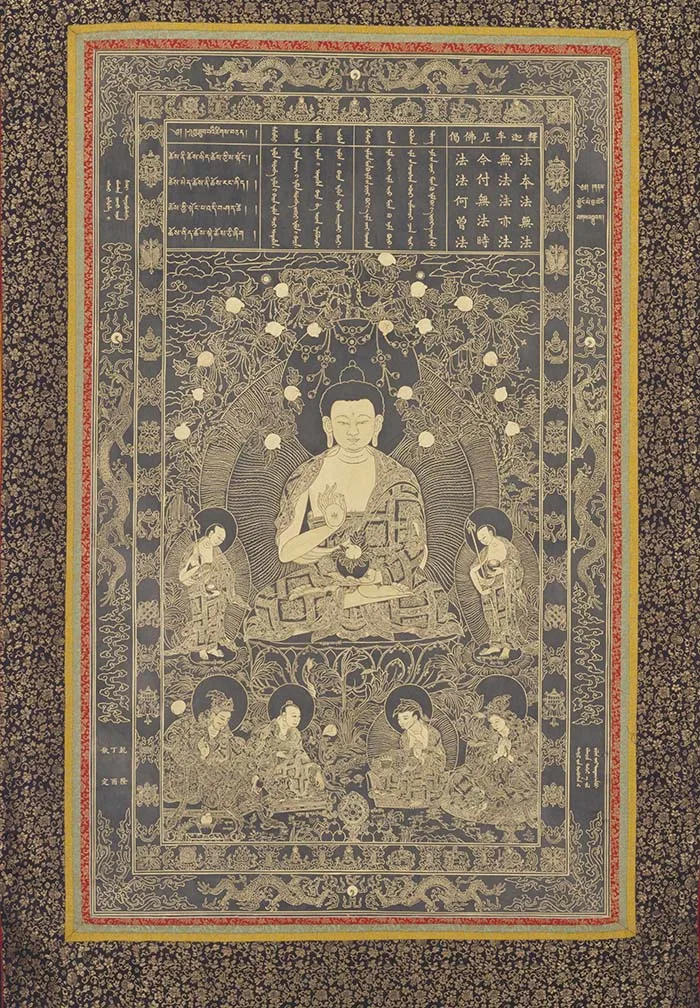
Quick answer: A central axis organizes Buddhist art by aligning major visual anchors from top to bottom. In TK1149, the text panel, canopy opening, Buddha’s head and torso, lotus seat, and lower central objects form a vertical route. Nearby figures balance that route without becoming exact mirror copies.
Complex Buddhist images often appear symmetrical at first glance, yet symmetry is only one part of their structure. A viewer may instead follow an imagined line through the most important forms, even when the left and right sides differ.
TK1149 provides a clear case for studying the central axis in Buddhist art. Its dark ground carries pale and gold-colored lines. A large seated Buddha occupies the middle, two standing figures flank the body, four smaller haloed figures fill the lower register, and a rectangular multiscript panel spans the top.
What is a central axis in Buddhist composition?
A central axis is an inferred vertical line that connects the principal visual anchors of a composition. It is not necessarily a painted line, a fold, or a measured geometric center. Researchers reconstruct it by comparing repeated midpoints and the direction of attention through the image.
In TK1149, the strongest anchors are the centered text panel, the opening in the foliage above the main head, the Buddha’s face and torso, the lotus seat, and the cluster beneath the throne. These features encourage a top-to-bottom reading. The axis remains useful even if later research changes the names assigned to the figures.
Where does the vertical route begin in TK1149?
The vertical route begins in the upper text register, where a broad framed panel sits above the pictorial field. Multiple scripts appear in columns or grouped lines, but this article does not transcribe or translate them. The panel’s placement, rather than its unread content, is the relevant evidence.
Below the panel, foliage bends around an open central zone. A pale circular detail and branching forms move the eye toward the Buddha’s head. Ornament surrounds this narrowing without blocking it.
How does the main Buddha reinforce the axis?
The main Buddha reinforces the axis through frontal placement, scale, and stacked body landmarks. The head, neck, torso, crossed legs, and lotus support cluster around the same middle zone. A dark circular aureole behind the head and upper body strengthens this alignment by framing the pale central figure.
The raised hand introduces a local diagonal, while the other hand and a flower-like form sit lower across the lap. Those asymmetrical details keep the figure from becoming mechanically rigid. The important distinction is that the body supports the vertical route even though every limb does not lie on it.
Do the flanking figures create perfect symmetry?
No. The two standing figures create broad balance, but their poses, robe contours, hands, and surrounding details are not exact duplicates. They should be recorded as a paired arrangement rather than assumed to be mirrored copies.
Both figures stand close to the central aureole and incline toward the seated Buddha. Their smaller scale and inward orientation strengthen the center. Differences in head angle and outline create motion around that stable reference.
How does the lower register continue the central axis?
The lower register continues the axis by arranging four smaller haloed figures around a central cluster of objects and ornamental forms. The row is dense, but a middle interval beneath the lotus seat links it to the dominant figure above.
The left and right pairs do not need to be identical for the register to feel balanced. Their bodies face in varied directions, and their robes create different contours. The throne above acts as a horizontal hinge: it separates the principal Buddha from the lower assembly while the vertical axis visually connects both zones.
| Zone | Visible anchor | What it supports |
|---|---|---|
| Upper register | Centered multiscript panel | A clear starting point above the image |
| Canopy | Opening and pale detail over the head | A transition from text to figure |
| Main figure | Head, torso, crossed legs, and aureole | The dominant vertical sequence |
| Throne | Lotus centered beneath the body | A hinge between upper and lower figures |
| Lower register | Central interval and object cluster | Continuation through a denser assembly |
How can you map a central axis without overclaiming?
You can map the axis reproducibly by recording visible midpoints before interpreting religious meaning. The process should work even when the inscription, identities, and provenance remain unresolved.
- Mark the image bounds. Record the full pictorial rectangle separately from the textile or decorative outer frame.
- Estimate the geometric midpoint. Draw a temporary vertical guide on a derivative, never on the archival source.
- Locate independent anchors. Note the centers of the text panel, face, torso, throne, and lower cluster without forcing them onto one line.
- Measure departures. Record which anchors sit left or right of the guide and by approximately how much.
- Separate structure from detail. Treat hands, branches, robes, and attendants as local variations around the larger route.
- Test the full view. Reduce magnification and ask whether the proposed path still predicts the first and second places the eye rests.
- State confidence. Describe the axis as strong, probable, weak, or multiple, and retain alternative readings.
Is the visual axis the same as the geometric center?
No. The geometric center is calculated from the image rectangle, while the visual axis is inferred from weighted forms. Cropping, mounting, uneven borders, or a dominant hand gesture can shift visual attention even when the main body remains centered.
TK1149 appears broadly centered, but the raised hand, lap-level flower-like form, uneven branches, and differentiated lower figures pull attention sideways. A careful record therefore compares the calculated midpoint with the observed route. Agreement strengthens the result; a small disagreement may reveal purposeful emphasis rather than an error.
Can the central axis identify the Seven Buddhas?
No. Alignment explains composition, not identity. The archive title associates TK1149 with “Seven Buddhas of the Past and Shakyamuni Buddha,” and seven principal figures are clearly visible: one large seated figure, two standing figures, and four smaller figures below. That count does not by itself resolve how the title assigns names or whether every figure belongs to the stated group.
Reliable identification would require readable inscriptions, attributes, gestures, series context, and a traceable catalog or scholarly source. The TANGKAWORLD beginner’s guide to reading a thangka explains how those evidence types work together. Here, the axis remains a valid finding without converting a filename into a verified record.
What should remain uncertain in TK1149?
The exact identities of the central, standing, and lower figures remain uncertain, as do the complete readings of the visible scripts. The religious function of the raised hand and flower-like form should not be fixed from this web image alone.
The date, maker, materials, production technique, school, collection, provenance, and relationship between this digital file and any physical object are also uncertain. Directly visible evidence is firmer: a centered text panel, floral canopy, large seated Buddha, dark aureole, paired standing figures, four smaller lower figures, lotus seat, decorated borders, and a strong vertical route.
Frequently asked questions
Does every thangka have one central axis?
No. Some compositions have several centers, circular organization, diagonal movement, or deliberately offset focal points. The axis should be demonstrated from visible anchors rather than assumed from the rectangular format.
Should I use the outer textile edge to find the midpoint?
Use both the full file and the inner pictorial field, but record them separately. Mounting, borders, and photography may be uneven, so the midpoint of the outer rectangle may not match the center of the designed image.
Can an off-center object still support the axis?
Yes. A hand, flower, vessel, or branch can create a deliberate sideward accent while the head, torso, throne, and lower register maintain the primary route. Local asymmetry often makes a stable composition more dynamic.
How should an axis overlay be archived?
Save it as a clearly labeled derivative with the TK number, date, software, guide coordinates, and source checksum. Preserve the original image unchanged so later researchers can distinguish observed pixels from editorial markings.
Conclusion
TK1149 shows how a central axis can unify text, foliage, a dominant Buddha, a lotus throne, and a dense lower assembly. The axis does not require perfect bilateral symmetry, nor does it identify the figures. By mapping independent anchors, measuring deviations, and separating visible structure from religious and historical claims, researchers gain a precise method for describing complex Buddhist compositions.
Sources and editorial method
This article is based on direct visual analysis of the TANGKAWORLD TK1149 image. Visible alignment evidence, religious identification, and uncertain historical attribution are treated as separate levels. The method uses full-image review, independent midpoint marking, anchor comparison, deviation recording, and explicit confidence labels; the filename is not treated as a verified museum record. For a reusable workflow and further references, consult How to Study Thangka Iconography with High-Resolution Images and How to Read a Thangka: A Beginner’s Guide.
Prepared and reviewed by the TANGKAWORLD editorial team. Last reviewed: September 14, 2026.

