How Line of Sight Organizes a Buddhist Narrative Painting: TK0274
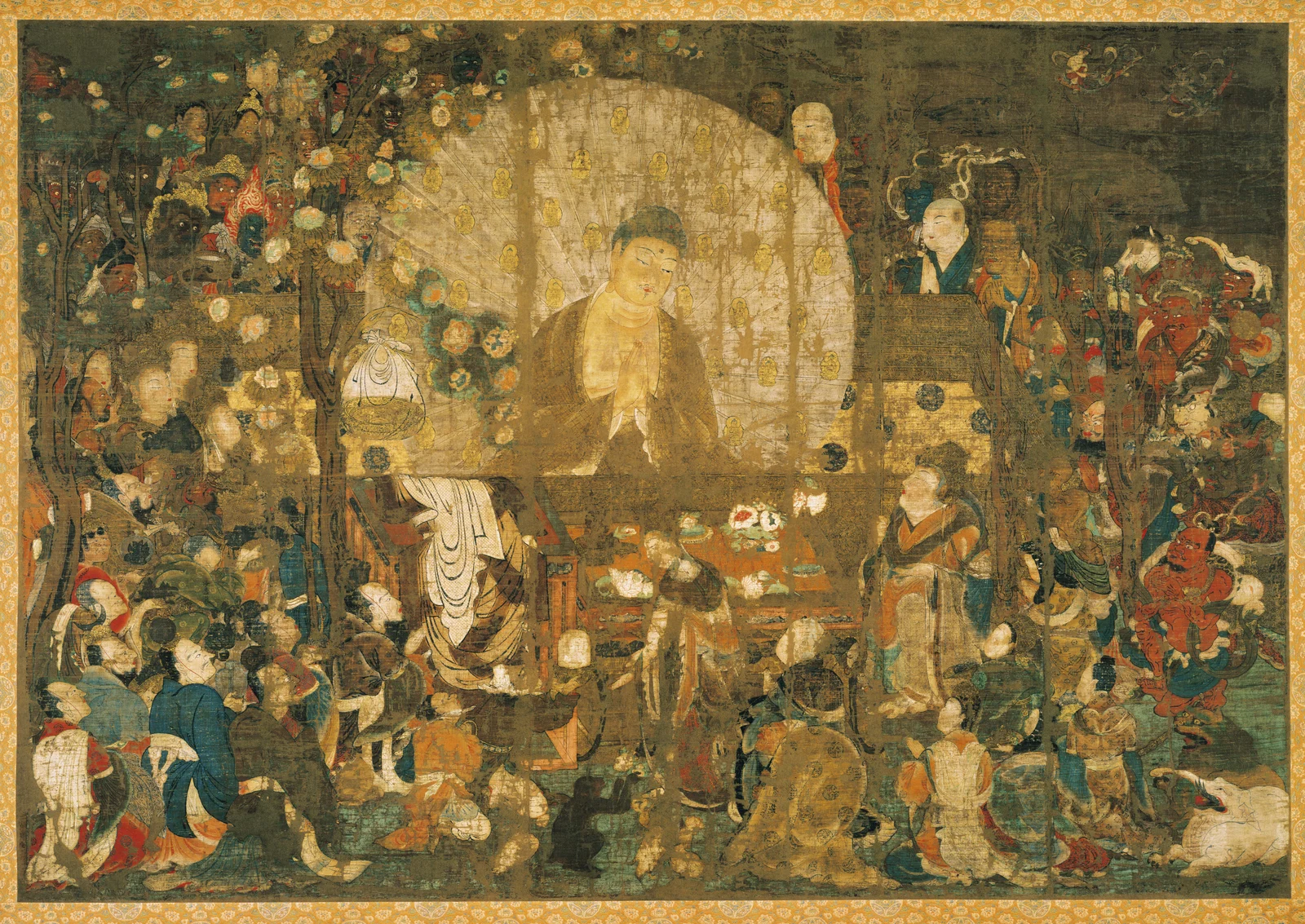
Quick answer: In TK0274, line of sight organizes a crowded Buddhist narrative by turning many separate faces and gestures toward the central Buddha-like figure. The large pale halo establishes the destination, while tilted heads, raised hands, kneeling bodies, guardians, and animals create converging paths that help viewers read attention before attempting uncertain identifications.
A crowded Buddhist painting can feel difficult because it presents many figures at once. TK0274 includes monks or attendants, richly dressed people, fierce guardian-like beings, animals, flowers, clouds, and small Buddha images. Yet the scene is not visually random. The direction of faces, hands, and bodies repeatedly returns attention to the luminous central figure.
This article studies that directional system rather than trying to name every participant. The archive filename calls the image “Shakyamuni Buddha” and associates it with Tokyo National Museum; its Chinese title suggests a scene of Shakyamuni emerging from a coffin. Those labels are useful research leads, not independently verified object data. Exact episode, date, maker, school, collection, and provenance therefore remain uncertain.
How does line of sight organize TK0274?
Line of sight organizes TK0274 by making the central Buddha-like figure the common destination of many local reactions. The figure occupies the middle of a broad horizontal field, backed by an unusually large pale halo. Small golden Buddha images appear across the halo, while rays or divisions extend outward. This luminous field is the most stable visual anchor in an otherwise dense scene.
Around it, heads turn inward from both sides. Some figures look upward, others angle their faces across the decorated platform, and several kneeling or seated bodies lean toward the center. These directions do not form one perfect geometric line. Instead, they create overlapping vectors. A viewer can enter through almost any surrounding cluster and still be led toward the same focal area.
Why does the central figure remain legible in such a crowded scene?
The central figure remains legible because stillness, brightness, and enclosure distinguish it from the surrounding activity. The pale face and body contrast with the darkened ground. The halo separates the head from the crowded background. A rectangular decorated structure below and beside the figure creates another boundary, while flowers and offerings mark the central zone.
Surrounding figures are more varied in posture, color, scale, and expression. Their differences create movement, but their orientation prevents that movement from dispersing. The central figure does not need to be vastly larger than every attendant. It is made dominant by the agreement of several signals: halo, position, tonal contrast, platform, offerings, and collective attention.
| Visible evidence | Directional role | Responsible conclusion |
|---|---|---|
| Large pale halo with small Buddha images | Creates the main visual destination | Supports sacred centrality; the exact doctrinal program is uncertain |
| Faces turned inward or upward | Connects side groups to the center | Shows shared attention without proving every figure's identity |
| Raised hands and leaning bodies | Extends gaze into visible gesture | Suggests response, reverence, grief, or surprise depending on the figure |
| Decorated platform or coffin-like structure | Forms a horizontal base beneath the central event | Fits the archive narrative lead but does not verify it alone |
| Guardians and animals at the edges | Broadens the field of witnesses | Shows a multi-being assembly; exact names remain uncertain |
How do gesture and posture extend the gaze?
Gesture and posture make attention visible even where eyes are too small or damaged to read. Palms pressed together, hands raised near the face, bowed heads, kneeling legs, and torsos inclined toward the center all indicate response. These bodily cues are especially valuable in a digital reproduction because fine pupils and facial lines may be unclear.
Not every response is identical. Calm attendants, grieving human figures, active guardians, and animals occupy different positions and use different bodies. A varied response field can make the central event feel consequential across social and cosmic categories. That is a compositional observation. Assigning each reaction a precise doctrinal meaning would require a reliable narrative source or object record.
How can you map line of sight in five steps?
A simple mapping method helps readers separate visible structure from interpretation:
- Locate the strongest anchor. In TK0274, begin with the central Buddha-like figure and the large pale halo, not with the busiest corner.
- Mark clearly turned faces. Record whether each readable head faces left, right, upward, downward, inward, or outward. Leave damaged faces unassigned.
- Add body direction. Note kneeling, bowing, leaning, and hand gestures. Body orientation can confirm or complicate facial direction.
- Group nearby vectors. Treat the lower-left mourners, upper-left guardians, right-side figures, and animals as clusters before naming individuals.
- State confidence levels. Distinguish direct observation, plausible narrative interpretation, and uncertain attribution in separate notes.
This method works well for narrative paintings because it explains how the viewer is guided without pretending that every small figure has already been identified. It also creates a repeatable record for comparing archive variants or higher-resolution images.
What do the side groups contribute to the narrative?
The side groups turn a central sacred event into a collective encounter. On the left, tightly packed heads, garments, guardian-like faces, flowers, and dark vertical forms build a dense wall of witnesses. On the right, standing and kneeling figures, fierce beings, and animals form another inward-facing sequence. Neither side is merely decorative.
The groups also control pacing. A viewer can pause over one cluster, follow its gaze toward the center, then move outward again to another response. This back-and-forth rhythm prevents the broad image from being read as a single frozen diagram. It functions more like a network of reactions organized around one event.
For comparison, the TANGKAWORLD guide to main icons and embedded scenes in Buddhist narrative painting explains how scale and placement separate central and subsidiary material. Here, the distinctive tool is directional attention: the side figures behave like visual pointers.
Does TK0274 depict the Buddha's Parinirvana?
The image is related to death-and-mourning imagery, but its precise episode should remain uncertain. A standard Parinirvana composition usually emphasizes the reclining Buddha. TK0274 instead shows an upright central Buddha-like figure associated with a decorated platform or coffin-like structure. The archive title's coffin-emergence claim may explain this difference, but it needs a matched institutional record.
Readers can compare the visual guide to the Buddha's Parinirvana in art for the reclining body, mourners, guardians, animals, trees, and celestial visitors commonly used to identify that broader narrative family. Similar surrounding witnesses do not automatically make two scenes identical.
How does condition affect the reading?
Surface darkening, abrasion, losses, and uneven contrast make some faces and objects difficult to distinguish. These changes can weaken or redirect apparent lines of sight. A dark patch may hide an eye; a lost contour may make a hand look detached; a faded garment may merge two bodies. Digital sharpening cannot safely restore information that is no longer visible.
The responsible approach is to record only clear directions and leave ambiguous areas unresolved. The archive file can support compositional study, but it cannot by itself establish the material support, restoration history, mounting history, or present condition of the physical work.
Frequently asked questions
What is line of sight in a Buddhist painting?
Line of sight is the implied direction created by a figure's eyes, face, body, or gesture. Multiple directions can guide the viewer toward a sacred center, connect separate groups, or clarify which event receives attention.
Can gaze direction identify every figure in TK0274?
No. Gaze explains compositional relationships, not personal identity. Names require attributes, inscriptions, narrative context, or reliable cataloguing. Damaged or tiny faces should be recorded as uncertain rather than forced into the map.
Why are animals included among the witnesses?
Animals extend the scene beyond human society and contribute additional bodies, faces, and directional cues. Their presence may carry narrative or religious meaning, but the safest first step is to describe species cautiously and record where each animal turns.
Does the filename prove that Tokyo National Museum owns this work?
No. The filename preserves that claim, but it is not a verified accession record. Confirmation would require matching the image to an official object page or scholarly catalogue through composition, dimensions, medium, inscriptions, and collection data.
Conclusion
TK0274 becomes readable when its many faces, gestures, and postures are treated as directional evidence. The halo establishes the destination, the decorated central structure provides a base, and groups of mourners, guardians, attendants, and animals repeatedly turn attention inward. This visual map is strong even while the exact episode and historical attribution remain open.
Sources and editorial method
This article is based on direct visual analysis of the TANGKAWORLD image TK0274. We separated visible evidence—central placement, halo, gaze, gesture, posture, platform, witnesses, animals, flowers, and surface condition—from religious identification and uncertain historical attribution. The archive filename was retained as a research lead, not treated as a verified museum record. For the general evidence-first method, see How to Read a Thangka.
Prepared and reviewed by the TANGKAWORLD editorial team.
Last reviewed: September 28, 2026.

