How Negative Space Clarifies Buddhist Art: TK0382
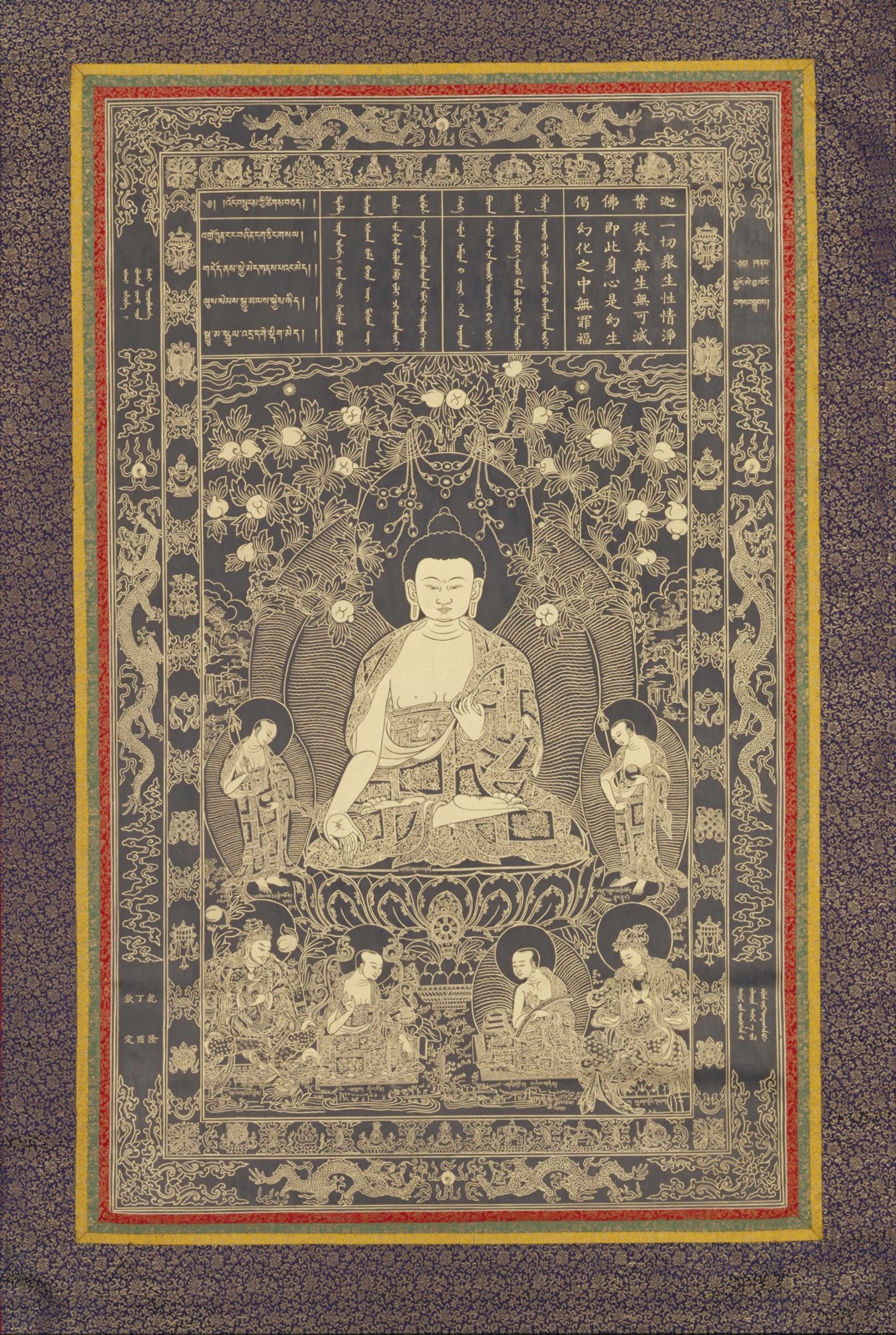
Quick answer: Negative space is the unoccupied ground that separates figures, ornaments, and text. In TK0382, dark gaps around the Buddha’s pale face, circular halo, shoulders, attendants, and lower assembly keep dense gold-colored lines readable. Mapping those gaps reveals visual hierarchy, but it does not identify the Buddha or prove a painting technique.
Dense Buddhist images are often studied by listing what they contain: figures, gestures, vessels, trees, halos, inscriptions, and borders. Yet the spaces between those things are equally active. A narrow dark gap can keep a face distinct from a halo, separate a robe edge from a branch, or prevent two small figures from merging into one cluster.
TK0382 is a strong case for examining negative space in Buddhist art. A large seated Buddha dominates the center, with two standing attendants, four figures below, fruiting trees, a lotus throne, a broad multiscript text panel, and dragon-decorated borders. The composition is richly patterned, but carefully retained areas of dark ground make the hierarchy visible. This article explains how to document those areas without confusing visual design with unsupported historical claims.
What is negative space in a Buddhist painting?
Negative space is the visible ground around and between depicted forms. It is not necessarily empty, unfinished, or meaningless. In a line-based image, a dark interval can function as a boundary just as clearly as a drawn contour.
For TK0382, negative space includes the dark field around the Buddha’s pale head, gaps between the head and circular halo, intervals between the shoulders and fruiting branches, and channels around the attendants and lower figures. Some areas contain sparse lines rather than no lines at all, so “low-density space” may be more precise than “blank space.”
Where does negative space clarify the central Buddha?
The strongest separation appears around the pale face and upper torso. The face remains visually distinct because the surrounding halo is dark and the nearest foliage does not cross the facial contour. The viewer can recognize the head immediately even though branches, hanging ornaments, and cloud-like forms fill the upper field.
A second separation occurs along the shoulders and arms. Dark channels interrupt the dense patterns of robe, halo, and background trees. These gaps help the body retain a readable silhouette. Without them, the gold-colored lines of textile, foliage, and aureole would compete at the same visual level.
How does the halo use figure–ground contrast?
The circular halo works as both a form and a field of contrast. Its dark interior surrounds the pale face, while a gold-colored boundary distinguishes the halo from the tree canopy. The result is a nested sequence: face, dark interval, halo edge, foliage, and wider landscape.
This sequence should be recorded in layers rather than described as one decorative circle. The face-to-halo gap establishes immediate clarity; the halo-to-foliage boundary establishes a second zone; and the larger dark spaces between branches keep the canopy from becoming a solid mass. The TANGKAWORLD guide to Buddhist halos provides related context, while the present reading focuses specifically on the spaces that make the circle legible.
Which negative spaces matter most in TK0382?
The most useful spaces are those that preserve figure boundaries or guide movement between registers. They can be mapped by location, shape, and the forms they separate.
| Location | Forms separated | Visual effect |
|---|---|---|
| Around the face | Head and halo | Makes the face the clearest focal point |
| Beside the shoulders | Body, robe, and branches | Preserves the central silhouette |
| Around standing attendants | Smaller bodies and the aureole | Keeps the pair distinct but subordinate |
| Between lower figures | Four seated figures and central objects | Creates local groups without fusing them |
| Between image and text | Canopy and inscription panel | Maintains two readable registers |
How do you document negative space reliably?
A reliable record treats spaces as measurable shapes rather than impressions such as “calm” or “open.” Use a consistent workflow that another researcher could repeat on the same file.
- Start with the full image. Identify the central figure, secondary figures, text panel, landscape, throne, and borders.
- Choose one boundary. Begin with the face and halo or another clearly visible figure–ground junction.
- Trace the dark interval. Follow its width and shape without filling interruptions by assumption.
- Name both neighboring forms. Record exactly what the interval separates, such as shoulder from branch.
- Classify density. Distinguish blank-looking ground, sparse ornament, patterned ground, and uncertain compressed detail.
- Compare repeated zones. Test whether left and right spaces are mirrored, broadly balanced, or deliberately different.
- Return to the composition. Explain how the mapped spaces affect hierarchy and legibility, not presumed symbolism.
Is negative space the same as an unpainted area?
No. A dark area in a digital image cannot be assumed to be bare support. It may contain pigment, textile, printed tone, a photographic shadow, or a digitally reproduced ground. Negative space describes visual function, whereas “unpainted” describes material condition.
TK0382 supports a statement about dark visual ground and line density. It does not establish the original medium or production method. Even the phrase “gold line” refers here to appearance unless a physical examination or reliable object record confirms metallic pigment. The guide to black-ground and gold-line painting explains relevant techniques and cautions, but this archive file alone cannot authenticate them.
How does negative space organize the lower register?
The lower register uses smaller gaps to divide four figures and the central cluster of objects. These spaces are narrower than those around the Buddha’s face, which makes the lower area feel denser and more conversational while preserving separate silhouettes.
The central Buddha sits above the lower group with the lotus throne acting as a horizontal divider. Dark intervals around the throne’s petals and the heads below help maintain the vertical hierarchy. A viewer reads the large Buddha first, then the paired attendants, and finally the compact lower assembly. Space, scale, and register boundaries work together.
Can negative space prove symbolic meaning?
Negative space can demonstrate compositional emphasis, but it rarely proves a specific doctrine or identity by itself. A broad gap around a face may make it prominent; it does not establish which Buddha is depicted. Symmetrical spacing may create balance; it does not automatically prove a ritual diagram.
Interpretation should therefore move in stages. First describe the visible interval. Then state its compositional effect. Only after comparing inscriptions, attributes, series context, and verified sources should the space be connected with a historical or religious program.
What remains uncertain in TK0382?
The archive filename associates the image with Kāśyapa Buddha, but that individual identity is not independently verified here. The identities of the attendants and lower figures, the readings of all scripts, and the meaning of small attributes also remain uncertain.
The date, maker, materials, school, collection, provenance, and relationship between this digital file and a physical object are uncertain. Direct visual observations are firmer: a central pale figure, circular dark halo, fruiting canopy, two standing attendants, four lower figures, lotus seat, text panel, dragon borders, and carefully distributed low-density ground.
Frequently asked questions
Is all dark ground negative space?
No. Dark ground becomes negative space when it functions between or around forms. A dark halo, robe, cloud, or border motif is itself a depicted form rather than merely an empty interval.
Can negative space be measured?
Yes. A research overlay can record width, area, contour, and line density. Keep measurements on a separate derivative and preserve the source image unchanged.
Why map space instead of only tracing figures?
Figure tracing can miss the intervals that maintain separation. Mapping both positive forms and surrounding gaps reveals why a dense composition remains readable and where compression may create false connections.
Does wide spacing mean a figure is more important?
Sometimes spacing reinforces prominence, but scale, placement, contrast, gesture, text, and iconographic context must also be considered. Space alone cannot establish rank or identity.
Conclusion
TK0382 demonstrates that the dark ground is not a passive remainder. Gaps around the face, halo, shoulders, attendants, throne, and lower figures separate dense lines and preserve a clear hierarchy. By tracing those intervals, naming the forms on both sides, and distinguishing visual function from material or symbolic claims, researchers gain a precise tool for studying complex Buddhist images.
Sources and editorial method
This article is based on direct visual analysis of the TANGKAWORLD TK0382 image. Visible figure–ground evidence, religious identification, and uncertain historical attribution are treated as separate levels. The editorial method uses full-image review, dark-interval tracing, line-density comparison, and explicit confidence labels; the filename is not treated as a verified museum record. For reusable methods and further references, consult How to Study Thangka Iconography with High-Resolution Images, Buddhist Halo in Thangka, and Black Thangka Painting.
Prepared and reviewed by the TANGKAWORLD editorial team. Last reviewed: September 8, 2026.

