How Scale Guides the Eye in a Shakyamuni Thangka: TK0582
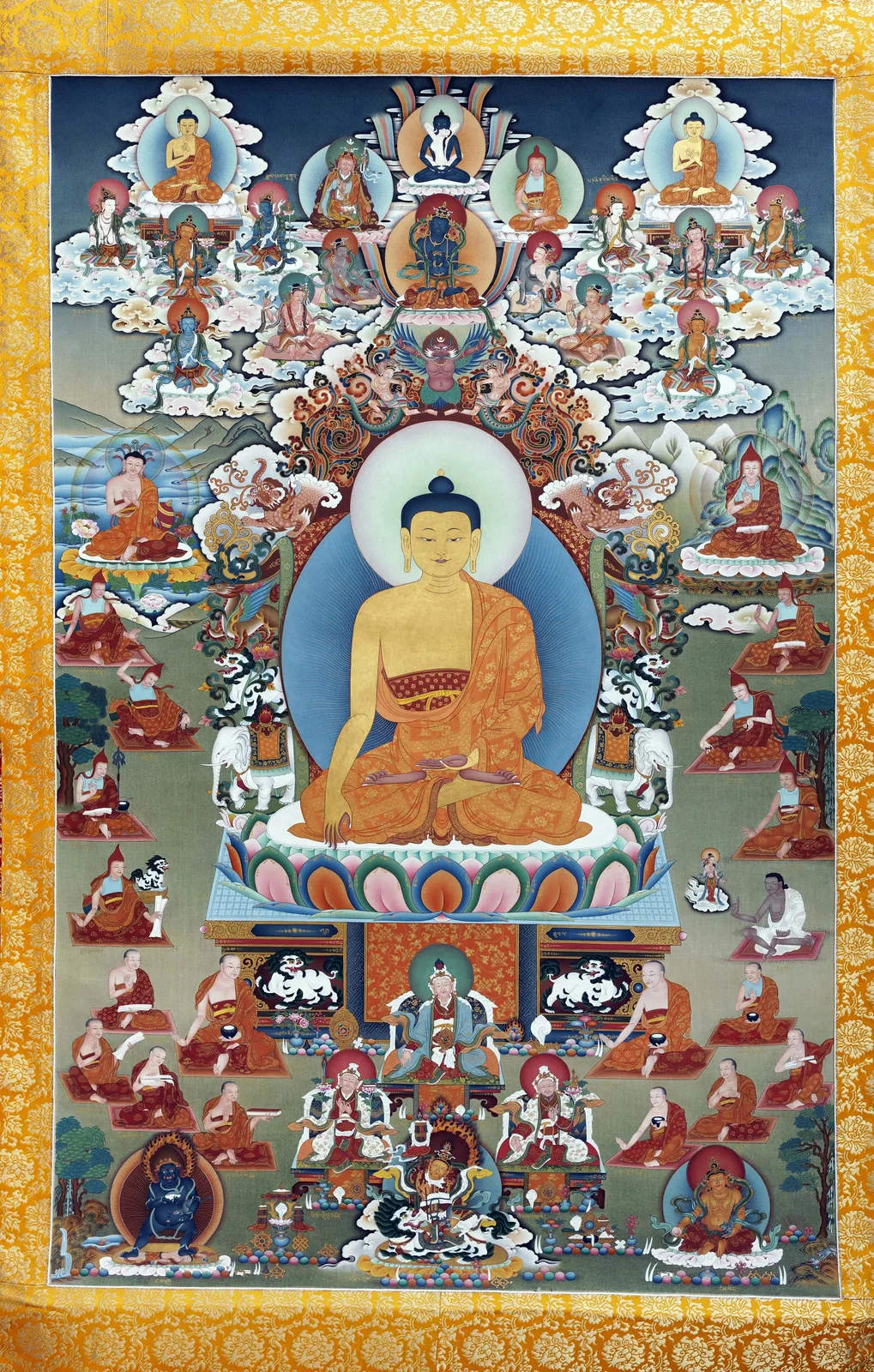
Quick answer: Scale tells the viewer where to begin in TK0582. The monumental central Shakyamuni Buddha anchors the image, while smaller monks, teachers, peaceful figures, and guardians form distinct supporting tiers. Size alone does not identify every person, but it reliably maps visual priority, group relationships, and a practical route through the crowded composition.
A densely populated thangka can feel difficult because every figure appears meaningful. The solution is not to name everyone immediately. First ask how the painter distributes size. In TK0582, one golden Buddha occupies most of the middle register. His broad halo, lotus seat, lowered right hand, and central placement create a clear starting point. Around him, smaller figures are organized above, beside, and below rather than competing at equal scale.
The English filename identifies the principal figure as Shakyamuni Buddha, and the visible earth-touching pose is consistent with that identification. Readers can compare the gesture with the TANGKAWORLD guide to Shakyamuni Buddha and the earth-touching mudra. That comparison supports a subject identification; it does not establish the maker, date, school, historical collection, or exact identity of every attendant.
What is scale hierarchy in a thangka?
Scale hierarchy is the deliberate use of relative size to signal importance and organize attention. A large sacred figure can dominate even when dozens of smaller figures surround it. Size works together with position, halo diameter, throne structure, color contrast, open space, and symmetry. It is therefore better to describe a bundle of visual signals than to treat height as a simple rank chart.
In TK0582, the central Buddha is several times larger than nearby monks. His body and mandorla form a stable oval inside an ornate architectural frame. The eye recognizes this unit before resolving the many smaller faces. The large lotus platform also isolates the central figure from the lower assembly. These features make visual priority legible at a glance.
How does TK0582 guide the eye?
TK0582 guides the eye through a sequence of large anchor, upper crown, side witnesses, lower teachers, and guardians. This is a viewing path, not a claim that the composition must be read in only one direction. The following five passes keep observation separate from identification.
- Start with the monumental Buddha. Record the central figure, halo, robe, hand positions, bowl, lotus seat, and throne before looking at the retinue.
- Move upward to the cloud-borne tiers. The upper field contains multiple seated sacred figures of intermediate size. Their shared clouds and halos make them a group, while the dark blue figure on the vertical center line provides a second focal point.
- Scan the side zones. Monastic figures sit on both sides of the central Buddha. Their smaller bodies and repeated rectangular seats create a surrounding community rather than a rival center.
- Read the lower gathering. Teachers, donors or patrons, ritual figures, offerings, and seated monks occupy the base. Some identities may be recognizable to specialists, but the image alone does not securely confirm every name.
- Finish with the protective edge. Dark and golden guardian-like figures at the bottom corners close the composition. Their placement gives the base visual weight without displacing Shakyamuni.
Which visual signals reinforce size?
Four visible signals strengthen the scale system: framing, repetition, contrast, and separation. Together they explain why the central Buddha remains dominant despite the extraordinary number of surrounding forms.
| Signal | Visible evidence in TK0582 | Safe conclusion |
|---|---|---|
| Framing | Large halo, blue mandorla, lotus throne, dragons, and white elephants encircle the Buddha. | The central figure is the principal visual anchor. |
| Repetition | Small monks recur along both sides and across the lower register. | They form related supporting groups, though individual identities remain uncertain. |
| Contrast | The golden body and orange robe stand against cool blue and green fields. | Color separation reinforces attention at the center. |
| Separation | The broad lotus seat and halo create space around the main body. | The painter protects the central silhouette from surrounding detail. |
These signals should be logged independently. A catalog entry might record “central figure occupies approximately the middle third of the painted field,” then note the halo, lotus, and flanking animals in separate fields. This approach makes later comparison easier and avoids turning interpretation into fact.
Does a larger figure always mean higher spiritual rank?
No. Larger size usually indicates pictorial emphasis, but it does not automatically prove a universal theological ranking. The principal subject may be enlarged because the painting supports a particular practice, lineage, commission, or narrative focus. A smaller figure may still be doctrinally important. Without a translated inscription or reliable catalogue, the safe statement is that scale establishes visual priority in this image.
This distinction matters in the upper register. Several figures are larger than the side monks but smaller than Shakyamuni. Their intermediate scale helps bridge the composition. It may also distinguish types of participants, yet size by itself cannot securely tell us whether each is a Buddha, bodhisattva, lineage master, or another sacred figure. Clothing, attributes, inscriptions, and comparative records must also be considered.
How should researchers document the hierarchy?
A useful record combines measurements with plain-language observation. It should remain reproducible even if a later scholar revises the identifications.
- Define the painted field separately from the textile border.
- Measure the principal figure from seat to crown and record its share of image height.
- Group secondary figures by register, support, halo, costume, and approximate size.
- Mark the center line and note which figures intersect it.
- Describe framing devices such as clouds, animals, throne elements, and landscape.
- Assign confidence levels to names: visible, probable, possible, or uncertain.
- Keep filename information separate from verified collection data.
For a broader workflow, the beginner’s guide to reading a thangka moves from the central figure to attributes, attendants, setting, and evidence. TK0582 shows why this order works: the scale system can be documented before every small figure has been identified.
Frequently asked questions
Is the central figure definitely Shakyamuni Buddha?
The filename says Shakyamuni Buddha, and the golden monastic figure with a lowered right hand and bowl is consistent with that identification. The visible evidence supports the name, but the filename is not a verified museum record.
Can all the smaller figures be named from this image?
No. Some figures have distinctive dress, colors, gestures, or mounts, but small inscriptions and attributes require closer study. Unconfirmed names should remain uncertain rather than being inferred from placement alone.
Why are monks shown at several different sizes?
The differing sizes help separate compositional roles and registers. They may reflect proximity, visual importance, grouping, or lineage structure, but those possibilities need supporting inscriptions or records before they become historical claims.
Should the textile border be included in scale measurements?
Record both overall image dimensions and the painted field, but do not mix them. The yellow textile border frames the object physically; the internal scale hierarchy is created inside the painted field.
Conclusion
TK0582 demonstrates how scale can make a crowded Buddhist image readable. Shakyamuni’s monumental body supplies the primary anchor; intermediate sacred figures crown the upper field; smaller monastics and teachers extend the assembly; and guardians stabilize the base. This hierarchy offers a disciplined route through the painting without pretending that size alone identifies every figure.
Sources and editorial method
This article is based on direct visual analysis of the TANGKAWORLD image TK0582. Visible evidence includes relative figure size, position, halos, seats, robes, gestures, animals, clouds, and painted registers. Religious identification is separated from uncertain historical attribution. The filename supports the Shakyamuni label, while artist, date, school, collection, and provenance remain uncertain.
Prepared and reviewed by the TANGKAWORLD editorial team.
Last reviewed: September 24, 2026.

