How to Audit Repeated Buddha Rows in a Thangka: TK0578
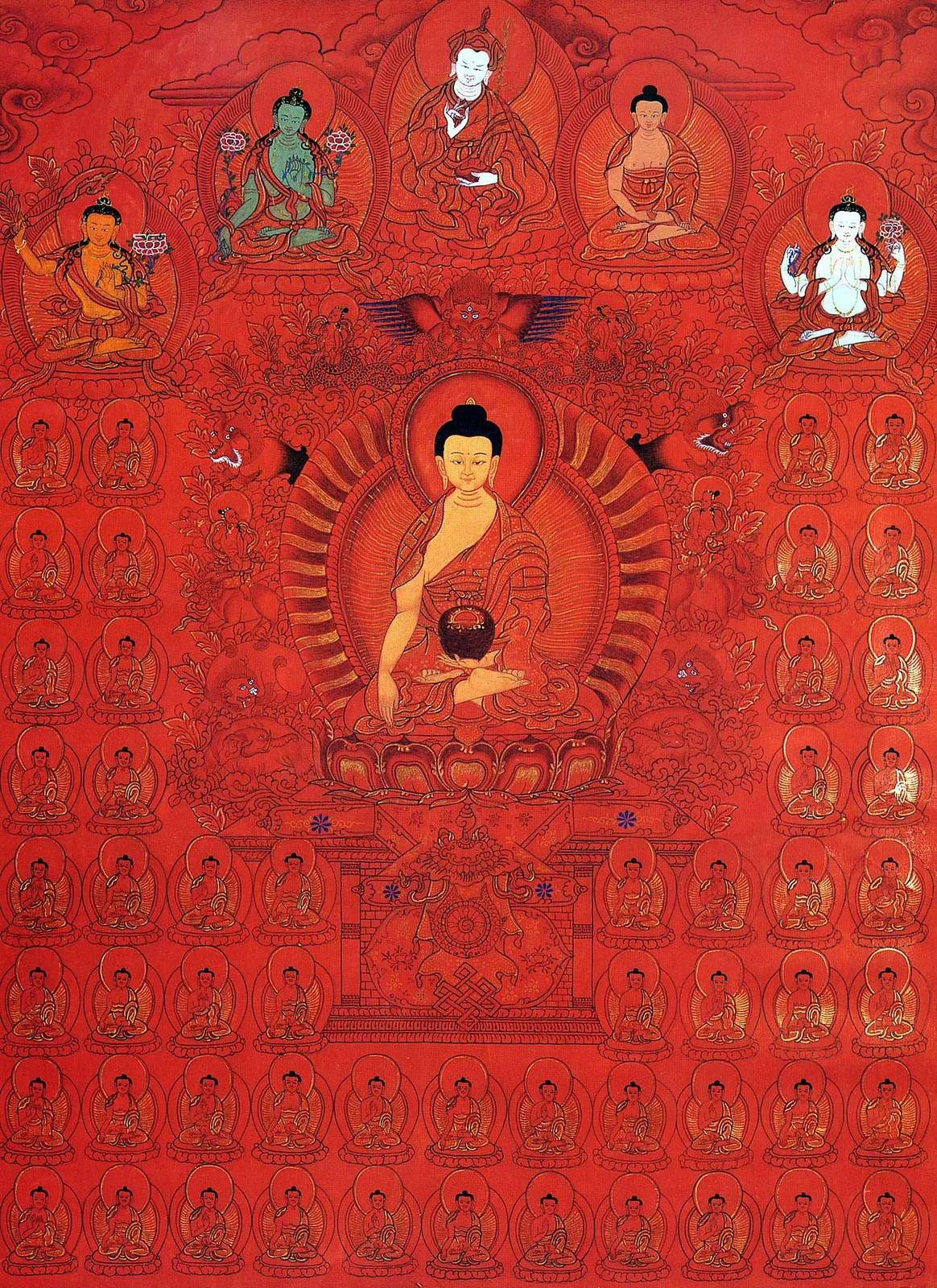
Quick answer: Repeated Buddha rows in a Thangka are serial rather than narrative when figures keep nearly the same pose, halo, seat, scale, spacing, and orientation without interacting or moving through changing settings. In TK0578, the regular small Buddhas form a serial field, while the varied upper figures form a differentiated assembly.
Repeated sacred figures can look like a story sequence, especially when a painting contains dozens of small images around a larger center. Yet repetition and narrative do different visual work. Repetition builds rhythm, multiplicity, and a structured field. Narrative usually signals change: a figure acts, travels, teaches, receives something, or appears in a new place.
TK0578 is a strong case study because both systems seem possible at first glance. A monumental Buddha-like figure occupies the center, while many smaller seated figures fill orderly rows along the sides and lower half. Five larger figures form an upper arc, and animal guardians, dragon-like heads, clouds, foliage, and a decorated pedestal create additional layers. The question is not simply “How many Buddhas are shown?” but “Which differences are meaningful enough to indicate a sequence?”
What is serial repetition in Buddhist art?
Serial repetition is the deliberate reuse of a stable visual unit across a painting. In TK0578, the smaller figures repeatedly sit on lotus-like bases, occupy oval or circular halos, face forward, and hold comparable seated postures. Their scale stays relatively consistent within each row, and the intervals between them are regular.
This pattern encourages comparison without demanding a chronological reading. A viewer can scan left to right, but nothing visible proves that the first small figure acts before the second. The units behave more like a repeated sacred presence, a counted series, or a structured assembly than consecutive scenes in an illustrated biography.
What makes a true narrative sequence?
A narrative sequence shows consequential change. Reliable clues include a protagonist appearing in different actions, settings that change from scene to scene, directional movement, interactions with new people, and architectural or landscape boundaries that separate episodes. Inscriptions may confirm an order, although unread text should never be treated as translated evidence.
TK0578 does not give the small figures that degree of differentiation. Their poses vary slightly, and some hands or robe lines differ, but minor variation can arise from painting technique, condition, or the need to avoid mechanical uniformity. Variation alone is not narrative. It becomes stronger narrative evidence when several clues—action, setting, direction, participants, and readable labels—work together.
| Question | Serial repetition | Narrative sequence |
|---|---|---|
| Does the pose change? | Mostly stable | Changes with the action |
| Does the setting change? | Usually shared or minimal | Distinct places or framed scenes |
| Do figures interact? | Little or no local interaction | Encounter, teaching, offering, travel, or conflict |
| Is there directional movement? | Rhythmic scanning across a row | A route or event order is visually supported |
| What can be concluded? | A repeated visual category | A probable sequence, confirmed only with further evidence |
How does TK0578 organize repetition?
TK0578 uses repetition in three visible zones. First, vertical columns of small haloed Buddhas run down the left and right sides. Second, horizontal rows extend across the lower field. Third, the central Buddha-like figure remains much larger than every repeated unit, anchoring the entire surface.
The repeated figures share a common visual vocabulary but are not exact copies. Hand positions, robe folds, and small highlights vary. Those differences should be recorded rather than erased, yet they do not automatically transform the rows into episodes. Equal scale, repeated seats, similar halos, frontal orientation, and grid-like spacing remain the dominant evidence.
The TANGKAWORLD guide to Buddhist halos is useful here because each halo marks an individual sacred figure while the repeated outline also links the row into a larger pattern.
Why is the upper assembly different from the lower rows?
The upper figures are differentiated by scale, body color, clothing, gesture, and attributes. The central upper figure is pale and richly robed; figures to either side include green, orange, and white bodies, lotus flowers, a sword-like object, varied hand gestures, and distinct costumes. They are larger and less mechanically spaced than the small Buddhas below.
That does not prove their names or relationships, but it does show a different organizational category. The upper zone behaves as an assembly of distinct figures. The lower and side zones behave as serial repetition. Between them, dragon-like heads, a central winged guardian-like form, clouds, foliage, and animal figures create a visual threshold around the monumental center.
How to test repetition versus narrative step by step
A reliable decision comes from cumulative evidence, not a single difference. Use the following audit before assigning episode names:
- Mark every repeated unit. Record halo shape, seat, body orientation, scale, and spacing before interpreting identity.
- Compare poses systematically. Note changes in hands, objects, gaze, and robe position. Separate substantial actions from minor drafting variation.
- Check the setting. Ask whether each figure occupies a new room, landscape, road, court, or event space.
- Look for interaction. Narrative figures normally respond to other people, animals, objects, or events; serial figures can remain self-contained.
- Search for an ordering device. Readable inscriptions, numbered panels, directional paths, or repeated protagonists can support sequence.
- Assign a confidence level. Use “serial repetition,” “possible sequence,” or “verified narrative cycle” according to the available evidence.
When zooming, inspect one row at a time and keep the full composition visible in a second window. The high-resolution Thangka study method explains how to compare details without losing their position in the whole image.
What should a catalogue record say?
A cautious record separates observation from interpretation. For TK0578, observation can state: “One large seated Buddha-like figure with a lowered right hand and dark bowl is surrounded by regular rows of small haloed seated Buddhas; five larger, differentiated figures occupy the upper register.” This description remains useful even if no names are confirmed.
A second field can preserve the archive title, Shakyamuni Buddha 4, without presenting it as a verified museum identification. A third field should state that the identities of the upper figures, purpose of the repeated series, date, maker, school, collection, and provenance are uncertain. This layered method is consistent with the TANGKAWORLD beginner’s guide to reading a Thangka.
Why counting alone is not enough
Counting can reveal rows, missing units, asymmetry, cropping, or damage, but a number does not explain the image. A digital reproduction may cut off figures at the edge, hide details in dark red passages, or make two adjacent units appear merged. Exact totals should be checked at full resolution and recorded with the counting method.
More importantly, the same count can serve different purposes in different paintings. A group may represent named Buddhas, a ritual multiplication, a lineage, a textual set, or a decorative-sacred field. Without inscriptions or a reliable catalogue, the visible pattern is secure; the doctrinal program is not.
Frequently asked questions
Do small differences in hand position prove separate episodes?
No. They may be meaningful, but they can also reflect normal variation, condition, or reproduction quality. Narrative identification needs additional evidence from setting, interaction, direction, inscriptions, or documentation.
Can repeated Buddhas represent different named figures?
Yes, but visual similarity alone cannot settle that question. Names require readable inscriptions, a known iconographic set, reliable catalogue data, or attributes clear enough for careful comparison.
Is every row meant to be read left to right?
No. A row creates a viewing path, but that path is not automatically chronology. Direction should remain uncertain unless the composition, text, or documented ritual use establishes an order.
Is the central figure definitely Shakyamuni Buddha?
The archive title and visible earth-touching-like gesture support that reading, but the local file is not a verified museum record. The article therefore preserves the title while distinguishing it from confirmed provenance.
Sources and editorial method
This article is based on direct visual analysis of the TANGKAWORLD TK0578 image. Visible evidence includes the monumental central seated figure, lowered right hand, dark bowl, lotus seat, layered halos, repeated rows of small seated Buddhas, five differentiated upper figures, clouds, foliage, dragon-like heads, guardian animals, and decorated pedestal.
Religious identification is treated as a reasoned reading supported by the archive title and visible gesture. The function and names of the repeated figures, the upper assembly, date, maker, school, collection, and provenance remain uncertain. The linked TANGKAWORLD guides provide the editorial method and a further-reading path without importing unverified third-party claims into the Blogger article.
Prepared and reviewed by the TANGKAWORLD editorial team.
Last reviewed: September 23, 2026.
Conclusion
TK0578 shows why repetition should not be mistaken for narrative. The small figures maintain stable scale, halos, seats, spacing, and frontal poses, so they form a serial field rather than a visibly chronological story. The upper figures are more differentiated, while the central Buddha-like figure controls the hierarchy. Recording these layers first produces a stronger catalogue entry and leaves uncertain meanings honestly open.

