How to Document a Buddha’s Patchwork Robe: TK1147
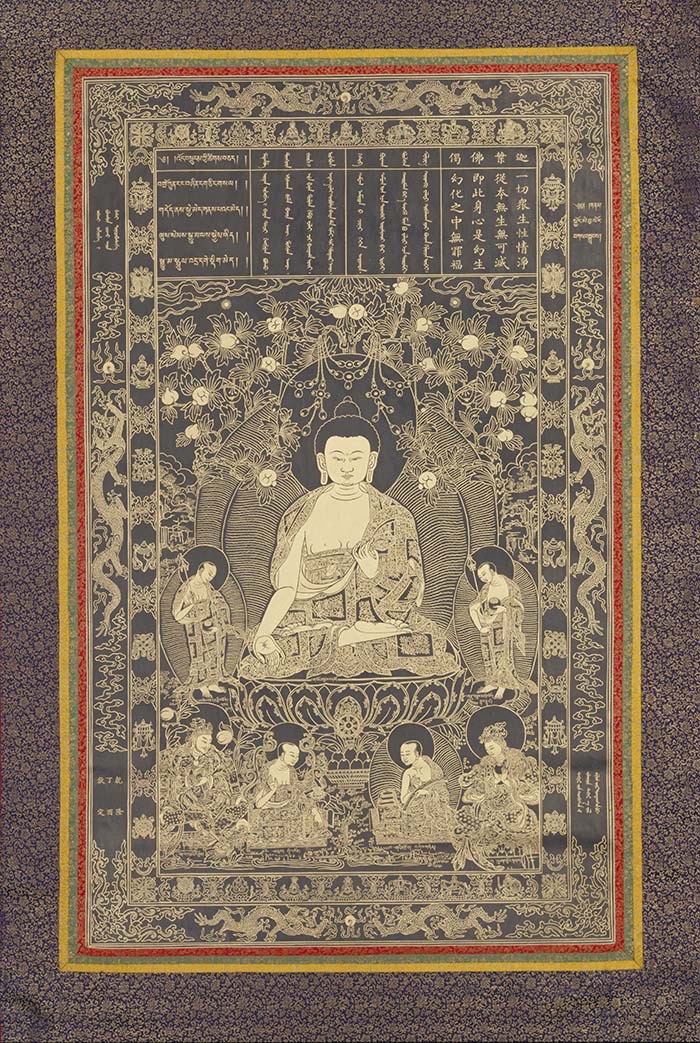
Quick answer: Document a Buddha’s patchwork robe by separating garment edges, rectangular fields, internal motifs, fold lines, and overlaps. In TK1147, record these visible features before interpreting their religious or historical meaning. The method preserves useful textile evidence while keeping identity, date, workshop, and provenance explicitly uncertain.
Robes are easy to notice and surprisingly difficult to describe. A catalogue may say “ornate robe” or “monastic garment,” but those phrases do not tell a later reader where the cloth begins, how it crosses the body, or which marks belong to its construction rather than its decoration. TK1147 offers a clear case for a more disciplined record.
The central seated Buddha wears a garment articulated by rectangular divisions and repeated interior patterns. One shoulder appears more exposed than the other, a broad draped section crosses the torso, and layered cloth covers the legs. Two standing attendants flank the main figure, while four haloed figures occupy the lower register. A multilingual text panel, flowering branches, dragons, and layered borders complete the image. The filename links the picture to Kāśyapa Buddha, but that association is not treated here as verified attribution.
What is a patchwork robe in Buddhist art?
A patchwork robe is a garment represented as a field of joined or visually separated sections, often arranged in bands or rectangular units. In Buddhist contexts, such divisions can recall the constructed form of monastic robes, but an image alone may not reveal whether every line represents a seam, a textile border, a painted motif, or a later stylistic convention.
That uncertainty is exactly why documentation should precede interpretation. The goal is not to decide from one reproduction how the real textile was cut. The goal is to create a precise description of the painted evidence. Terms such as “rectangular field,” “outer edge,” “fold line,” and “repeated motif” are safer than claiming a specific fabric, tailoring method, period, or regional school.
What robe features are visible in TK1147?
TK1147 visibly shows a robe with several kinds of line: the outer silhouette of the garment, larger rectangular divisions, smaller patterns inside those divisions, and curved lines associated with drapery. These categories should not be collapsed into one generic word such as “decoration.”
| Feature | What is visible | Safe record |
|---|---|---|
| Garment edge | A broad boundary runs over the covered shoulder and down the torso | Trace as an outer robe edge |
| Rectangular fields | Repeated box-like sections organize the torso and lower garment | Count and map visible fields |
| Interior motifs | Fine repeated marks fill many fields | Describe shape and density; do not name fabric |
| Drapery lines | Curving lines follow the lap, arm, and seated pose | Record direction and overlap |
| Body exposure | The robe covers the shoulders unevenly | State viewer-left/right convention |
The gold-line technique makes the garment structure legible against a dark ground, but it also creates ambiguity. A bright line may mark a seam, a fold, a patterned border, or simply the edge of one ornamental unit. The TANGKAWORLD guide to black thangka and gold-line painting provides broader context for reading this visual language without assuming a specific technique for every image.
How do you document the robe step by step?
Document the robe from large structure to small detail. This order prevents dense motifs from obscuring the garment’s basic path across the body.
- Declare orientation. State that left and right refer to the viewer. This avoids confusion when another researcher uses the Buddha’s proper left and right.
- Trace the outer silhouette. Follow the visible garment edge over the shoulder, across the torso, around the arms, and over the crossed legs. Mark any point where the edge disappears behind the body or another layer.
- Divide the robe into major zones. In TK1147, useful zones include the shoulder drape, diagonal torso section, sleeve or arm-adjacent cloth, lap, and lower leg covering. Zone codes make later notes unambiguous.
- Map rectangular fields. Record their position, approximate proportion, alignment, and whether their boundaries continue across folds. Do not automatically call every boundary a sewn seam.
- Describe motifs separately. Note whether a field contains floral, geometric, scrolling, dotted, or indeterminate marks. At 700 pixels wide, very small forms may remain unresolved.
- Record folds and overlaps. Curves that respond to the seated body should be distinguished from straight or repeated field boundaries. Note which cloth layer appears to pass over another.
- Add confidence levels. Label direct observations as high confidence, structural interpretations as moderate, and claims about material, date, workshop, or religious identity as uncertain unless supported elsewhere.
How can seams, folds, and motifs be kept separate?
Seams, folds, and motifs can be kept separate by assigning each line a functional category only when its behavior supports that category. A line that repeatedly encloses rectangular units may define a field. A curve that changes direction with the knee may indicate drapery. A small repeated form inside multiple fields is more likely ornamental.
Use neutral codes when the function is unclear: E for edge, F for field boundary, D for probable drapery, and M for motif. Add a question mark when evidence is weak. For example, “F-03?” is more honest and more reusable than “horizontal seam” if the line cannot be followed through the image. Cropped detail views can help, but the master record should always retain the full-image location.
Do not let symmetry decide the answer. A painter may repeat motifs for visual balance without depicting a literally symmetrical garment. Likewise, a damaged, compressed, or low-resolution region may make two different line types look alike. The high-resolution image study guide explains why researchers should distinguish what a file displays from what an original object may contain.
What can the robe prove about the figure’s identity?
The robe can support a broad classification as a Buddha or monastic-form figure, but it cannot by itself prove that TK1147 represents Kāśyapa Buddha. Robe structure is shared across many Buddhist images, and the surrounding assembly, gesture, object, and inscriptions must be evaluated together.
TK1147’s filename is useful archive context because it preserves an existing association. It is not equivalent to a museum accession record, verified inscription, or documented provenance. A responsible catalogue can therefore store “Kāśyapa Buddha” in an uncertain association field while keeping the visual description independent. This separation allows a later specialist to revise the identity without rewriting the garment evidence.
The same rule applies to date and origin. Rectangular fields and rich patterning may invite stylistic comparison, but visual resemblance alone cannot establish a workshop, region, or period. The beginner’s guide to reading a thangka is useful for coordinating robe evidence with pose, halo, seat, attendants, text, and composition.
What should a robe documentation checklist include?
A useful robe record should include the following fields:
- Image ID, filename, dimensions, and checksum.
- Viewer-left/right or figure-proper orientation convention.
- Outer garment edge and points of interruption.
- Major robe zones and their position on the body.
- Rectangular field count, alignment, and visible boundaries.
- Motif description, repetition, scale, and legibility.
- Probable fold lines, overlaps, and uncertain line functions.
- Image-resolution limits and confidence level for every interpretation.
This checklist is deliberately descriptive. It gives future researchers comparable data while preventing a decorative pattern from becoming unsupported proof of identity or origin.
Frequently asked questions
Does every rectangle in a painted robe represent a sewn patch?
No. A rectangle may depict robe construction, a woven or painted pattern, a border, or a stylized visual convention. Record the visible field first and identify its function only when the evidence is strong.
Can TK1147 confirm Kāśyapa Buddha from the robe?
No. The robe supports a broad Buddha or monastic-form reading, not a unique identity. The Kāśyapa association comes from the archive filename and remains uncertain without stronger inscriptional, iconographic, or provenance evidence.
Why record viewer-left and viewer-right?
Orientation makes every note reproducible. “Covered shoulder” can be misunderstood, while “viewer-right shoulder covered by the outer robe” tells another researcher exactly where to look.
Is a 700-pixel image sufficient for robe study?
It is sufficient for major edges, zones, and many rectangular fields, but not for every fine motif or material claim. Small details should be marked unresolved rather than enlarged into false certainty.
Conclusion
TK1147 shows how a robe can be documented as evidence rather than used as a shortcut to attribution. By separating edges, fields, motifs, folds, overlaps, and uncertainty, researchers create a record that remains useful even if the figure’s identity or history is revised. The method is simple, visual, and well suited to catalogues, teaching notes, and digital annotation.
Sources and editorial method
This article is based on direct visual analysis of TANGKAWORLD image TK1147 and the internal guides linked above. It separates visible robe evidence from religious identification and uncertain historical attribution. No museum, date, maker, school, collection, provenance, material, or textile construction has been invented from the filename or visual resemblance. The Kāśyapa association is reported only as uncertain archive context.
Prepared and reviewed by the TANGKAWORLD editorial team.
Last reviewed: September 1, 2026.

