How to Document a Palm Mark in Buddhist Art: TK0383
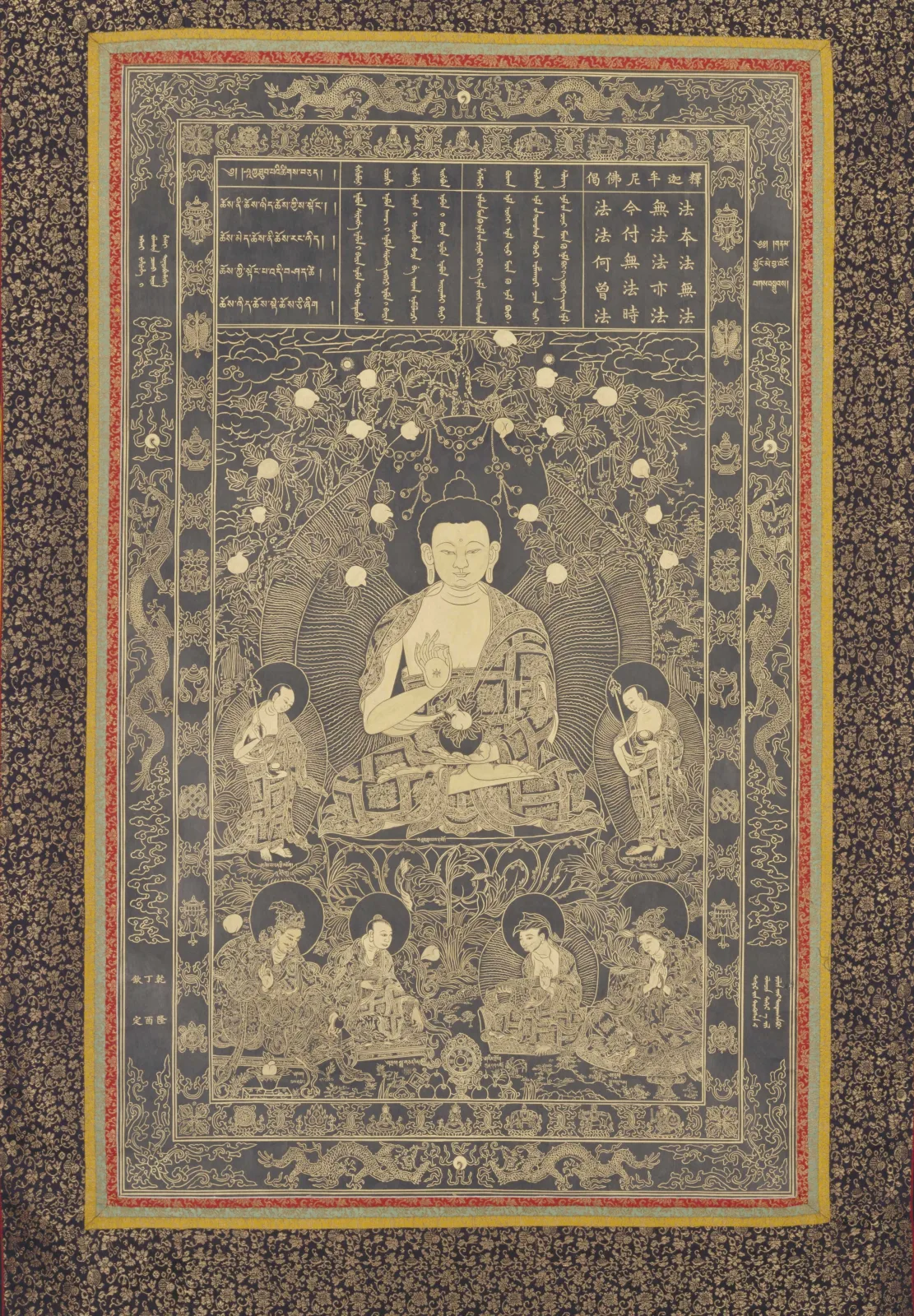
Quick answer: Document a Buddhist palm mark by recording its position, outline, internal strokes, contrast, and relationship to the fingers before naming it. In TK0383, a small dark-centered, radiating form is visible inside the central figure’s raised palm, but its exact symbolic identity cannot be confirmed from the image alone.
Hands attract immediate attention in Buddhist art because their positions can carry iconographic meaning. Yet a hand may contain another layer of evidence: a small painted or drawn mark inside the palm. When the image is dense, it is easy to treat that mark as part of a familiar symbol before checking what is actually visible.
TK0383 offers a focused case for studying a palm mark in Buddhist art. A large central seated figure raises one hand near the chest. Within the pale palm is a compact form with a dark center and several short radiating strokes. This article explains how to document that feature without allowing a presumed mudra, identity, or doctrine to determine the description in advance.
What is visible in the raised palm of TK0383?
A small, high-contrast mark is visible near the center of the raised palm. It appears to have a darker central point or compact core surrounded by short outward strokes. At this scale, “radiating palm mark” is a more defensible description than a specific iconographic name.
The mark is separate from the outer contour of the hand and does not appear to be a crease extending from a finger. It is also positioned inside the palm rather than on the nearby robe. These observations support treating it as an intentional depicted feature, while leaving its exact form and meaning uncertain.
Why should the palm mark be separated from the hand gesture?
The palm mark and the hand gesture are different evidence types. The gesture concerns the position of the palm, fingers, wrist, and arm. The mark concerns a small internal feature drawn on the hand’s surface.
A familiar-looking hand pose can bias the reading of the mark, and a familiar-looking emblem can bias the identification of the gesture. A reliable record therefore describes them independently. For TK0383, the palm faces outward or partly outward, several fingers are extended or curved, and a radiating form sits inside the palm. Each statement can be tested without first assigning a mudra name.
How can you describe a palm mark precisely?
Describe the mark through observable properties that another researcher can check. Position, geometry, stroke direction, contrast, and attachment are more useful than a premature symbolic label.
| Property | Visible observation | Uncertain inference |
|---|---|---|
| Position | Near the center of the raised palm | Whether placement follows a formal iconographic rule |
| Outline | Compact form with outward-pointing strokes | Whether the complete shape is floral, solar, wheel-like, or another type |
| Center | Small dark core against the pale hand | Whether the center represents a hub, seed, jewel, or simple contrast |
| Relationship | Contained within the palm and separate from the robe | Its doctrinal meaning or identity function |
How do you test whether the mark is intentional?
Test intentionality by comparing the mark with noise, damage, hand creases, and repeated motifs elsewhere in the image. One unusual pixel cluster is not enough; the form should have coherent placement and structure.
- Inspect the full composition. Confirm which hand belongs to the central figure and how it is oriented.
- View the source at one-to-one scale. Avoid interpreting only a browser thumbnail or enlarged preview.
- Trace the hand contour. Separate the palm boundary, fingers, wrist, robe edge, and nearby background lines.
- Record the mark’s center and rays. Count only strokes that remain visible at the native resolution.
- Compare local artifacts. Look for JPEG blocks, sharpening halos, stains, or scratches with similar contrast.
- Search for repetition. Check feet, other palms, halos, textiles, and borders for related forms without assuming they share a meaning.
- Assign a confidence level. Separate confidence that a mark exists from confidence in any proposed identification.
Could the mark be a wheel or another auspicious sign?
It could be compared with wheel-like or auspicious body marks, but TK0383 alone does not confirm such an identification. The visible form is small, stylized, and reproduced through a digital photograph or scan whose object history is uncertain.
A stronger identification would require a clear spoke count, rim or hub structure, parallels on the feet or other images, readable inscriptions, and a traceable catalog or scholarly source. Until those checks are available, “radiating palm mark” preserves the evidence without closing the question.
How does contrast make the palm mark legible?
Contrast makes the mark visible by placing dark strokes on a broad pale hand. The central face and torso use similarly calm pale fields, while robes, foliage, and borders contain much denser linework. The hand therefore acts as a small visual pause around the emblem.
The mark also sits near the figure’s central axis and chest, where viewers naturally look after the face. Its compact darkness attracts attention without competing with the much larger body. Placement, tonal difference, and surrounding open space work together; no single property proves symbolic importance.
Does the palm mark identify Shakyamuni Buddha?
No. A palm mark by itself cannot securely identify the central figure. The archive filename links TK0383 with the Seven Buddhas of the Past and Shakyamuni Buddha, but a verified identification would require the full evidence set: inscriptions, gestures, attributes, attendants, series context, and a traceable object record.
The TANGKAWORLD guide to reading a thangka explains why individual features must be considered together. Here, the filename is preserved as a research lead, not converted into a confirmed museum attribution.
How should a digital archive store this observation?
A digital archive should store the observation, proposed interpretation, and confidence in separate fields. The observation can say “small dark-centered radiating mark inside raised palm.” The interpretation can list “wheel-like, floral, solar, or uncertain” as alternatives rather than one fixed answer.
Record the source dimensions, color space, checksum, and viewing scale. Any crop, contrast adjustment, or tracing should be saved as a clearly labeled derivative. The source must remain unchanged so later researchers can distinguish original pixels from editorial aids. The high-resolution iconography workflow provides a broader method and further reading.
What remains uncertain in TK0383?
The exact identity and meaning of the palm mark remain uncertain, as do the hand gesture’s formal name, the individual identities of the seven visible figures, and the complete readings of the scripts. The flower-like form near the lap should also remain separately described rather than used to force an identification.
The date, maker, materials, production method, school, collection, provenance, and relationship between this file and a physical object are uncertain. Direct evidence remains useful: a raised pale palm with a compact radiating mark, central seated figure, paired standing figures, four lower figures, fruiting canopy, multiscript panel, lotus seat, and decorated borders.
Frequently asked questions
Is every dot or star inside a palm intentional?
No. Compression, damage, dust, and sharpening can create false marks. Confirm coherent shape, central placement, stable edges, and contrast at native resolution before treating a feature as intentional.
Can I name the palm mark from the archive filename?
No. A filename can preserve a useful research lead, but it does not verify the mark’s shape, symbolism, figure identity, or historical attribution.
Should the mark and mudra share one metadata field?
No. Store hand position and internal palm features separately. This allows one interpretation to change without rewriting the other observation.
What is the safest public caption?
Use visible language such as “central seated figure raising a hand with a small radiating palm mark,” followed by an explicit statement that the exact symbolism and attribution are uncertain.
Conclusion
TK0383 demonstrates why a tiny palm feature deserves its own evidence record. By documenting position, outline, center, strokes, contrast, and artifact risk before assigning a name, researchers can preserve an important visual clue without overstating what the digital image proves. The same method can be applied to marks on feet, foreheads, halos, garments, and ritual objects.
Sources and editorial method
This article is based on direct visual analysis of the TANGKAWORLD TK0383 image. Visible palm evidence, religious identification, and uncertain historical attribution are treated as separate levels. The editorial method uses full-image review, native-scale inspection, contour separation, artifact comparison, repeated-form checking, and explicit confidence labels; the filename is not treated as a verified museum record. For the broader method and source pathway, consult How to Study Thangka Iconography with High-Resolution Images and How to Read a Thangka: A Beginner’s Guide.
Prepared and reviewed by the TANGKAWORLD editorial team. Last reviewed: September 16, 2026.

