How to Document a Sacred Tree in Buddhist Art Without Guessing: TK1148
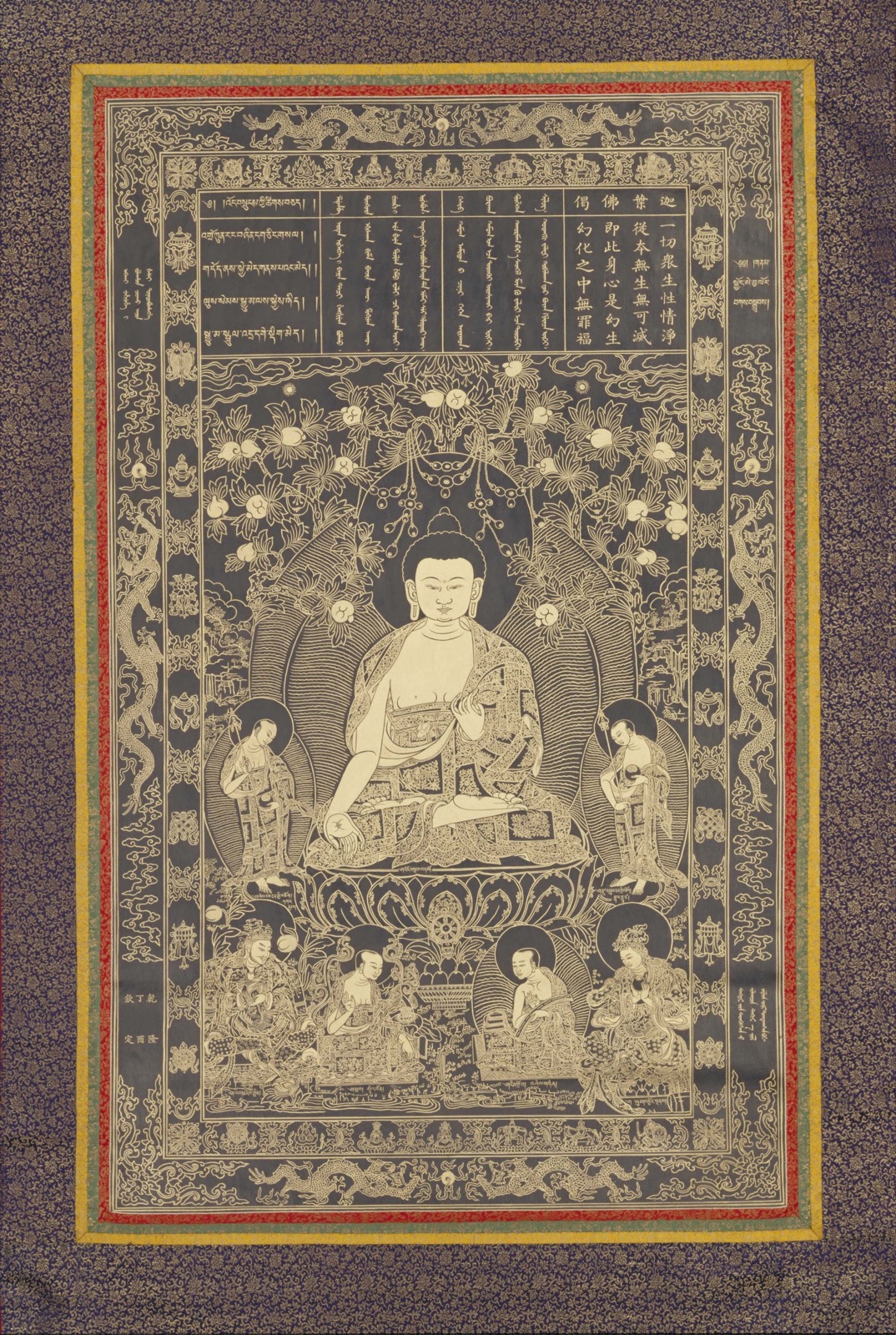
Quick answer: Document a sacred tree by recording its canopy outline, branch direction, leaf groups, round botanical forms, trunk visibility, overlaps, and relationship to the central figure. In TK1148, these features can be described confidently, while the tree species, Buddha identity, date, workshop, and provenance must remain uncertain.
A tree in Buddhist art can be visually dominant yet botanically elusive. TK1148 demonstrates why careful description should come before naming.
The image shows a large seated Buddha under an expansive tree, flanked by two standing attendants and four lower haloed figures. Dense leaves and pale round forms fill the upper half. A multiscript panel, dragons, clouds, auspicious motifs, and layered borders surround the assembly. The filename associates the work with Kāśyapa Buddha, but this remains uncertain archive context.
What makes a tree visually sacred in Buddhist art?
A tree appears sacred through its placement, scale, and relationship to a holy figure, not merely through a recognizable species. In TK1148, the tree rises directly behind the central Buddha, expands around the halo, and forms a protective upper field. Its compositional role is clear even though its botanical identity is not.
This distinction is useful for cataloguing. “Sacred tree” describes the tree’s function inside the image; “banyan,” “bodhi,” or another species would be a botanical identification requiring separate support. A responsible record can therefore describe sacred placement with high confidence while leaving the species field unresolved.
What tree features are visible in TK1148?
TK1148 visibly preserves an arched canopy, repeated leaf clusters, branching stems, and many round botanical forms. The trunk is largely hidden behind the Buddha and surrounding lines, so its full structure cannot be traced from this view.
| Feature | Visible evidence | Safe description |
|---|---|---|
| Canopy | A broad crown curves around the central halo | Arched, enclosing canopy |
| Branches | Multiple stems radiate upward and outward | Branch direction and junctions |
| Leaves | Dense pointed or oval leaf-like forms occur in clusters | Cluster shape, count, and orientation |
| Round forms | Pale circular and lobed forms repeat among the leaves | Possible flowers or fruits; uncertain |
| Trunk | Most of the central supporting structure is obscured | Partly visible or unresolved |
| Overlaps | Foliage intersects the halo, attendants, and background lines | Record front-to-back relationships |
The gold-line design clarifies contours but does not automatically clarify plant anatomy. Repetition may be decorative, and pale fills may emphasize rhythm rather than botanical realism. The TANGKAWORLD guide to black thangka and gold-line painting helps explain why line function must be interpreted cautiously.
How do you document a sacred tree step by step?
Document the tree from its overall silhouette to its smallest legible units. Working in this order preserves composition before detail and reduces the temptation to identify a species from one attractive feature.
- Define the image orientation. State that left and right refer to the viewer. Record the full image ID, pixel dimensions, derivative filename, and checksum.
- Trace the canopy outline. Mark the highest point, lateral spread, lower edge, and any gap around the halo. Note whether the canopy is symmetrical or only approximately balanced.
- Map major branches. Follow visible stems from their lowest observable point toward the outer crown. Assign branch codes rather than assuming hidden connections behind the figure.
- Group leaves by form. Record whether leaves appear pointed, rounded, paired, alternating, clustered, or unresolved. Do not infer a species from a single stylized cluster.
- Separate flowers, fruits, and ornaments. Label the pale round forms as botanical candidates until details such as petals, stems, or fruit attachments can be confirmed.
- Record overlaps. Note where foliage passes behind the halo, beside the attendants, or in front of background lines. These relationships distinguish the tree from decorative border motifs.
- Add confidence and visibility fields. Use “visible,” “partly obscured,” “uncertain,” and “not resolved at this scale” rather than leaving ambiguous blanks.
How can leaves, flowers, and fruits be distinguished?
Leaves, flowers, and fruits should be distinguished by structure, attachment, repetition, and confidence—not by color alone. A leaf usually shows a repeated blade-and-stem relationship; a flower may show petals or a radial center; a fruit may hang from a stem or display a consistent solid body. Stylization can blur all three.
In TK1148, the pale round forms include both simple circles and lobed shapes. Some sit near branch ends, while others are surrounded by leaves. That arrangement supports a cautious phrase such as “round botanical forms,” but it does not prove that every form is a fruit or flower. A detailed annotation can number each candidate and describe its outline without forcing a single category.
Resolution matters. The source image is large enough to inspect repeated contours, yet a digital file still cannot reveal surface texture, pigments, underdrawing, or physical corrections that may exist on an original object. The high-resolution thangka study guide explains how zooming improves visual research while remaining distinct from examination of the artwork itself.
What does the tree contribute to the composition?
The tree organizes the upper figure field by framing the Buddha, separating the central body from the dark ground, and connecting the halo to the text register above. Its branches create a visual arch, while the repeated leaves and round forms distribute attention across both sides of the central axis.
This reading does not depend on species. The tree can be documented as an enclosing structure without a botanical name. It also distinguishes the sacred center from the outer dragons and ornamental bands.
The two standing attendants overlap the lower foliage zones, and the central halo sits against dense branches. Below, the lotus pedestal separates the tree-and-Buddha register from four smaller haloed figures. For a broader method of reading central figures, attendants, registers, and visual hierarchy together, consult the beginner’s guide to reading a thangka.
Can the tree identify Kāśyapa Buddha?
The tree may contribute to an identification hypothesis, but it cannot by itself confirm Kāśyapa Buddha in TK1148. A reliable identification would need coordinated evidence from the text panel, iconographic attributes, established series context, and trustworthy provenance or catalogue documentation.
The filename is still worth preserving because it records an existing association. Store it in a field such as “archive title” or “associated identity,” with an uncertainty note. Keep direct observations—central Buddha, branching tree, leaf clusters, round botanical forms, attendants, and lower figures—in separate fields that remain valid if the historical label changes.
Even when tradition associates a Buddha with a particular tree, that does not prove a stylized painted form depicts the same species. Image evidence and textual tradition should remain distinct.
What should a sacred-tree documentation checklist include?
A practical record should include the following fields:
- Image ID, source filename, dimensions, color mode, and checksum.
- Canopy height, width, outline, and relationship to the halo.
- Major branch codes, direction, junctions, and hidden sections.
- Leaf form, grouping, orientation, and visible repetition.
- Flower or fruit candidates with individual confidence notes.
- Trunk visibility, roots if present, and points of obstruction.
- Overlaps with figures, halos, text, landscape, and borders.
- Proposed species, supporting evidence, reviewer, and review date.
The checklist keeps observation reusable. It also makes disagreement productive: two researchers can compare the same coded feature rather than arguing over an undocumented overall impression.
Frequently asked questions
Is the tree in TK1148 a confirmed species?
No. The image supports a detailed description of canopy, branches, leaves, and round botanical forms, but it does not securely establish a species. The species should remain uncertain unless stronger visual or textual evidence is available.
Can a sacred tree be identified only from its leaves?
Usually not. Stylized leaves may omit scale, venation, attachment, and natural variation. Identification should consider branches, flowers, fruits, inscriptions, series context, and reliable comparative sources.
Why describe possible flowers and fruits separately?
Separating candidates preserves uncertainty and prevents one assumption from spreading through the record. A later high-resolution crop or specialist review can then revise individual features without rewriting the whole description.
Does the tree prove the central figure is Kāśyapa Buddha?
No. The filename provides an uncertain Kāśyapa association, but identification requires multiple independent forms of evidence. The tree is one visual component, not decisive proof.
Conclusion
TK1148 shows how a prominent sacred tree can be documented without guessing its species. By separating canopy, branches, leaves, botanical candidates, overlaps, composition, and historical claims, researchers create a precise record that survives later correction. The tree’s sacred visual role is clear; its botanical and historical identity remains open to responsible study.
Sources and editorial method
This article is based on direct visual analysis of TANGKAWORLD image TK1148 and the internal guides linked above. It separates visible botanical evidence, religious interpretation, and uncertain historical attribution. No species, museum, date, maker, school, collection, provenance, or inscription reading has been invented from the filename or visual resemblance. The Kāśyapa association is reported only as uncertain archive context.
Prepared and reviewed by the TANGKAWORLD editorial team.
Last reviewed: September 2, 2026.

