How to Identify a Digital Watermark in Buddhist Art: TK0581
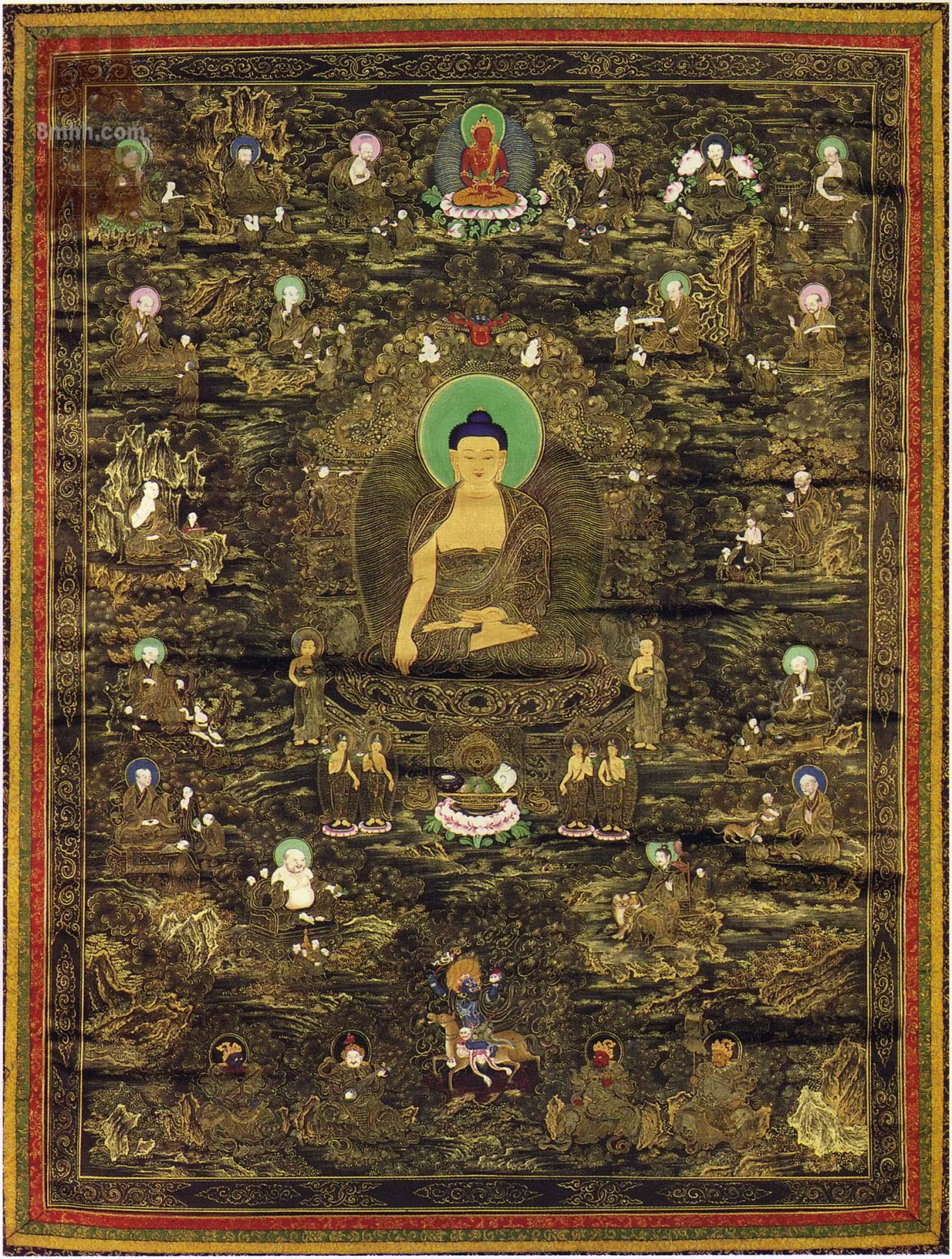
Quick answer: A digital watermark is an added identifying overlay rather than part of the depicted artwork. In TK0581, translucent modern lettering crosses the upper-left image area and differs from painted contours in opacity, alignment, and edge behavior. Record it separately from inscriptions, seals, damage, and original iconography.
Digital images of Buddhist paintings often contain evidence from more than one moment. The artwork may show figures, landscape, borders, inscriptions, and condition changes, while a photographer, archive, website, or later distributor may add a logo or text across the reproduction. If those layers are not separated, a modern overlay can be mistaken for an original inscription or collection mark.
TK0581 offers a clear case for documenting a digital watermark in Buddhist art. A large seated Buddha-like figure dominates the center, surrounded by numerous smaller monastic and attendant figures arranged through a dark landscape. Near the upper-left corner, pale translucent modern lettering crosses both background and depicted forms. Its visual behavior differs from the painted image beneath it.
What watermark evidence is visible in TK0581?
A broad, low-opacity word or domain-like fragment is visible across the upper-left pictorial field. The letters run horizontally and remain lighter than the dark landscape while still allowing underlying figures and branches to show through.
The overlay crosses unrelated depicted elements without changing its baseline or typographic form. It is not contained by the painted border, a cartouche, a cloud, or an inscription panel. Only part of the text is clearly legible at the available scale, so the archive record should avoid reconstructing missing characters or naming an owner from an uncertain fragment.
How does a watermark differ from an original inscription?
A watermark usually follows modern typographic and digital-layer behavior, whereas an original inscription belongs to the artwork's material and compositional structure. The distinction should be based on visible evidence, not merely on language or location.
| Feature | Digital watermark | Original inscription or seal |
|---|---|---|
| Opacity | Translucent and even across different forms | Usually responds to the material surface and wear |
| Alignment | Modern horizontal baseline independent of composition | Placed within a designed panel, margin, seal field, or painted space |
| Edges | Uniform digital-looking letter edges | Brush, stamp, pigment, abrasion, or fabric behavior may be visible |
| Occlusion | Floats across figures and landscape | Participates in the object's physical layering |
Why is the watermark not a collector's seal?
The visible overlay does not behave like a traditional stamped or painted seal. Collector's seals commonly occupy a bounded shape and have material edges, while the TK0581 overlay is an extended translucent text line crossing the image.
This conclusion concerns visual behavior, not ownership. The overlay may have been added by a website, archive, photographer, vendor, or another intermediary, but the fragment alone does not prove which one. For comparison, the TANGKAWORLD guide to Buddhist painting seals explains what should be recorded when a physical mark is present.
How can you document a watermark reproducibly?
Document the overlay as a separate image layer with its own location, dimensions, opacity, text confidence, and relationship to the artwork. Preserve the unedited source file.
- Record the source. Save filename, TK number, pixel dimensions, color space, file size, and checksum.
- Map the overlay bounds. Note its approximate pixel coordinates and the depicted forms it crosses.
- Transcribe conservatively. Record only clearly visible characters; use brackets or “uncertain” for missing portions.
- Test transparency. Check whether underlying lines remain visible through the letters at a consistent strength.
- Compare edge behavior. Inspect whether letter edges resemble modern raster text rather than brushwork, stamping, cracking, or abrasion.
- Search related files. Compare other archive images for the same overlay, placement, font, or domain-like ending.
- Create derivatives only when needed. Keep crops and contrast tests separate, labeled, and linked to the untouched source checksum.
Should a watermark be removed from a research image?
No removal should be performed on the archival source. A watermark is part of the digital file's transmission history even when it is not part of the original artwork. Erasing it would destroy evidence and could fabricate details hidden beneath the letters.
A publication derivative may sometimes be cropped or replaced with a licensed unwatermarked source, but that decision requires rights and provenance checks beyond this visual analysis. Any edited derivative must be labeled. The safest default is to preserve the source, disclose the overlay, and avoid reconstructing obscured forms.
How does the overlay affect iconographic reading?
The overlay reduces confidence in the small forms it crosses but does not invalidate the entire image. Researchers should isolate the affected zone and lower confidence only for details whose contours are obscured or altered.
In TK0581, the watermark crosses the upper-left region containing small figures, branches, clouds, and dark landscape. Descriptions of that local area should therefore remain cautious. The central seated figure, broad halo, lotus throne, surrounding monastic figures, and lower guardian assembly are largely outside the overlay and can be described independently.
What does the wider composition show?
The wider composition presents a dominant central seated Buddha-like figure surrounded by many smaller figures distributed through multiple landscape levels. A second seated red figure appears near the top center, while monks or elders occupy ledges and rocky settings around the main figure.
Below the throne are paired standing figures and a central offering-like cluster. Farther down, smaller guardian or narrative figures appear among dark clouds, rocks, animals, and trees. These are visible compositional observations. The archive title associates the central figure with Shakyamuni Buddha, but individual identities and narrative relationships require stronger evidence.
Can the watermark establish the image's source or ownership?
No. A visible watermark is a lead, not proof of ownership, custody, copyright, collection, or original publication. It may identify a site that displayed the image, yet that site may itself have reproduced material from elsewhere.
Source research requires the complete text, matching files, page history, licensing statements, object records, and ideally a chain back to the physical work or authorized photograph. A filename and partial watermark should never be promoted into a museum attribution or rights claim without that supporting record.
What remains uncertain in TK0581?
The exact watermark text, who added it, when it was added, and what rights or custody it represents are uncertain. The precise identities of the many figures, the scene's full religious program, and the meaning of small attributes are also uncertain.
The date, maker, materials, school, collection, provenance, and relationship between this JPEG and a physical object remain uncertain. Direct evidence is firmer: a central seated figure, multiple surrounding monks and attendants, layered landscape, colored halos, lotus support, lower guardian figures, textile-like borders, and a translucent modern text overlay at upper left.
Frequently asked questions
Is every text fragment on a digital thangka a watermark?
No. Text may be painted, written on the mount, stamped as a seal, added in a catalog photograph, or overlaid digitally. Classify it from placement, opacity, edges, material behavior, and context.
Can I identify the website from a partial watermark?
Only with corroboration. Do not complete missing letters by guesswork. Compare multiple files and archived pages before recording a site name as probable or confirmed.
Does a watermark make the image unusable?
No. It limits confidence in the covered area, but unaffected regions may remain valuable for composition, figure placement, color, and comparative research.
Should the watermark appear in ALT text?
Yes when it is visually significant. Briefly disclose a translucent modern watermark while keeping the main subject first and avoiding an uncertain transcription.
Conclusion
TK0581 shows why digital overlays must be separated from painted evidence. The upper-left lettering is translucent, typographically aligned, and independent of the underlying composition, supporting its classification as a modern watermark. Recording its bounds, visibility, and uncertainty preserves transmission history while preventing it from being mistaken for an inscription, seal, provenance mark, or original iconographic feature.
Sources and editorial method
This article is based on direct visual analysis of the TANGKAWORLD TK0581 image. Visible overlay evidence, religious identification, and uncertain historical attribution are treated as separate levels. The method uses source checksums, native-scale inspection, opacity and edge comparison, conservative transcription, related-file comparison, and explicit confidence labels; neither the filename nor watermark fragment is treated as a verified museum or rights record. For the broader workflow and further references, consult How to Study Thangka Iconography with High-Resolution Images and Buddhist Painting Seals: How to Read Collector Marks.
Prepared and reviewed by the TANGKAWORLD editorial team. Last reviewed: September 17, 2026.

