How to Map Gaze Direction in Buddhist Art: TK0380
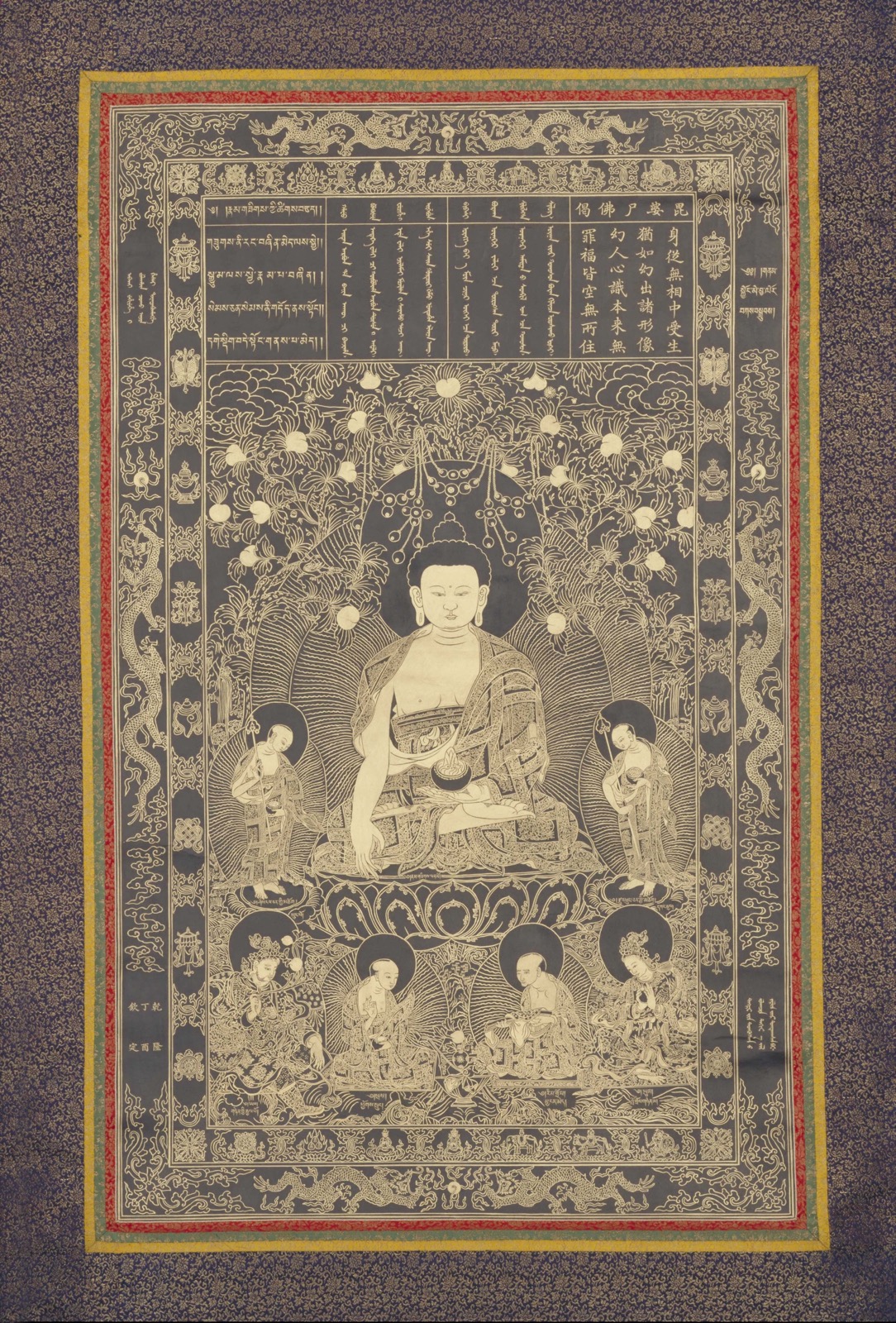
Quick answer: Map gaze direction by recording the head axis, face angle, eyelid line, and the nearest likely focus separately. In TK0380, the central Buddha remains frontal while attendants and lower figures turn in varied directions. These relationships organize attention around the central figure, but tiny pupils alone cannot securely identify who looks at whom.
A Buddhist assembly does not direct attention only through scale and symmetry. Heads incline, faces turn, eyelids lower, and bodies angle toward or away from nearby figures. These small decisions can guide the viewer through a composition even when no painted line literally connects one person to another.
TK0380 is a useful case for studying gaze direction in Buddhist art. A large seated Buddha occupies the center, flanked by two standing attendants and four figures in a lower register. Fruiting branches, a circular halo, a lotus throne, a multiscript text panel, and dragon borders surround them. Rather than naming every figure, this article asks a narrower question: how can a researcher document visual attention without claiming more than the image shows?
What evidence reveals gaze direction?
Head orientation is usually the strongest evidence, followed by face angle and eyelid direction. Pupil position may help in a sharp close-up, but it is often too small, stylized, or compressed to carry the conclusion alone. Torso angle and hand placement provide supporting context rather than proof of sight.
Four observations should be kept separate. First, record whether the head is frontal, turned, tilted, or bowed. Second, note which side of the face is more visible. Third, describe whether the eyes appear open, lowered, or unclear. Fourth, identify any nearby figure or object that may be the focus. A “likely focus” is an interpretation and should be labeled accordingly.
How does the central Buddha hold the viewer’s attention?
The central Buddha is nearly frontal and much larger than the surrounding figures, so the composition establishes this figure as its primary visual anchor. The face appears calm and broadly symmetrical, with lowered or narrowly drawn eyes. That restrained gaze does not point sharply toward a single attendant or object.
The frontal pose stabilizes the image while other heads create directional movement around it. The central body, dark halo, pale face, lotus support, and vertical alignment beneath the text panel reinforce the same axis. The viewer therefore returns to the center even after following the smaller figures below.
What do the standing attendants contribute?
The two standing attendants create inward-directed attention through inclined heads and bodies positioned toward the central Buddha. Their exact eye targets are too small to establish securely, but their overall orientation supports a paired relationship with the central figure.
The left attendant bends the head and upper body slightly inward. The right attendant also turns and inclines toward the center. Because their placements mirror one another broadly without duplicating every detail, they function as directional brackets. The useful statement is that both visually lead toward the central axis, not that each looks at one precisely identified hand or object.
How can the lower register be mapped?
The lower register should be indexed from left to right before interpreting glances. Four haloed figures sit beneath the lotus throne. Their faces and torsos do not all share one orientation, so the row creates several short attention paths rather than a single symmetrical gaze.
| Figure zone | Visible orientation | Safe conclusion |
|---|---|---|
| Central Buddha | Frontal head with lowered-looking eyelids | Stable central attention; precise eye target uncertain |
| Standing pair | Heads and bodies incline inward | Both guide attention toward the central axis |
| Lower left pair | Faces angle toward the row’s interior | A local relationship is plausible, not an identified dialogue |
| Lower right pair | Heads differ in tilt and face direction | Record each orientation before grouping the pair |
A numbered record such as lower figure 1 through lower figure 4 is safer than beginning with names. For each, note head axis, visible cheek, eyelid direction, torso angle, hands, and neighboring objects. This extends the approach in the TANGKAWORLD guide to Buddhist attendant figures while keeping today’s analysis focused specifically on visual attention.
How do you build a reproducible gaze map?
A reproducible map uses the same observations for every figure and preserves uncertainty at each step. Another researcher should be able to see which part of the conclusion comes from the pixels and which part comes from compositional interpretation.
- Index every face. Assign neutral identifiers by register and position before using religious names.
- Draw the head axis. Mark a simple line from crown to chin and record any tilt.
- Estimate the face angle. Note frontal, three-quarter, profile, bowed, or unclear.
- Inspect the eyelids. Record open, lowered, closed-looking, or unresolved without inventing pupils.
- Add the torso axis. Compare the shoulders and chest with the direction of the head.
- Propose a focus. Identify the nearest plausible figure, object, or central axis and label confidence.
- Return to full view. Test whether the individual directions create a coherent route through the whole composition.
Why can head direction and eye direction disagree?
Stylized figures may turn the head while keeping the eyes nearly frontal, or lower the eyelids while the torso faces another direction. Such differences can express contemplation, deference, or compositional balance, but those meanings should not be assumed automatically.
Digital limitations add another problem. At reduced size, a short eyelid stroke can resemble a pupil, and compression can merge the eye with the brow. The high-resolution iconography workflow is therefore essential: examine the full composition first, zoom into the face, and then return to the whole image before recording a target.
Does an inward gaze prove devotion or hierarchy?
No. Inward orientation can emphasize a central figure, but it does not by itself identify the surrounding people as devotees, donors, disciples, or named attendants. Scale, placement, gesture, dress, inscriptions, and series context must also be considered.
For TK0380, the two standing figures clearly support the center compositionally. The four lower figures form a secondary assembly. Those are strong layout observations. Their individual identities and relationships remain uncertain because this digital image alone does not supply a verified object record or fully transcribed labels.
What should remain uncertain in TK0380?
The archive filename’s association with Vipaśyin Buddha remains a research lead rather than a confirmed identification. The exact identities of the attendants and lower figures, the readings of all inscriptions, the doctrinal meaning of every glance, and the date, maker, materials, school, collection, and provenance are uncertain.
Visible evidence can still be stated carefully: one dominant frontal Buddha, two inward-inclining standing attendants, four lower haloed figures with varied face directions, a rounded lap vessel, a large halo, fruiting trees, a lotus throne, multiscript text, and decorated borders. This division between observation and attribution keeps the gaze map useful even if later documentation changes the names.
Frequently asked questions
Can a lowered gaze identify a specific Buddha?
No. Lowered eyes are common across many Buddhist images. Identification requires a larger evidence set that may include gestures, attributes, inscriptions, attendants, series context, and a traceable record.
Should I draw arrows over the archive image?
Use arrows only on a separate research derivative. Preserve the source unchanged, identify the overlay clearly, and retain a legend explaining whether each arrow shows head direction, eye direction, or a proposed focus.
What if the pupils are not visible?
Record the pupils as unresolved and rely on head axis, face angle, eyelid line, torso direction, and composition. Uncertainty is more accurate than enlarging compression artifacts into evidence.
Does every figure need a gaze target?
No. Some figures may have a meditative, frontal, or ambiguous gaze with no specific target. A gaze map should allow “none visible” and “uncertain” rather than forcing every face into a network.
Conclusion
TK0380 shows that visual attention can be documented without pretending to read every painted eye. The central frontal figure anchors the image, the standing pair directs attention inward, and the lower register creates several local orientations. By separating head axis, face angle, eyelids, torso, and proposed focus, researchers can build an auditable gaze map while leaving religious and historical claims appropriately uncertain.
Sources and editorial method
This article is based on direct visual analysis of the TANGKAWORLD TK0380 image. Visible evidence, religious identification, and uncertain historical attribution are treated as separate levels. The editorial method uses neutral figure indexing, head-axis and face-angle comparison, full-image review, and confidence labels; the filename is not treated as a verified museum record. For reusable methods and further references, consult How to Study Thangka Iconography with High-Resolution Images and Buddhist Attendant Figures in Thangka: A Visual Guide.
Prepared and reviewed by the TANGKAWORLD editorial team. Last reviewed: September 6, 2026.

