How to Map Halos in a Crowded Buddhist Image: TK0377
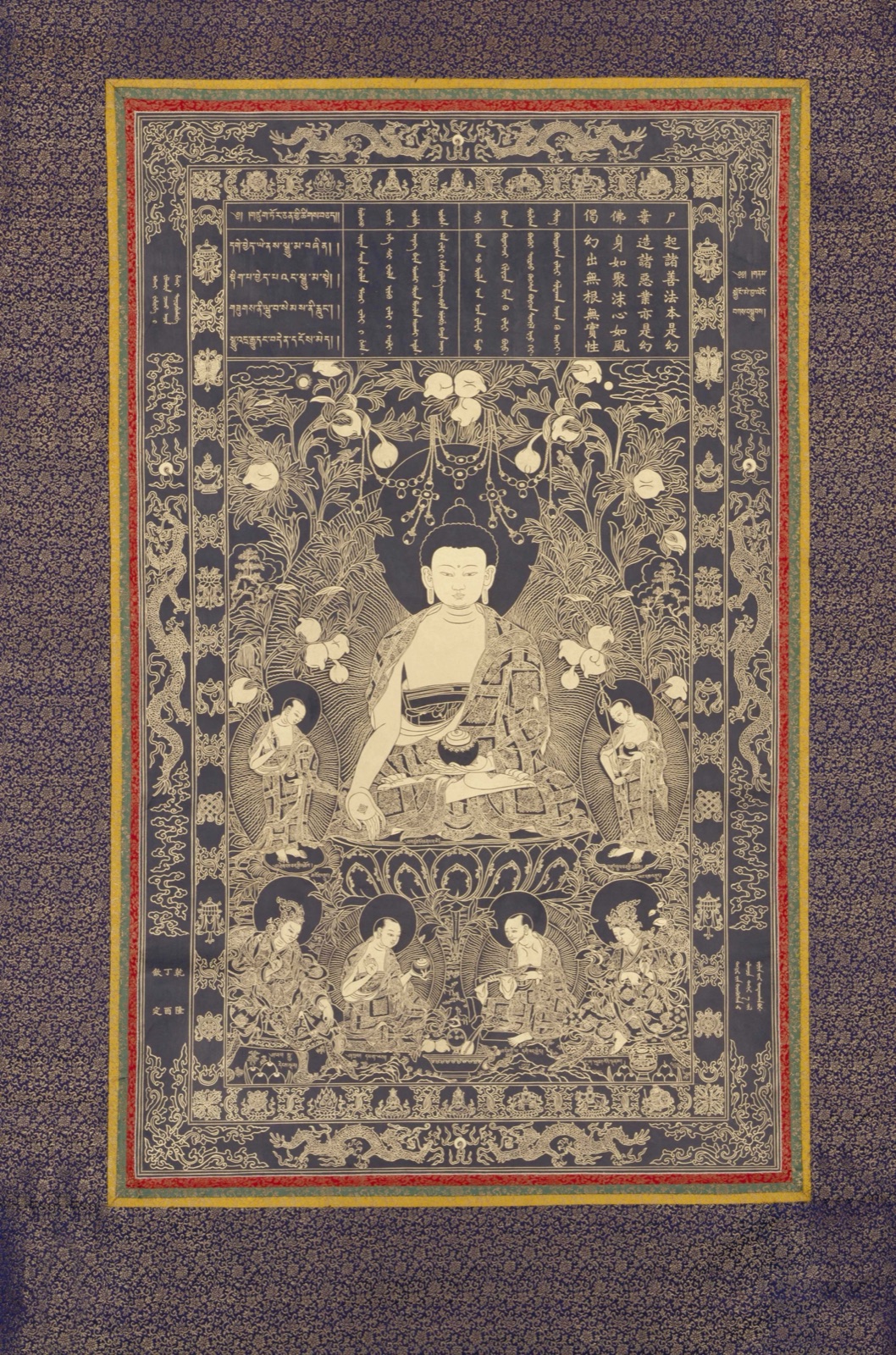
Quick answer: Map halos by recording each figure’s position, halo shape, outer boundary, line density, overlaps, and visibility before assigning meaning. In TK0377, six smaller circular halos and a broad dark central aureole organize the assembly. Halo form supports a compositional reading, but it cannot alone verify the Buddha’s identity, date, workshop, or provenance.
Halos are easy to recognize and oversimplify. TK0377 offers a useful case for precise Buddhist halo documentation because several halo systems occupy one compact composition.
The image presents a large seated Buddha above a lotus throne, two standing attendants, and four haloed figures below. Trees, flowers, an upper text panel, dragons, auspicious motifs, and layered borders surround the assembly. The filename links the image to Śikhin Buddha, but that association is not proof.
What is Buddhist halo documentation?
Buddhist halo documentation is the systematic recording of a luminous or framing field around a sacred figure without assuming that the field alone identifies the figure. A useful record describes geometry, boundary, decoration, color, overlap, and visibility. Interpretation is added only after those visible facts are secure.
Words such as “halo,” “aureole,” and “nimbus” vary across catalogues. Record what is visible first: a circle behind the head, a larger field behind the body, a radiating band, or a partly obscured contour. Neutral geometry remains useful when terminology changes.
Which halo forms are visible in TK0377?
TK0377 shows six clearly bounded circular halos around the smaller figures and a much broader dark framing field behind the central Buddha. The central boundary is less isolated because it meets dense foliage, garment lines, and the upper canopy area.
| Figure zone | Visible halo evidence | Safe record |
|---|---|---|
| Central seated Buddha | Broad dark field behind the head and upper body | Large central aureole; outer contour partly merged with surrounding forms |
| Viewer-left standing figure | Round dark disc with repeated radiating lines | Circular halo, partly overlapped by the figure |
| Viewer-right standing figure | Matching round disc behind the head and torso | Circular halo with similar scale and line treatment |
| Four lower figures | Four separate dark discs behind the heads | Smaller circular head halos in a balanced lower row |
The count should be tied to visible figures rather than decorative circles. Small round forms also appear among the plants and ornaments, but their location and relationship to bodies differ from the six clearly figure-centered discs. Position is therefore as important as shape.
Why does the central aureole look different?
The central aureole looks different because scale, open space, and surrounding detail give the main Buddha a larger visual field. The pale face and torso stand against a dark area, while dense tree branches and gold lines gather around its outer edge. This contrast makes the central body readable before the eye reaches the smaller figures.
A larger halo can support a hierarchy reading, but it is not a mathematical rank code. Artists adapt halo size to posture, available space, and composition. In TK0377, the seated body occupies far more space than either standing attendant.
The gold-line treatment also affects perception. Bright contours remain highly visible on the dark ground, while the darker interior fields join the surrounding background. The TANGKAWORLD guide to black thangka and gold-line painting explains why contour density and contrast should be documented separately from claims about material or age.
How do overlaps change a halo reading?
Overlaps show which forms belong to a figure and which belong to the setting. A halo normally sits behind the head or body, so the figure interrupts its contour. Foliage, robes, hands, seats, and neighboring ornaments may conceal other sections. Recording those interruptions helps reconstruct the intended geometry without digitally inventing missing lines.
In TK0377, the standing figures cover parts of their radiating discs, and the lower figures interrupt their smaller head halos. The central aureole is harder to isolate because its edge meets trees and patterned lines. A researcher should mark the boundary as “visible,” “probable continuation,” or “not resolved” rather than drawing a perfect circle across obscured areas.
How do you map halos step by step?
Map halos from the whole composition to individual boundaries. This order keeps the figure hierarchy visible and prevents a decorative round form from being mistaken for a sacred halo.
- Set orientation. State that left and right refer to the viewer, then record the TK number, source dimensions, derivative filename, and checksum.
- Number the figures. Assign stable position codes to the central figure, two side figures, and four lower figures before tracing any halo.
- Classify basic geometry. Record circle, oval, body-length field, flame-like surround, or unresolved form. Do not force a hidden edge into a perfect shape.
- Trace visible boundaries. Mark where a contour is continuous, interrupted by a body, lost in foliage, or merged with the ground.
- Record interior treatment. Note solid dark areas, concentric bands, rays, fine parallel lines, repeated motifs, and empty zones.
- Measure relationships. Compare halo width with head width and figure height. Relative measurements remain useful when the physical object size is unknown.
- Add confidence fields. Separate direct observation, reconstructed continuation, iconographic interpretation, and historical attribution.
Can a halo identify Śikhin Buddha?
No. The halo system in TK0377 helps explain visual hierarchy, but it cannot independently confirm Śikhin Buddha. Circular head halos and broad central aureoles occur widely in Buddhist art. Secure identity would require coordinated evidence from inscriptions, attributes, documented series context, and a reliable file-to-object record.
The archive filename should still be preserved as evidence of a prior association. Store “Śikhin Buddha” in an archive-title or proposed-identity field with an uncertainty note. Keep the halo map separate. That map remains accurate even if a later transcription or catalogue comparison changes the identification.
A related TANGKAWORLD guide examines how a closely corresponding Sikhin Buddha image uses four-language inscriptions. It demonstrates why written and series evidence can be stronger than pose or halo alone. It does not establish that TK0377 is the same physical object.
What can high resolution add to halo analysis?
High resolution can reveal broken contours, fine rays, repeated line patterns, and small gaps hidden in a screen preview. It can also help distinguish a deliberate halo edge from compression noise or a neighboring plant stem. The 3427 by 5179-pixel source of TK0377 preserves considerably more boundary detail than a thumbnail.
Resolution does not reveal everything. A photograph cannot prove the metallic composition of the lines, the original support, the reverse of the work, repainting, or the exact color of an object under controlled light. The high-resolution thangka study guide explains how to move between full view and detail while retaining this evidence boundary.
What should a halo documentation checklist include?
A reusable halo record should include:
- Figure position code and relationship to the central axis.
- Halo type, basic shape, width, height, and visible contour.
- Interior bands, rays, motifs, fill, and line density.
- Overlap with head, body, robe, foliage, seat, and neighboring forms.
- Sections that are visible, reconstructed, obscured, or unresolved.
- Relative measurements and the pixel dimensions of the source.
- Proposed interpretation, supporting evidence, confidence, and reviewer date.
The checklist enables comparison without claiming that every difference has a fixed meaning. Two images can share circular halos yet organize them differently through scale, spacing, rays, and overlap.
Frequently asked questions
Is every circle behind a figure a halo?
Not automatically. Confirm that the circle is centered on a head or body, lies behind the figure, and behaves consistently with other sacred framing fields. Decorative discs, flowers, jewels, and celestial forms require separate records.
Should an obscured halo be completed digitally?
Not in the evidence copy. A separate interpretive overlay may show a probable continuation, but it must be labeled as reconstruction. Preserve the unaltered source and mark hidden sections as unresolved.
Does a larger halo always mean a more important figure?
A larger halo often supports visual emphasis, but size also responds to posture, available space, and composition. Treat hierarchy as an interpretation supported by several features, not a rule derived from diameter alone.
Can halo style determine a thangka’s date or school?
No single halo style securely determines date or school. Comparison can generate a research hypothesis, but attribution requires material evidence, inscriptions, provenance, and documented examples of the same object or workshop tradition.
Conclusion
TK0377 shows that halos are structured visual evidence, not generic circles. Recording geometry, line density, overlap, visibility, and relation to each figure produces a map that can be checked and revised. The image supports a clear compositional analysis; its precise identity and historical attribution remain uncertain.
Sources and editorial method
This article is based on direct visual analysis of TANGKAWORLD image TK0377 and the internal guides linked above. It separates visible halo geometry, religious interpretation, and uncertain historical attribution. No transcription, date, maker, school, collection, provenance, or physical-object identity has been invented from the filename or visual resemblance. The Śikhin association is reported only as uncertain archive context.
Prepared and reviewed by the TANGKAWORLD editorial team.
Last reviewed: September 3, 2026.

