How to Map Simultaneous Narrative in Buddhist Art: TK0469
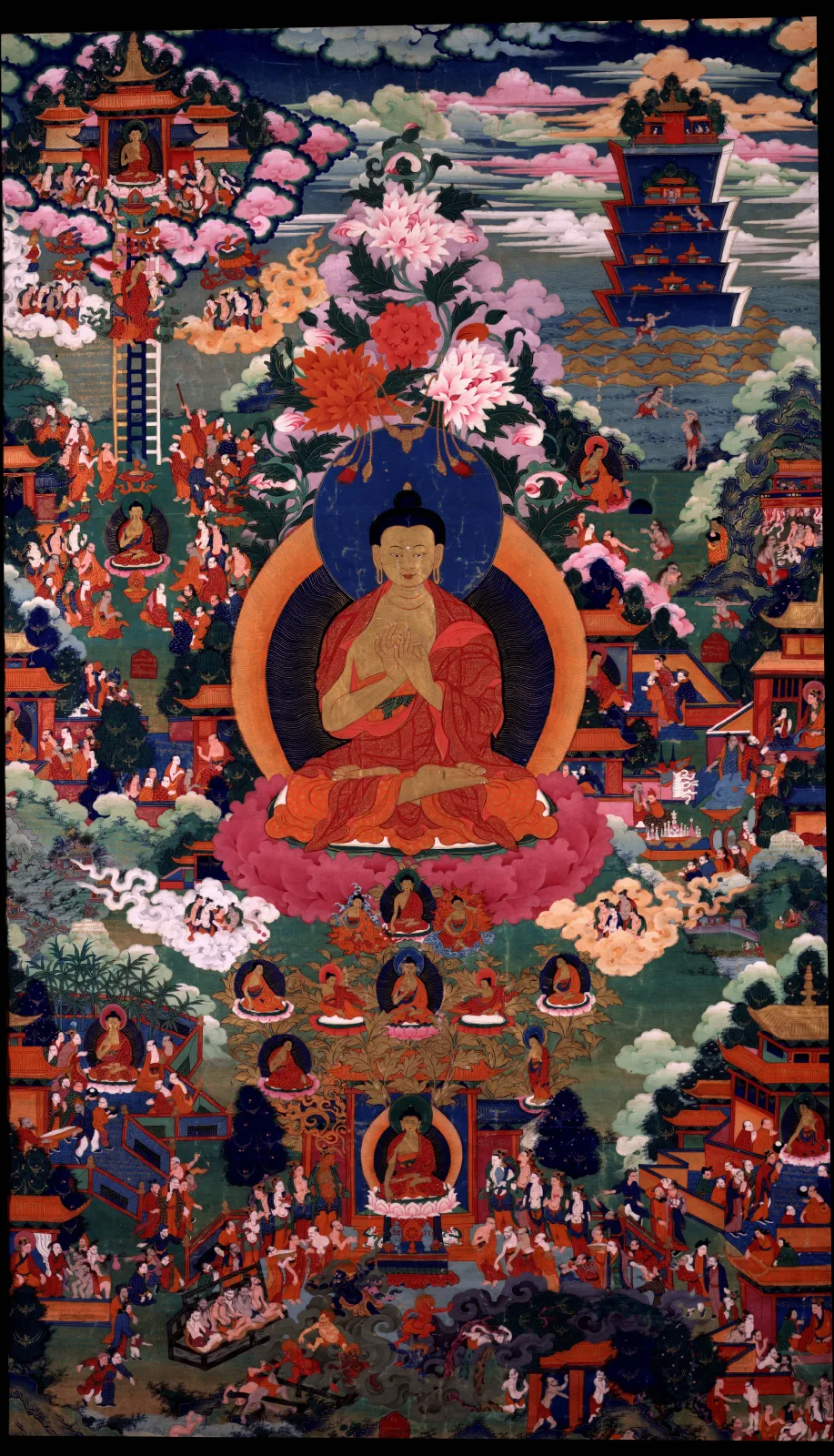
Quick answer: Simultaneous narrative presents several episodes within one continuous image rather than isolating each in a separate frame. In TK0469, clouds, buildings, landscape bands, figure clusters, and changes in scale create local scenes around a dominant central Buddha, but their precise stories and chronological order remain uncertain.
A crowded Buddhist painting can contain far more than one moment. A central sacred figure may anchor the whole composition while smaller groups enact teachings, journeys, offerings, miracles, or biographical episodes around it. The viewer must decide where one scene ends and another begins even when no rectangular panel marks the boundary.
TK0469 provides a strong case for studying simultaneous narrative in Buddhist art. A very large seated Buddha-like figure occupies the center. Around that figure are palaces, tiered buildings, cloud banks, a huge flowering plant, groups of monks and laypeople, animals, secondary Buddhas, and many compact encounters. The method below identifies visual scene units without forcing names or chronology onto uncertain details.
What is simultaneous narrative in Buddhist art?
Simultaneous narrative is the presentation of multiple episodes in a single continuous pictorial field. Different moments may share the same landscape, and the same principal figure may appear more than once. The arrangement can be thematic, spatial, hierarchical, or chronological, but chronology must be demonstrated rather than assumed.
In TK0469, the surrounding groups are not divided into equal boxes. Instead, clouds, architecture, vegetation, paths, water, and changes of scale create soft boundaries. The central Buddha remains visually present while the eye moves among smaller clusters, making the image both iconic and narrative.
How does the central Buddha organize the surrounding scenes?
The central Buddha organizes the image through exceptional scale, frontal placement, a large circular aureole, and a broad lotus seat. These features make the figure the primary anchor even though dozens of smaller people and events occupy the surrounding field.
The body also divides the composition into left and right routes. Smaller scenes gather around the shoulders, halo, throne, and lower lotus. Viewers can leave the center to inspect a local episode and then return to the face, hands, or lotus as a stable reference point. This hierarchy does not prove that every surrounding scene occurs before or after the central moment.
Which visual cues create scene boundaries?
Scene boundaries are created by interruptions and enclosures rather than hard frames. A cloud bank can separate upper and lower groups; a temple wall can contain an assembly; a rocky ledge can support one encounter; and an open patch of sky or ground can prevent adjacent figures from merging.
| Cue | Visible effect | Safe conclusion |
|---|---|---|
| Cloud banks | Wrap around figure groups and buildings | A local scene unit is likely |
| Architecture | Creates rooms, courts, platforms, and towers | Figures belong to a shared setting |
| Landscape ledges | Support compact groups at different heights | Vertical position separates episodes |
| Scale changes | Distinguish dominant and secondary figures | Hierarchy is visible; time is not proven |
| Gaze and gesture | Link nearby participants | A local interaction is plausible |
How can researchers segment the image without naming episodes?
Researchers can assign neutral scene identifiers based on position and enclosure. Names such as “upper-left temple group” or “lower-right cloud assembly” preserve location without inventing a story.
- Start with the dominant anchor. Record the central figure, aureole, lotus, and throne as the reference zone.
- Trace major dividers. Follow continuous cloud banks, walls, water edges, vegetation, and rocky ledges.
- Group interacting figures. Use gaze, gesture, shared objects, and proximity to define a local cluster.
- Assign neutral coordinates. Label scenes by upper, middle, lower, left, center, and right positions.
- Record repeated figures cautiously. Similar robes or halos do not automatically prove the same person appears twice.
- Test alternative boundaries. Note where one cluster could reasonably join an adjacent scene.
- Delay chronology. Establish a sequence only after inscriptions, narrative sources, or consistent directional cues support it.
Does vertical position indicate chronological order?
Not by itself. Upper scenes may represent distant places, elevated status, celestial realms, or simply compositional balance. Lower scenes may show earthly settings, later events, donors, or guardian figures. Position is evidence about layout before it is evidence about time.
TK0469 includes a prominent upper-left temple assembly, a large floral form near the top center, a tiered architectural structure at upper right, numerous lateral groups, and dense lower gatherings. These zones may belong to an organized narrative program, but reading them top-to-bottom or clockwise remains a hypothesis until corroborated.
How do repeated Buddha figures function?
Repeated Buddha-like figures may mark different episodes, teaching locations, ritual presences, or a hierarchy of sacred beings. Their recurrence creates continuity, but visual similarity alone cannot establish whether they depict one individual at several moments or multiple individuals.
In TK0469, smaller seated Buddha figures appear in architectural and landscape settings above and below the central figure. Researchers should index each one by position, halo color, gesture, seat, nearby attendants, and setting. Only after comparison should a proposed identity or narrative role be added with a confidence level.
What role does the giant flowering plant play?
The large flowering plant near the upper center acts as a compositional separator and connector. Its stem rises behind the central figure, while large blossoms occupy the space between upper scenes. The plant links vertical zones without behaving like a rectangular frame.
Its exact species and symbolic meaning remain uncertain. The reliable observation is structural: the plant creates a central route, interrupts the horizontal sky bands, and provides a buffer between the upper-left assembly and upper-right tiered architecture. Botanical or doctrinal naming would require stronger evidence.
How should animals and lower guardian figures be recorded?
Animals and lower figures should be indexed as scene participants before being assigned narrative names. Species, posture, direction, nearby people, and setting can be recorded directly, while identity and episode remain interpretive.
The lower field of TK0469 contains dense groups, dark cloud or smoke forms, animals, buildings, and forceful figures. This area may differ in mood from the calm central Buddha, but visual contrast does not by itself establish a specific hell, battle, miracle, or protective rite. Neutral scene mapping keeps later identifications auditable.
Can the filename verify a Brooklyn Museum attribution?
No. The filename's Brooklyn Museum reference is a research lead, not verified provenance. A trustworthy attribution would require a matching accession record, dimensions, title, image, rights statement, and object history from a traceable source.
The filename should remain preserved in metadata because it may help future reconciliation. It should not be converted into a confirmed collection statement inside the article. The same caution applies to the archive title's Shakyamuni identification: it is plausible context, but the visual analysis here does not independently verify it.
What remains uncertain in TK0469?
The exact narrative episodes, their order, the identities of repeated Buddha figures and attendants, the meaning of the great flower, and the role of lower guardians remain uncertain. Some small objects and gestures are also too compact for secure identification in a web derivative.
The date, maker, materials, school, collection, provenance, and museum attribution are uncertain. Direct visual evidence is firmer: one dominant central seated figure, many local groups, repeated sacred figures, palaces and towers, cloud enclosures, landscape ledges, flowers, animals, lower dramatic scenes, and a composition that supports multiple simultaneous narrative units.
Frequently asked questions
Must a simultaneous narrative repeat the same person?
No. Multiple episodes can be linked by setting, doctrine, or theme without clearly repeating one protagonist. Repetition should be demonstrated through attributes and context.
Can clouds be treated as panel borders?
They can function as soft boundaries, but they may also connect scenes. Trace where a cloud band encloses, separates, overlaps, or opens before assigning a boundary.
What is the safest way to label an unknown scene?
Use neutral coordinates and visible content, such as “upper-right tiered building with small figures,” then add interpretations in a separate field with confidence levels.
Does the largest figure always represent the latest event?
No. Scale normally signals emphasis or sacred hierarchy more directly than chronology. A sequence needs additional evidence from inscriptions, sources, repetition, or directional cues.
Conclusion
TK0469 shows how one continuous painting can hold many local scenes around a stable sacred center. Clouds, architecture, ledges, scale, gaze, and vegetation create boundaries without rigid panels. By indexing clusters before naming them and separating spatial hierarchy from chronology, researchers can map simultaneous narrative while keeping uncertain episodes, attributions, and identities open to further evidence.
Sources and editorial method
This article is based on direct visual analysis of the TANGKAWORLD TK0469 image. Visible scene-boundary evidence, religious identification, and uncertain historical attribution are treated as separate levels. The method uses full-image review, neutral coordinate labels, cloud and architecture tracing, figure-cluster indexing, alternative-boundary testing, and explicit confidence labels; the filename is not treated as a verified museum record. For the broader method and further references, consult How to Study Thangka Iconography with High-Resolution Images and How to Read a Thangka: A Beginner’s Guide.
Prepared and reviewed by the TANGKAWORLD editorial team. Last reviewed: September 18, 2026.

