How to Record Guardian Figures on a Buddha Throne: TK0187
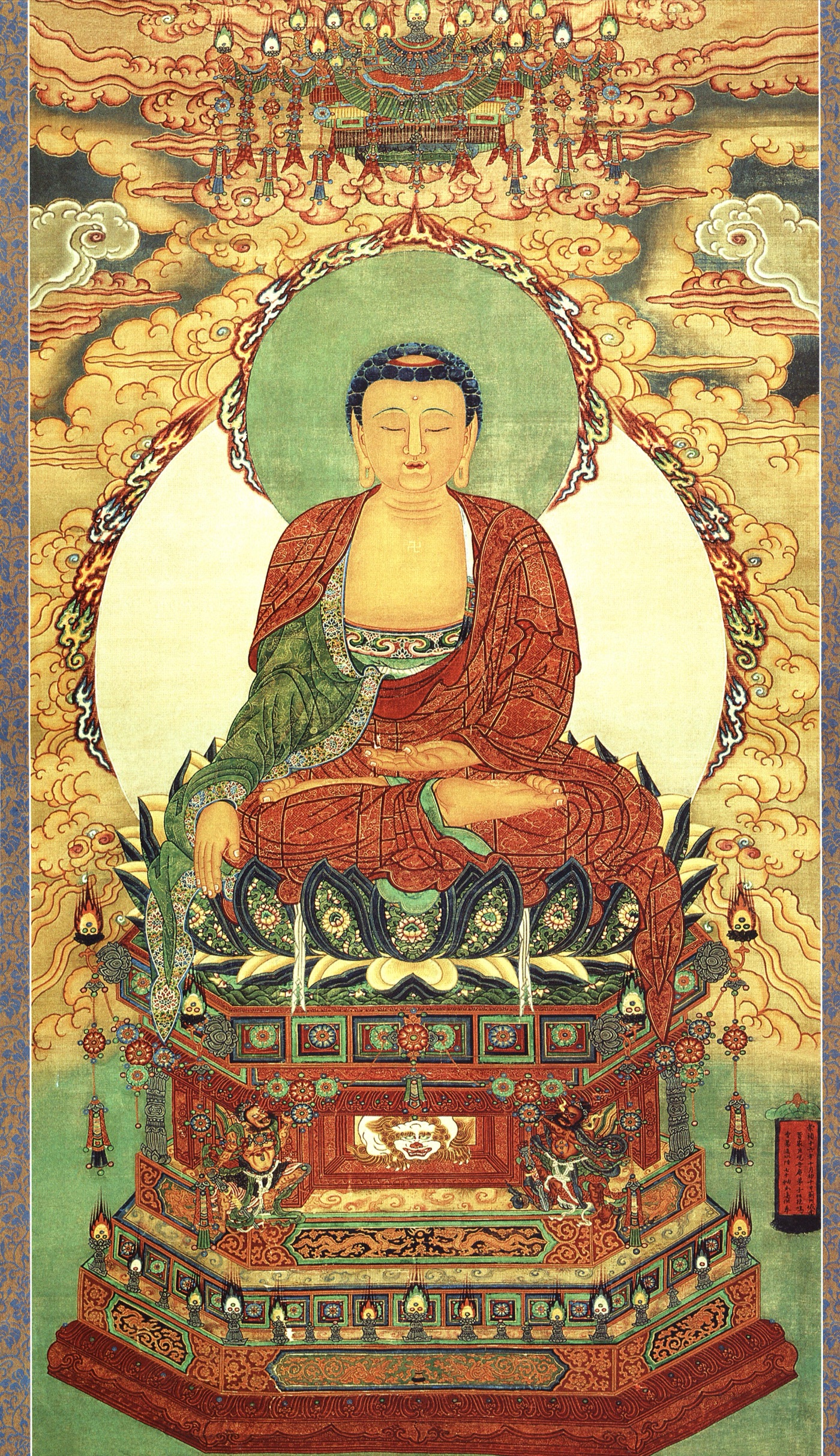
Quick answer: Guardian figures on a Buddha throne should be recorded by location, pose, direction, scale, and contact with the architecture before they are named. In TK0187, two dynamic figures occupy a pedestal band on either side of a central mask-like face, visually supporting and protecting the sacred seat without securely revealing their individual identities.
Small figures beneath a Buddha can be easy to overlook. They may be called guardians, attendants, donors, throne bearers, decorative spirits, or narrative characters, yet those labels describe different roles. The most reliable starting point is not a name but a map of where each figure stands and how it interacts with the throne.
TK0187 provides a clear case for documenting guardian figures on a Buddha throne. A large seated Buddha-like figure occupies the upper center on a lotus support. Far below, inside a highly decorated architectural pedestal, two small dynamic figures flank a central pale, mask-like face. Their position, movement, scale, and symmetry distinguish them from the calm central figure and from the repeated lamp or finial forms around the platform.
Where are the guardian figures in TK0187?
The two guardian-like figures occupy the middle of the throne base, below the lotus and above the lowest stepped courses. Each stands or braces within an architectural bay, one to the left and one to the right of a central rectangular panel containing a frontal face.
Their placement matters more than an immediate identification. They are not floating in the cloud field, seated beside the Buddha, or positioned outside the throne. They are embedded within the structure that supports the sacred figure. That architectural attachment makes a protective or supporting function plausible, although the exact role remains uncertain.
What visible evidence suggests a guardian role?
A guardian interpretation is supported by dynamic posture, bilateral placement, expressive bodies, and proximity to a threshold-like central panel. These features contrast with the still, frontal Buddha-like figure above.
The two lower figures bend, turn, or gesture rather than sit in meditation. Their clothing and bodies are rendered with strong color contrasts, and they face inward toward the center of the pedestal. They occupy the same horizontal register and balance one another across the central axis. None of these features alone proves identity, but together they establish a coordinated pair associated with the throne.
How are guardians different from decorative motifs?
Guardians behave as embodied participants, while decorative motifs repeat as patterns or architectural ornaments. The distinction can be tested through anatomy, pose, gaze, and interaction.
| Feature | Guardian-like figure | Decorative or architectural motif |
|---|---|---|
| Body | Limbs, torso, head, and active pose are visible | Pattern, finial, panel, column, or hanging ornament |
| Direction | Turns or gestures toward the central bay | Follows the structure's repeated alignment |
| Variation | Left and right figures differ in color and pose | Units repeat with regular shape and spacing |
| Role | Appears to act within or protect the space | Frames, supports, fills, or marks the architecture |
Why does the central face matter?
The central face creates a focal threshold between the paired figures. It is frontal, pale, and enclosed by a rectangular architectural panel, while the two guardians are shown in more active three-quarter or profile-like poses.
The face may be a lion-like mask, protective emblem, architectural ornament, or another type of symbolic head, but its exact identity is uncertain. A careful record should describe the visible eyes, mouth, mane-like outline, color, and enclosure before applying a specialized term. The important compositional fact is that both lower figures orient around this central panel.
Do the two guardians form an identical pair?
No. The figures form a coordinated pair, but they are not exact duplicates. Their colors, gestures, body angles, clothing, and nearby details differ.
This asymmetry is useful evidence. A mirrored architectural position can signal a shared function even when the individuals are distinct. Researchers should therefore record pair structure and individual features separately: “left guardian-like figure” and “right guardian-like figure” are safer catalogue labels than a single plural name that assumes both identities are known.
How does scale separate sacred and protective roles?
Scale makes the Buddha-like figure dominant and the guardians subordinate. The seated central figure fills most of the composition, while the two lower figures are small enough to fit within one band of the pedestal.
This difference is hierarchical rather than naturalistic. It tells the viewer which presence is primary, but it does not provide physical measurements or prove a historical relationship. The guardians' small scale also binds them to the throne architecture: they function visually as part of the sacred seat's protective base rather than as independent figures in the surrounding cloud field.
What should researchers record about throne architecture?
Researchers should record the throne as a sequence of connected layers. In TK0187, the lotus support, decorated upper rail, hanging ornaments, guardian band, central face panel, repeated flame or lamp forms, painted panels, and broad lower plinth each form a separate register.
Mapping these layers prevents small figures from being detached from their setting. The same guardian pose would mean something different beside a cloud, at a doorway, beneath a lotus, or outside the border. Architectural context is therefore part of the figure record, not optional background.
How can you document uncertain guardians step by step?
Uncertain guardians can be documented with a reproducible sequence that separates visible evidence from interpretation.
- Locate the register. State whether the figure is above, beside, within, or below the throne.
- Assign a neutral label. Use left guardian-like figure and right guardian-like figure before proposing names.
- Record anatomy and pose. Note head direction, bent limbs, hand positions, stance, and body angle.
- Trace architectural contact. Identify the platform, column, rail, panel, or object touched by the figure.
- Compare the pair. Separate shared placement from differences in color, clothing, gesture, and attributes.
- Map nearby motifs. Record the central face, hanging ornaments, lamps, floral units, and painted panels independently.
- Assign confidence. Mark guardian function as probable or possible and personal identity as uncertain unless corroborated.
Can the filename confirm a Water-and-Land ritual context?
No. The filename provides a useful research lead, but it cannot by itself verify ritual use, historical period, or the central figure's identity. The phrase “Water-and-Land Ritual Painting, Ming–Qing Period” should remain archive metadata until it is matched to dependable documentation.
A stronger attribution would require a traceable catalogue entry, accession or inventory number, dimensions, inscription, image match, material record, and provenance. The lower guardian pair may be compatible with a ritual visual program, but compatibility is not confirmation.
What details remain uncertain in TK0187?
The personal identities of the lower figures, the central face, the upper assembly, and the many repeated flame or lamp forms remain uncertain. The exact meaning of the pedestal program, the inscription at lower right, and the relationship between the throne and any specific ceremony also require further evidence.
The date, maker, materials, workshop, school, collection, and provenance are uncertain. Direct visual evidence is firmer: a dominant seated Buddha-like figure, lotus support, circular head halo, pale body surround, cloud field, upper ornamented structure, tiered throne, repeated lights or finials, a central mask-like panel, and two dynamic lower figures.
Frequently asked questions
Are all small figures beneath a Buddha guardians?
No. Small figures may be donors, attendants, throne bearers, narrative characters, deities, or decorative beings. Their placement, pose, contact, and comparative evidence must be assessed.
Does a symmetrical pair always depict the same being twice?
No. Symmetry can coordinate two different figures. Record each side independently before deciding whether the pair represents matching, complementary, or unrelated identities.
Can the central face be identified as a lion?
A lion-like reading is possible, but the web image alone does not securely establish the motif. “Frontal mask-like face” is the safer descriptive label.
Why include throne architecture in a figure record?
Architecture establishes the figure's position and likely function. A guardian embedded in a pedestal band operates differently from a figure in clouds, landscape, or narrative space.
Sources and editorial method
This article is based on direct visual analysis of the TANGKAWORLD TK0187 image. Visible evidence—register, anatomy, pose, direction, scale, pairing, and architectural contact—has been separated from religious interpretation and uncertain historical attribution. The related TANGKAWORLD visual guide to Buddhist Water-and-Land ritual painting explains the wider composition. The beginner's guide to reading a thangka provides a broader method and includes Sources and further reading.
Prepared and reviewed by the TANGKAWORLD editorial team.
Last reviewed: September 20, 2026.
The lower pair in TK0187 becomes more useful when it is treated as evidence rather than a ready-made label. Their shared register, inward orientation, active poses, and attachment to the throne support a guardian-like role, while their individual names remain open. That balance makes the archive record both informative and revisable.

