How to Separate a Main Icon from Embedded Episodes: TK0580
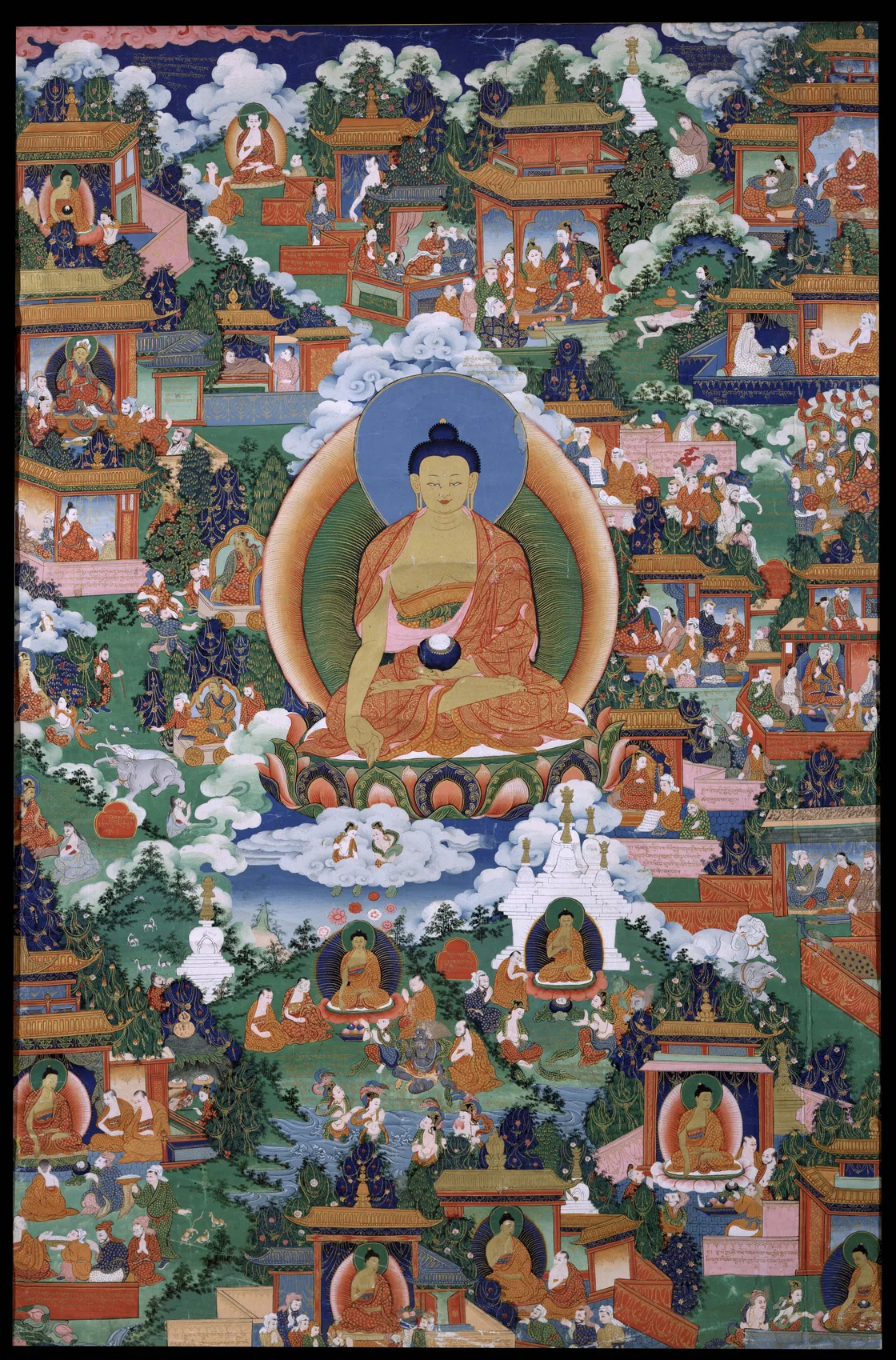
Quick answer: In TK0580, the main icon is distinguished by its dominant scale, centered placement, complete lotus seat, layered halo, frontal stability, and overlap across the surrounding field. The smaller groups behave differently: architecture, clouds, trees, inscriptions, and changes of scale divide them into embedded episodes without establishing a verified chronology.
A dense Buddhist painting can contain two kinds of looking at once. One view presents a single sacred figure for recognition or devotion. Another view distributes many smaller groups across buildings, gardens, roads, clouds, and inscriptions. TK0580 makes that dual structure especially clear. A large seated figure occupies the center, while numerous compact scenes surround it from top to bottom.
The local English archive title is Shakyamuni Buddha, and the central figure visibly makes a lowered earth-touching-like gesture while holding a dark bowl in the lap. Those clues support the archive label, but the file is not a verified museum record. The maker, date, school, collection, provenance, individual inscriptions, and names of the smaller episodes are uncertain.
What is a main icon in a multi-scene Buddhist painting?
The main icon is the figure that organizes the image’s visual hierarchy, even when many other figures appear. It is not necessarily the first event in a story or the only sacred presence. In TK0580, the central figure is much larger than every surrounding person, sits on a fully developed lotus, occupies the strongest vertical axis, and is enclosed by a broad blue head halo and a larger radiating body field.
These features make the figure structurally primary. The body interrupts the middle of the surrounding landscape rather than fitting inside one small room or garden. Its scale is symbolic, not an ordinary measurement of physical distance. Viewers should therefore avoid treating the entire surface as one literal place seen from a single viewpoint.
How do embedded episodes differ from the central icon?
Embedded episodes are compact groups that create local actions or encounters around the dominant figure. In TK0580, some groups sit inside roofed halls; others gather around teachers, texts, bowls, offerings, animals, water, or stupa-like structures. Several zones include writing panels. These combinations suggest discrete units of attention, although their exact subjects cannot be named safely from appearance alone.
The smaller scenes also use a different visual grammar. Their figures face one another, kneel, read, carry objects, travel, or gather in clusters. The central figure remains calm and frontal. This contrast between stable iconic presence and localized activity is stronger evidence than any guess about narrative order.
| Visible evidence | Main icon | Embedded episodes |
|---|---|---|
| Scale | Monumental and composition-wide | Small and locally proportioned |
| Framing | Lotus, layered halo, central axis | Rooms, terraces, trees, clouds, walls |
| Pose | Frontal, stable, self-contained | Interactive, directional, varied |
| Reading role | Establishes sacred focus | Adds encounters, places, and possible episodes |
| Certainty | Archive label plus visible iconographic clues | Most individual identities remain uncertain |
Which visual boundaries separate the smaller scenes?
Scene boundaries in TK0580 are built from architecture and landscape rather than modern boxes. Rooflines create horizontal stops. Walls and terraces enclose groups. Clouds hide transitions and let another cluster begin. Trees form vertical curtains. Rivers, paths, rocks, and changes in ground color create softer divisions. Inscriptions may label or accompany a zone, but unread text should be recorded before it is interpreted.
Some boundaries overlap. A roof may separate one group while a cloud joins it to the larger composition. A tree can frame two neighboring scenes at once. This means the painting should not be divided mechanically into equal rectangles. The goal is to document how attention shifts, not to force every figure into a rigid grid.
How to build a reliable scene inventory
A scene inventory records visible units before assigning names. This is useful for cataloguing, teaching, conservation photography, and digital comparison. It also keeps observation separate from interpretation.
- Mark the dominant icon. Record position, scale, gesture, held object, halo, seat, and overlap with the surrounding field.
- Divide the image into broad zones. Use upper, middle, lower, left, center, and right before inventing a story sequence.
- Number local clusters. Treat a room, terrace, teaching group, procession, animal group, or stupa setting as a candidate unit.
- Describe the boundary. Note whether architecture, cloud, tree, water, wall, or empty interval separates the unit.
- Record actions and objects. Use neutral verbs such as seated, kneeling, reading, offering, carrying, crossing, or listening.
- Transcribe inscriptions separately. Preserve location and script appearance; do not guess a translation from a small web image.
- Add certainty labels. Separate directly visible facts, probable religious identification, and uncertain historical attribution.
For a high-resolution workflow, enlarge one zone at a time and keep a coordinate note such as “upper right, second pavilion” or “lower center, beside the water.” The TANGKAWORLD guide to studying Thangka iconography with high-resolution images explains how close inspection can support careful comparison without turning pixels into proof.
Does the image show a chronological biography?
The painting may contain biographical or teaching episodes, but chronology is not established by the digital image alone. Western reading habits can encourage a left-to-right or top-to-bottom sequence, yet Buddhist narrative paintings may organize episodes by sacred importance, geography, textual grouping, ritual use, or a visual route that requires inscriptions to reconstruct.
TK0580 includes repeated seated teachers, assemblies, buildings, animals, white stupa-like forms, and inscribed panels. Those are strong observations. Saying that a particular group depicts a named event requires additional evidence: readable text, a documented catalogue, comparison with an established narrative cycle, or a reliable institutional record.
Why scale is evidence but not a date or identity
Hierarchical scale tells us which figure commands attention. It does not by itself prove who the figure is, when the work was made, or which workshop produced it. The central Buddha-like figure in TK0580 is visually primary because of scale, axis, halo, lotus, and frontal pose. The earth-touching-like hand and bowl help with religious identification, but none of these features verifies a historical attribution.
This distinction prevents two common errors. First, a large figure should not be assumed to stand physically closer to the viewer. Second, every small figure should not be assigned to the same moment. The painting builds a sacred hierarchy and a field of many encounters simultaneously.
Frequently asked questions
Is the largest figure always the main icon?
Usually it is a strong clue, but scale should be checked with placement, halo, seat, gesture, and compositional overlap. A large donor, guardian, or later pasted element could otherwise be misread.
Can clouds be treated as scene dividers?
Yes, when they visibly interrupt one setting and open another. Clouds can also connect zones, so their role should be described locally rather than assigned one fixed meaning across the whole painting.
Should every pavilion count as a separate episode?
No. A pavilion is a framing device, not automatic proof of an independent story. Count a candidate episode when architecture combines with a distinct group, action, object set, or inscription.
Can TK0580 be securely dated from style alone?
No. Color, costume, architecture, and line can guide comparison, but a dependable date needs documented provenance, inscriptions, material study, or a reliable catalogue. The date, maker, school, collection, and provenance remain uncertain here.
Sources and editorial method
This article is based on direct visual analysis of the TANGKAWORLD TK0580 image. Visible evidence includes the central scale hierarchy, earth-touching-like hand, bowl, lotus, halos, buildings, clouds, trees, animals, stupa-like forms, inscriptions, and many smaller groups. Religious identification is treated as a reasoned reading supported by the archive title, while individual episodes and historical attribution remain uncertain.
For the broader method, see the TANGKAWORLD beginner’s guide to reading a Thangka and the linked high-resolution study guide above. These main-site guides provide the research context and further-reading path without turning an unverified filename into a museum record.
Prepared and reviewed by the TANGKAWORLD editorial team.
Last reviewed: September 22, 2026.
Conclusion
TK0580 becomes easier to read when the main icon and embedded episodes are documented as different visual layers. Monumental scale, central placement, a complete lotus, layered halo, and frontal stability establish the dominant figure. Architecture, landscape, inscriptions, and local actions organize the smaller groups. This method produces a useful scene map while keeping uncertain names, chronology, and historical claims clearly labeled.

