How to Separate Overlapping Forms in Buddhist Art: TK0379
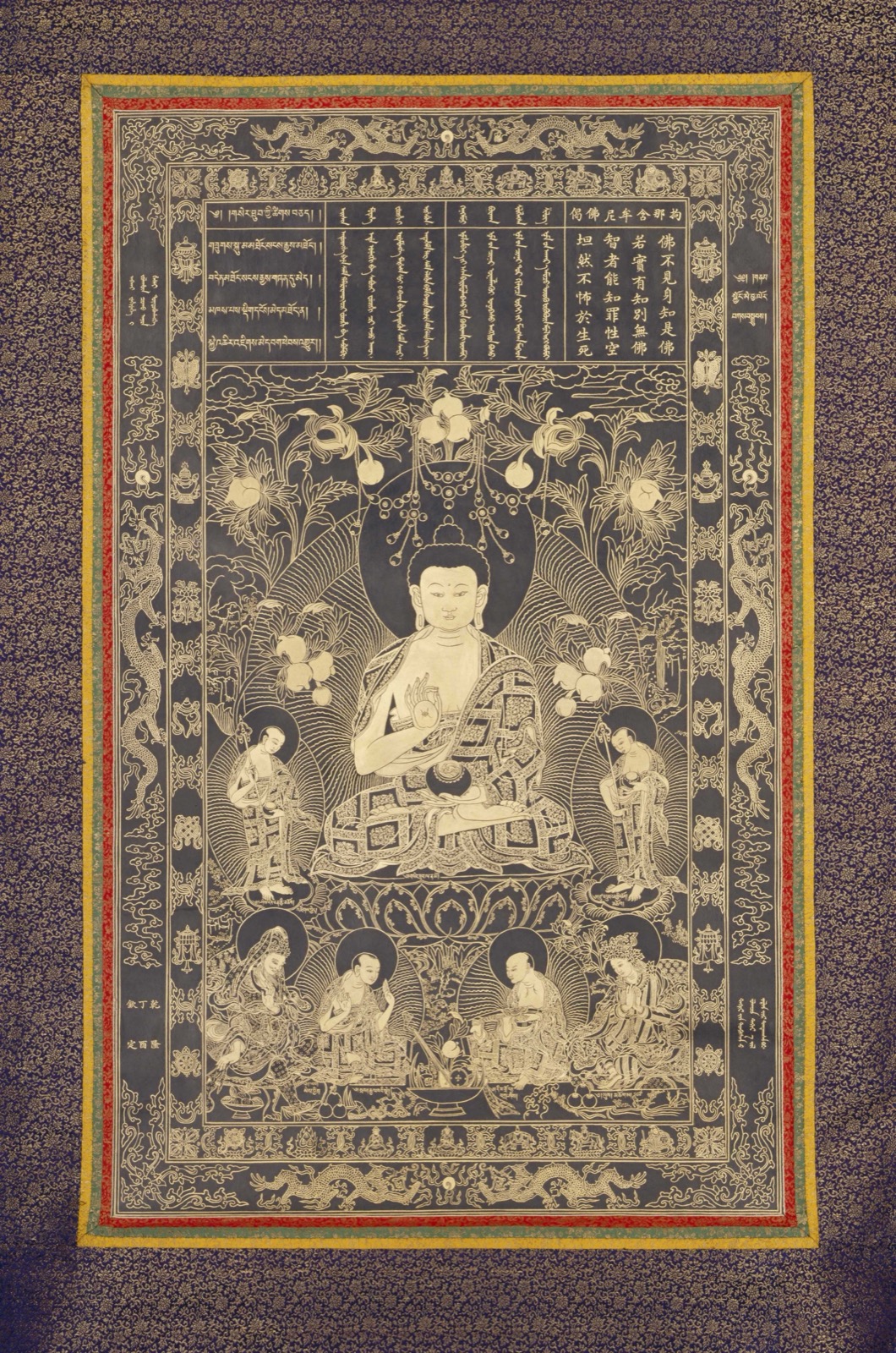
Quick answer: Separate overlapping forms by tracing one contour at a time, marking where it disappears, and finding where the same line resumes. In TK0379, the Buddha’s hands, robe, lap vessel, halo, branches, and attendants meet closely. An occlusion map records those relationships without turning a partly hidden shape into an unsupported identification.
Gold lines on a dark ground can make a Buddhist image look immediately legible, yet the most important details often meet at the same place. A hand crosses a robe edge, a vessel sits against patterned cloth, fruiting branches pass behind a halo, and attendants occupy the same vertical field as the central figure. If every line is read at once, separate forms can merge into one invented object.
TK0379 offers a practical case for studying overlapping forms in Buddhist art. The archive image presents a seated Buddha at the center, two standing attendants, four figures in the lower register, a broad multiscript text panel, foliage, a lotus throne, and decorated borders. The goal here is not to authenticate the filename’s individual Buddha name. It is to explain how a researcher can separate visible layers before assigning iconographic meaning.
What counts as an overlap in a Buddhist image?
An overlap occurs when one visible form interrupts, covers, or passes in front of another. The interruption may be physical within the imagined scene, such as a hand resting before a robe, or graphic, such as a halo line meeting a branch. The key evidence is not closeness alone but a change in contour continuity.
In TK0379, several high-density zones deserve attention. The right hand is positioned before the chest and robe. The left hand meets a rounded vessel at the lap. Patterned bands cross the torso and knees. Behind the head, a dark circular halo meets leaves, fruit, and hanging ornaments. Each zone contains lines that belong to different visual layers.
Which layers are visible in TK0379?
At least five descriptive layers can be recorded without identifying every symbol. Moving from front to back, the image shows hands and lap objects, garment edges and patterned cloth, the seated body and lotus support, the large halo, and the surrounding trees and landscape. The attendants and lower figures form adjacent layers rather than extensions of the central body.
| Zone | Visible relationship | Safe record |
|---|---|---|
| Chest | Raised hand crosses garment lines | Trace fingers before naming the gesture |
| Lap | Lower hand meets a rounded vessel | Record hand, rim, body, and base separately |
| Head and halo | Circular halo meets branches and hanging forms | Note interruptions and resumed curves |
| Lower register | Four figures overlap offerings and landscape | Index each figure before describing attributes |
How do you trace a partly hidden contour?
Trace from a point where the contour is unmistakable, stop at the first interruption, and resume only where direction and curvature remain plausible. Do not bridge a gap simply because two lines appear near each other. A reliable record distinguishes a visible segment from a reconstructed continuation.
For the lap vessel, begin at its rim rather than the surrounding robe pattern. Follow the rim, mark the point where the hand overlaps it, and then look for the contour on the other side. Repeat the process for the vessel body and base. This makes it possible to say that a rounded container is visible while leaving its exact ritual category uncertain.
The same method applies behind the head. The halo is a large circular field, but branches and suspended ornaments approach or cross its boundary. Record the halo curve in short segments. Where a branch interrupts the line, describe the branch as foreground or adjacent only when the junction clearly supports that reading.
Why should gesture and object be recorded separately?
A gesture and an object can support different identifications, so combining them too early multiplies error. In TK0379, the raised hand has a complex finger arrangement and a small circular form within or near the palm. The lower hand is associated with the lap vessel. These are visible relationships, but their exact doctrinal names require comparison and clearer evidence.
A useful catalogue separates anatomy from interpretation. Record which hand is raised, palm direction, visible fingers, contact points, and any small form. For the vessel, record shape, rim, placement, and contact with the hand. Only afterward should a researcher consult securely identified examples. This approach complements the broader high-resolution iconography workflow, where tiny attributes are checked against the full composition.
How can an occlusion map prevent false identifications?
An occlusion map makes every inference auditable by showing which lines are directly visible and which continuations are proposed. It prevents a robe fold from becoming a staff, a branch from becoming a halo ornament, or two unrelated curves from becoming one ritual implement.
- Divide the image into zones. Use the text panel, head, chest, lap, attendants, lotus seat, lower assembly, and borders as stable regions.
- Choose one form. Trace only the hand, vessel, robe band, halo, or branch under review.
- Mark every interruption. Record where the line stops because another form crosses it or because resolution is insufficient.
- Classify continuity. Label the continuation visible, probable, possible, or unresolved.
- Compare nearby lines. Check thickness, curve direction, decorative pattern, and repeated forms elsewhere in the image.
- Return to the whole composition. Confirm that the proposed layer order fits the body, throne, attendants, landscape, and border.
- Save uncertainty. Keep the unresolved gap in the record instead of smoothing it into a confident drawing.
Does the dark ground make layering easier to read?
The dark ground increases contrast, but it does not remove ambiguity. Gold-colored lines can share similar weight across bodies, textiles, foliage, clouds, and ornament. Compression and downscaling may also fuse neighboring strokes. High contrast therefore helps locate contours while making disciplined separation even more important.
The TANGKAWORLD guide to black-ground and gold-line painting explains the broader visual language. For TK0379, however, the material and technique cannot be confirmed from the digital file alone. “Gold-line composition on a dark ground” is a description of appearance, not a laboratory identification of pigment, support, or process.
What should remain uncertain in TK0379?
The individual Buddha identity, transcription of all scripts, doctrinal names for small attributes, historical date, maker, materials, school, collection, and provenance remain uncertain. The archive filename is preserved because it is useful metadata, but it is not treated as an independently verified museum record.
Direct visual evidence is stronger for layout: one central seated Buddha, two standing attendants, four lower figures, a circular halo, a lap vessel, fruiting foliage, a lotus support, an upper text panel, and decorated borders. Even here, counts should be tied to the visible digital image and revised if a higher-resolution or source-object record changes the reading.
Frequently asked questions
Is every touching line an overlap?
No. Lines can meet because forms are adjacent, because an ornament is continuous, or because compression has fused separate strokes. An overlap should be recorded when one contour clearly interrupts or covers another; otherwise label the relationship unresolved.
Can I complete a missing contour digitally?
You can create a research reconstruction, but keep it separate from the archive image and mark every restored segment. The untouched source and the interpretive overlay should never be confused.
Does the lap vessel identify the Buddha?
Not by itself. Its shape and placement are useful evidence, but identification should also consider gestures, inscriptions, series context, attendants, and a traceable source record.
Why trace the whole composition after examining a detail?
A local reading can be geometrically possible yet compositionally wrong. Returning to the full image tests whether the proposed hand, object, branch, or robe line fits the figure’s posture and surrounding layers.
Conclusion
TK0379 shows why line-rich Buddhist art benefits from an explicit layer map. Hands, vessel, robes, halo, branches, attendants, and lower figures can be separated through contour tracing, interruption marks, and confidence labels. This method preserves what the digital image actually shows while preventing a visually plausible connection from becoming a false iconographic claim.
Sources and editorial method
This article is based on direct visual analysis of the TANGKAWORLD TK0379 image. Visible evidence is separated from religious identification and from uncertain historical attribution. The editorial method uses full-image review, zone mapping, contour tracing, and confidence labels; it does not treat the filename as proof of identity or provenance. For reusable methods and further references, consult How to Study Thangka Iconography with High-Resolution Images and Black Thangka Painting: Gold Lines, Technique, and Care.
Prepared and reviewed by the TANGKAWORLD editorial team. Last reviewed: September 5, 2026.

