How to Test Hand–Object Contact in Buddhist Art: TK0381
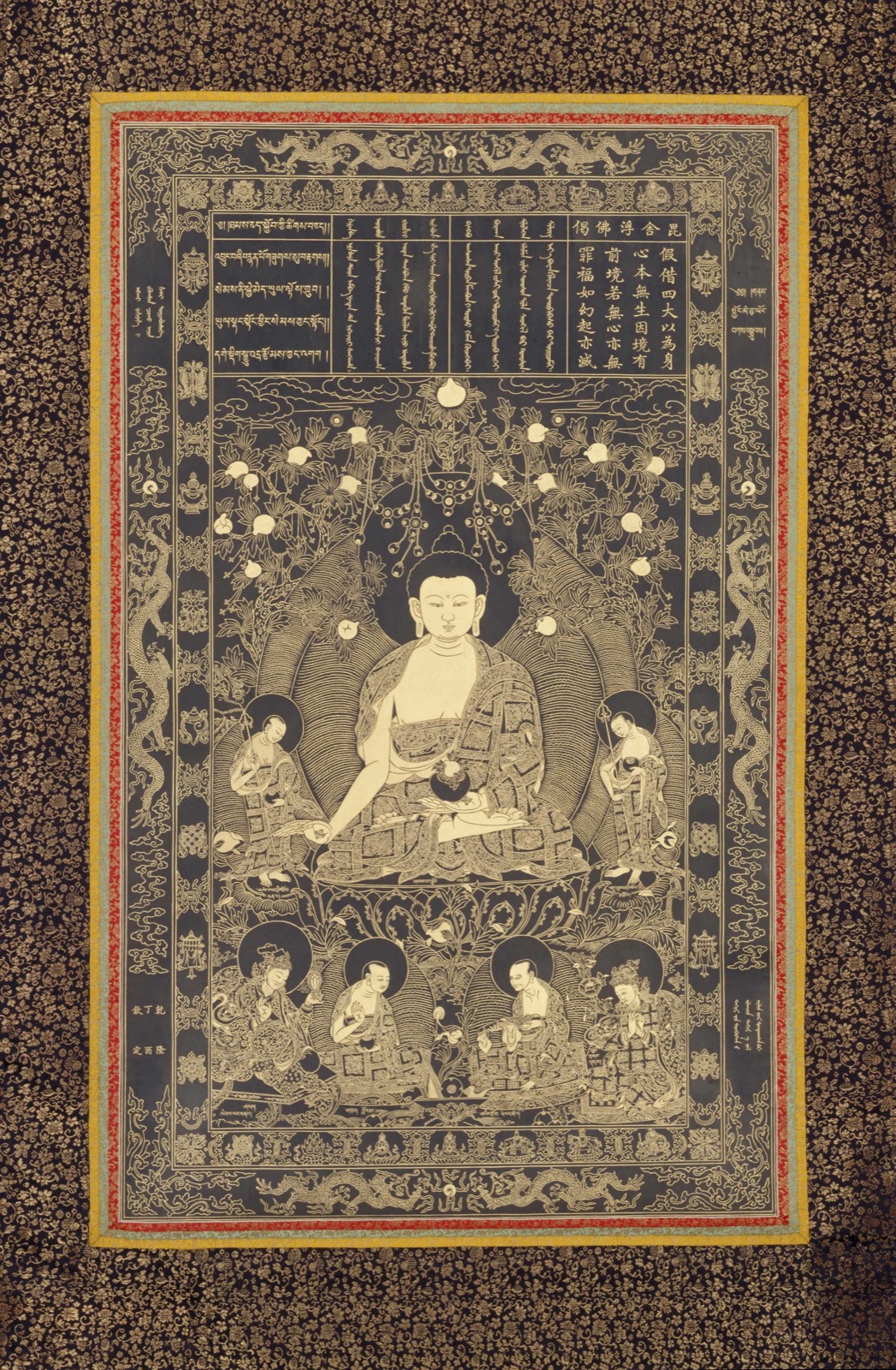
Quick answer: Test hand–object contact by tracing the object from its clearest end toward the fingers, then recording whether the contour touches, passes behind, or stops before the hand. In TK0381, a slender line appears to connect the Buddha’s lowered fingers with a flower-like form, but the plant and its religious meaning remain uncertain.
In a line-rich Buddhist image, an object placed near a hand is easy to describe as “held.” That word seems harmless, yet it quietly changes a visual observation into a claim about action and iconography. A stem may pass behind the fingers, terminate just short of them, merge with a robe edge, or belong to background foliage.
TK0381 provides a focused case for documenting hand-object contact in Buddhist art. The central seated Buddha extends one arm downward toward a thin line that leads to a flower-like form at the left. Two standing attendants flank the Buddha, four figures occupy the lower register, and fruiting trees, a lotus throne, a circular halo, multiscript text, and dragon borders complete the composition. The question is not whether the flower has a familiar symbolic name. It is whether the pixels support a physical connection.
What is visible between the hand and flower-like form?
A slender line can be followed from the area of the Buddha’s lowered fingers toward a blossom-shaped form beside the left standing attendant. The line is visually distinct from the larger tree branches behind the figure, although some crossings and dense ornament make its full route difficult to see.
This supports cautious wording: “the lowered hand appears to contact a slender stem connected with a flower-like form.” It does not yet justify a botanical species, a doctrinal attribute name, or a claim that the Buddha is presenting the flower to another figure. Contact, identity, and action are separate research questions.
Why is proximity not enough?
Proximity is only the first clue because two forms can be close without touching. Painters often compress hands, garments, stems, ribbons, and halos into a small area. Downscaling or JPEG compression can also close a gap that exists in the source or erase a short connecting stroke.
A reliable description therefore records the exact relationship at the fingers. Does the line enter the space between two fingers? Does it meet the fingertip? Does it disappear behind the palm and resume? Or does it stop nearby? Each answer carries a different confidence level, and “unclear” is a valid result.
How do you trace a possible held attribute?
Begin at the object’s clearest endpoint rather than at the hand. A blossom, vessel rim, staff finial, or book edge usually has a more recognizable contour than the crowded finger area. Trace backward until the line reaches its first interruption.
- Locate the clearest object boundary. In TK0381, start with the flower-like form at the far end of the thin line.
- Follow one contour only. Ignore neighboring foliage and robe patterns until the suspected stem is mapped.
- Mark every crossing. Note where the line meets the attendant, the Buddha’s robe, decorative lines, or the hand.
- Inspect the finger junction. Record whether the contour touches a fingertip, passes between fingers, disappears behind them, or remains separated.
- Compare line character. Check thickness, curvature, color, and continuity on both sides of an interruption.
- Return to full view. Test whether the proposed connection fits the arm position and surrounding composition.
- Assign confidence. Use visible, probable, possible, or unresolved instead of converting a gap into certainty.
Which claims require different evidence?
Contact, object identity, and religious meaning should be evaluated independently. A line can visibly meet a hand even when the object is unidentifiable. Conversely, a familiar flower type may be recognizable while its physical relationship to the hand remains obscured.
| Question | Needed evidence | TK0381 status |
|---|---|---|
| Are the forms near each other? | Full-image position | Clearly visible |
| Does a line connect them? | Continuous contour or documented interruption | Appears probable |
| What kind of plant is it? | Distinct petals, leaves, stem, and secure comparison | Uncertain |
| What does it identify? | Gesture, inscriptions, series context, and verified records | Uncertain |
How should the fingers be described?
Describe finger position anatomically before naming a gesture. Note which hand is lowered, palm direction if visible, extended or curved fingers, the point nearest the slender line, and any uncertainty created by overlapping robe contours.
In TK0381, the lowered arm reaches diagonally toward the flower-like form. The finger area and thin line appear associated, but a web view is not enough to reconstruct every contact point. This is exactly where the high-resolution iconography workflow helps: compare the full composition, a one-to-one pixel view, and a clean detail crop without altering the source.
Could the line belong to the background tree?
That alternative must be tested because the composition contains dense fruiting foliage behind the Buddha. The suspected stem should be compared with nearby branch thickness, curve direction, leaf attachment, and the way lines cross the attendant and robe.
If the line behaves like a branch and continues into the canopy, “background foliage near the hand” would be safer. If it begins at the flower-like endpoint, follows a distinct route, and meets the fingers without joining the tree, “probable held stem” becomes stronger. The present image favors a connection with the lowered hand, but does not make the plant’s identity certain.
Does a flower-like attribute identify Viśvabhū Buddha?
No single flower-like form can verify that identity. The filename associates TK0381 with Viśvabhū Buddha, one of the Seven Buddhas of the Past, but a responsible identification would also require the inscriptions, series context, gestures, attendants, and a traceable object or publication record.
The broader TANGKAWORLD guide to reading a thangka explains why attributes work as part of a system. Here, the flower-like form is valuable evidence, but it should not override uncertainty about the figure, date, maker, or provenance.
How should a digital archive record the finding?
A good record preserves observation, interpretation, and confidence in separate fields. The observation might state that a thin line runs from the lowered hand area to a flower-like form. The interpretation might say “probable hand-held stem.” Confidence can be recorded as moderate because the line is visible but the finger junction is dense.
Keep the source image unchanged. If a tracing or magnified crop is needed, create a derivative with the TK number, crop coordinates, software, date, and checksum. Any arrows or reconstructed segments should be visibly marked. This prevents a later viewer from mistaking an editorial overlay for original painted evidence.
What remains uncertain in TK0381?
The precise plant, the doctrinal name of the attribute, the action implied by the hand, the individual identities of the seven figures, and the readings of all inscriptions remain uncertain. The archive filename’s Viśvabhū association is preserved as metadata, not presented as a verified museum attribution.
The date, maker, materials, school, collection, provenance, and relationship between this digital file and any physical object are also uncertain. Direct visual evidence remains useful: one central Buddha, two standing attendants, four lower figures, a probable hand-to-stem connection, fruiting trees, halo, lotus throne, text panel, and ornamented borders.
Frequently asked questions
Can I call the flower a lotus?
Only when the visible petals, leaves, stem, and context support that reading. In TK0381, “flower-like form” is safer because the web image does not establish a botanical or doctrinal identification securely.
Does touching an object mean the figure holds it?
Not always. The hand may rest beside, support, present, receive, or simply overlap the object. Record the contact first and infer the action only from stronger compositional evidence.
What if the line disappears behind a finger?
Mark the interruption and compare the contour on both sides. Similar direction and thickness can support a probable continuation, but the hidden segment should remain reconstructed rather than visible.
Should a filename determine the attribute name?
No. A filename can preserve a useful research lead, but it cannot replace direct visual evidence, a readable inscription, or a traceable institutional or scholarly record.
Conclusion
TK0381 shows why “held” deserves an evidence test. By tracing from the flower-like endpoint to the finger junction, comparing line behavior, and separating contact from identity and meaning, researchers can describe the probable hand–stem relationship without overclaiming. The method applies equally to staffs, bowls, books, jewels, ribbons, and other small attributes in crowded Buddhist images.
Sources and editorial method
This article is based on direct visual analysis of the TANGKAWORLD TK0381 image. Visible contact evidence, religious identification, and uncertain historical attribution are treated as separate levels. The editorial method uses full-image review, contour tracing, finger-junction inspection, alternative-path testing, and explicit confidence labels; the filename is not treated as a verified museum record. For reusable methods and further references, consult How to Study Thangka Iconography with High-Resolution Images and How to Read a Thangka: A Beginner’s Guide.
Prepared and reviewed by the TANGKAWORLD editorial team. Last reviewed: September 7, 2026.

