Reading Dragon Pairs in Buddhist Borders: A Visual Test with TK0378
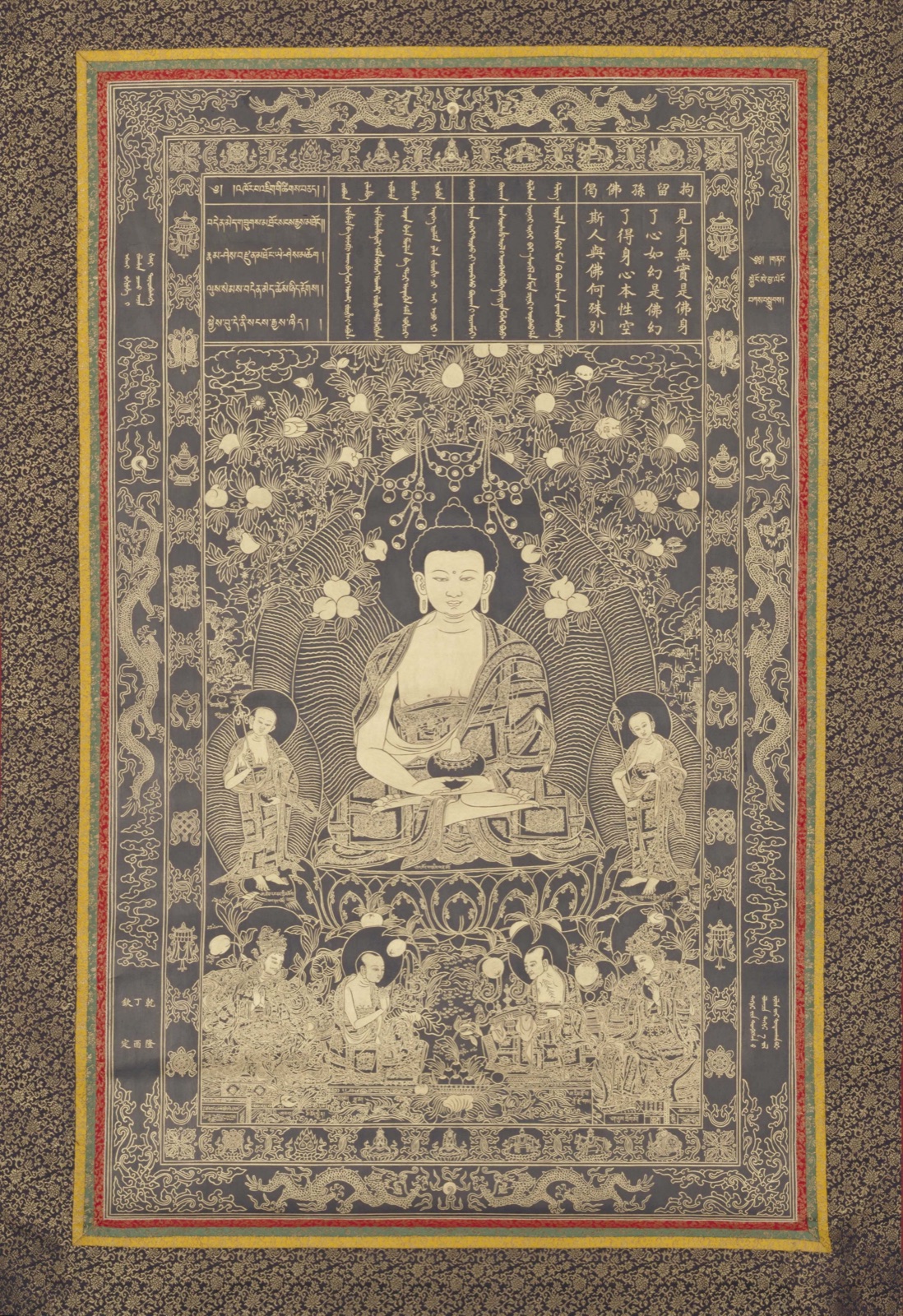
Quick answer: Read dragon pairs by following each animal from head to tail, recording its direction, limbs, surrounding scrollwork, and relationship to its partner. In TK0378, horizontal pairs frame the top and bottom while elongated dragons occupy the sides. This arrangement explains the border’s visual structure, but does not prove imperial patronage or date.
A dragon can disappear into ornament when its body shares the same gold-colored line as clouds, leaves, and curling stems. TK0378 rewards a slower reading. Instead of starting with a symbolic label, follow the animal’s anatomy and then ask how several animals work together around the central scene.
The archive image shows a large seated Buddha holding a bowl-like vessel at the lap, two standing attendants, and four smaller figures below. A broad text panel, foliage, halos, and a lotus seat fill the interior. Outside that scene, dragon forms occupy the long horizontal and vertical border bands. The present study concerns these paired and directional arrangements, not the identification of the central Buddha.
Where are the dragon pairs in TK0378?
Two dragons occupy the upper horizontal band and two occupy the lower band, while one elongated dragon runs along each side. Their bodies can be followed separately from the surrounding curling ornament. The upper and lower pairs turn their heads toward the central area of their respective bands.
This produces two different viewing movements. Across the top and bottom, the eye travels inward from opposing bodies toward a shared center. Along the sides, the longer bodies establish vertical paths. Together, these directions form a frame around the text and sacred assembly without becoming part of the figures’ immediate space.
| Location | Visible arrangement | Question to record |
|---|---|---|
| Upper band | Two horizontal dragons approaching the central motif | How do the heads, forelimbs, and intervening space relate? |
| Lower band | A second horizontal pair around a central motif | Does it repeat the upper pair exactly or only broadly? |
| Side bands | One elongated dragon on each side | Where are the head, body bends, limbs, and tail? |
| Adjacent ornament | Curling lines continue around the animals | Which lines belong to bodies and which to the surrounding scrollwork? |
How can you separate a dragon from floral scrollwork?
Look for a connected body with a recognizable head, attached limbs, and a tail, rather than identifying an isolated curl as an animal. In TK0378, the dragons have long patterned bodies, projecting limbs, and distinct heads. Floral and cloud-like lines weave around them but do not share that continuous anatomical organization.
Start at the head because a curling tail may resemble a plant stem. Trace the upper and lower body edges until they converge toward the tail. Then return to each limb and check whether its contour actually joins the body. In a dense gold-line image, two crossing lines can appear connected even when they belong to separate motifs.
Use a neutral note when a connection is unclear: “limb attachment obscured by adjacent ornament” is more useful than inventing an extra leg. The task is not to force naturalistic anatomy onto a stylized creature. It is to preserve the visible relationships that allow another reader to test the description.
What does pairing contribute to the composition?
Pairing establishes a shared center and gives the horizontal borders a balanced rhythm. The two dragons do not simply fill empty space. Their opposed directions hold attention within the width of the image and reinforce the central axis already established by the Buddha, bowl, lotus seat, and upper text panel.
Balanced does not mean identical. Compare the curves of the spines, the spacing of limbs, the position of the heads, and the distance from each animal to the central motif. A broad mirrored arrangement may contain many small differences. Record those differences before deciding whether they reflect design, reproduction, wear, or another cause.
The two vertical dragons solve a different spatial problem: they occupy narrow, tall fields. Their elongated curves accommodate the border’s proportions. Calling every animal “a repeated dragon” would conceal the distinction between a horizontal partner and a vertical counterpart.
How should the central motifs be described?
Describe the central motifs by their visible shape and position before naming them. Each horizontal pair surrounds a small upright device near the midpoint. Its relationship to the two heads is clear, but a confident symbolic name would require a closer, documented comparison.
A phrase such as “paired dragons facing a central upright motif” preserves the composition without assuming a pearl, jewel, ritual emblem, or other specific object. Familiar terminology can be a useful search lead, but it should not replace inspection. Keep a proposed name in a separate field from the visual description.
How do you compare the upper and lower pairs?
Compare equivalent features in a fixed order, keeping both complete bands visible. This avoids mistaking a cropped fragment or a difference in enlargement for a difference in design.
- Locate the midpoint. Mark the central device and the space between the two heads in each band.
- Record head direction. Note whether each head turns toward the midpoint, away from it, or at an uncertain angle.
- Follow the body path. Describe major bends, raised sections, and changes in thickness before examining small surface patterns.
- Check limbs independently. Record only visible attachments and distinguish an obscured foot from an absent one.
- Compare negative space. Look at gaps between the bodies, border lines, central device, and adjacent curls.
- Separate observation from explanation. A difference in tail shape is observable; the reason for that difference may remain uncertain.
For a practical comparison sheet, use columns for upper left, upper right, lower left, and lower right. A short description in each cell is preferable to a single claim that all four animals match. The side dragons can be recorded separately because their vertical format changes the comparison.
Do dragons prove an imperial commission?
No. Dragon ornament alone does not establish an imperial commission, a particular ruler, a workshop, or a date for TK0378. Such claims require a traceable object record, inscriptions, documented history, and relevant comparisons. A motif can be copied or reused, and a digital reproduction may omit evidence outside the photographed front.
The main-site guide to a related Seven Buddhas image and its inscriptions shows how a documented comparison can connect text, image, and historical context. Its findings concern the objects and archive file discussed there; they must not be transferred automatically to TK0378.
Similarly, a photograph’s warm lines do not prove gold content, and its dark ground does not identify a pigment or support. The English archive title Seven Buddhas of the Past is preserved here as a file label. The individual Buddha identity and historical attribution remain uncertain.
Frequently asked questions
Are the side dragons members of the horizontal pairs?
They belong to the same enclosing border system, but they occupy different fields. Document the upper pair, lower pair, and two vertical side dragons separately before interpreting their combined effect.
Should claw counts be used when the feet are unclear?
No. Record the visible foot and state that the claw count is uncertain. Enlarging indistinct pixels does not supply missing evidence, and an uncertain count should not support a historical attribution.
Does an inward-facing pair have one fixed meaning?
The orientation establishes a visible relationship around a center. A more specific religious or historical meaning depends on the complete image and documented context, not direction alone.
Can a detail crop replace the complete border image?
No. A crop helps examine anatomy, but the complete view preserves orientation, pairing, and relation to the central scene. Keep both views linked to TK0378 and leave the original file unchanged.
Conclusion
TK0378 becomes clearer when its dragons are read as connected animals arranged in distinct border fields. Head direction, body continuity, pairing, and surrounding space explain how the frame works. Those observations remain useful without claiming a patron, date, workshop, or fixed symbolic interpretation that the file cannot verify.
Sources and editorial method
This article is based on direct visual analysis of TANGKAWORLD image TK0378. Visible animal forms and placement are distinguished from religious interpretation and uncertain historical attribution. For the wider framing context, consult the border documentation guide. The high-resolution study guide includes Sources and further reading linking to museum and specialist resources. No museum ownership, inscription reading, artist, or date is asserted for this file.
Prepared and reviewed by the TANGKAWORLD editorial team.
Last reviewed: September 4, 2026.

