Single Figure or Triad? How to Test a Buddhist Grouping: TK0270
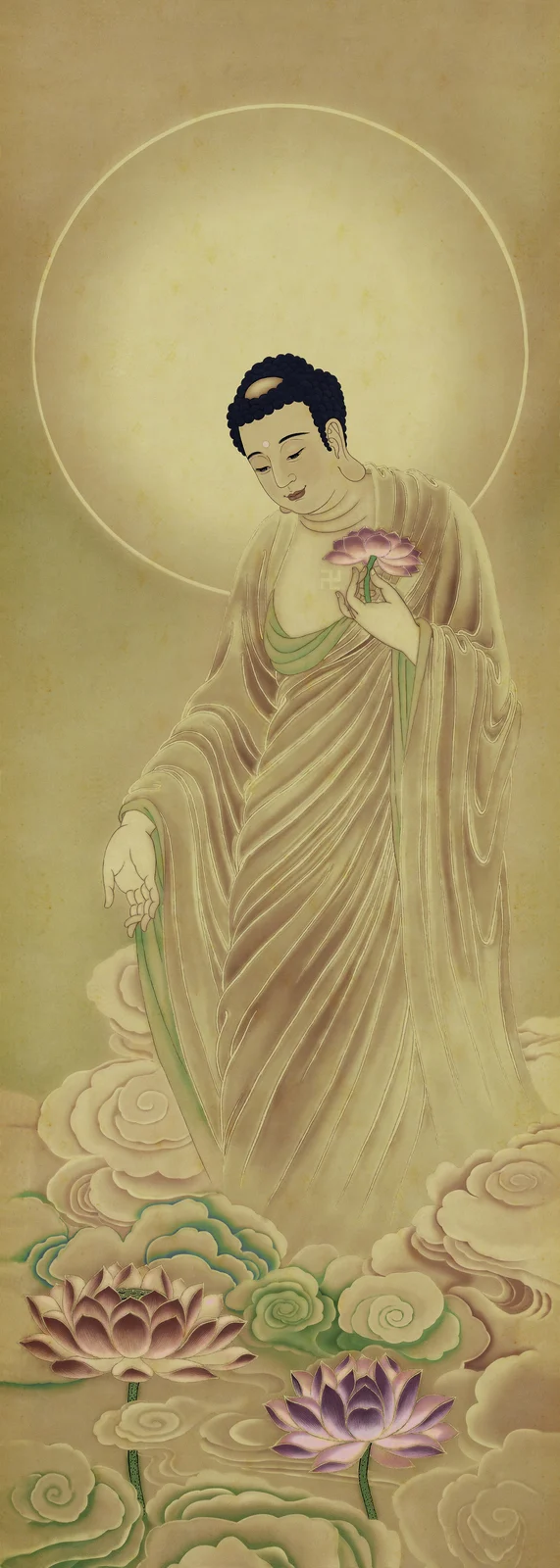
Quick answer: Audit an Amitabha triad archive label by separating what the file shows from what its filename claims. TK0270 visibly contains one standing Buddha-like figure, not a complete three-figure group. Record the halo, lotus, lowered hand, robes, clouds, and image edges, then retain “Western Three Saints” only as unverified archive metadata.
Digital Buddhist art archives often preserve a useful title without preserving the evidence that originally justified it. TK0270 is a clear example. Its English filename names the Three Saints of the West and Amitabha Buddha, while the visible image presents a single standing figure against a pale field. The practical question is how to distinguish a single figure from a Buddhist triad when inherited metadata names companions the pixels do not show.
This article treats the archive label as a research lead. The standing monastic figure, large circular halo, lotus held near the chest, open lowered hand, clouds, and foreground lotuses support an Amitabha-related reading. They do not, by themselves, prove that the surviving file once belonged to a triad, that unseen companions were cropped away, or that the image was designed as one panel of a set.
What does TK0270 visibly show?
TK0270 visibly shows one standing Buddha-like figure surrounded by a large circular halo. The head inclines gently, the eyes look downward, and layered monastic robes fall in long pale folds. One hand holds a pink lotus close to the chest, while the other extends downward with an open palm. Clouds gather around the feet, and two large lotus blossoms rise across the lower foreground.
These details create a quiet descending or approaching effect. The lowered gaze and hand direct attention toward the bottom of the image. The cloud banks separate the body from ordinary ground, while the tall lotuses establish a devotional foreground. The archive identification of Amitabha is plausible in this network of signs, but the exact hand gesture, date, maker, school, collection, and provenance remain uncertain.
Why does the “Western Three Saints” label need an audit?
The label needs an audit because a triad is a relationship among three visible figures, and this file shows only one. In a familiar Pure Land grouping, Amitabha appears with Avalokiteshvara and Mahasthamaprapta. Their presence should be demonstrated through bodies, attributes, inscriptions, or a documented object record rather than supplied from the filename.
Several explanations are possible. TK0270 may reproduce a deliberately independent Amitabha image. It may be a detail taken from a larger composition. It may represent one panel from a coordinated set, or the archive title may have been attached inaccurately. The current file does not decide among those possibilities. A responsible record preserves all of them as hypotheses and marks the two companions as not visible.
| Evidence layer | What TK0270 supports | What remains uncertain |
|---|---|---|
| Visible image | One standing monastic Buddha-like figure, halo, lotus, lowered hand, clouds, foreground flowers | Whether anything exists outside the recorded edges |
| Religious identification | An Amitabha-related reading is plausible from the combined signs | Exact ritual form and precise gesture name |
| Archive metadata | The filename preserves a “Western Three Saints” claim | Whether it describes this file, a larger object, a set, or an earlier source |
| Historical attribution | No date, maker, school, or collection is visibly established | All historical and provenance claims |
How should the image edges be examined?
The edges should be examined as evidence, not as proof of cropping. At left, right, top, and bottom, record whether bodies, halos, lotus stems, clouds, architecture, inscriptions, borders, or mounting elements are cut off. In TK0270, the large halo approaches the side edges, and the foreground flowers continue close to the bottom. However, no partial attendant, secondary halo, or severed body is clearly visible.
That absence matters, but it does not demonstrate that this is the complete original composition. A scan can omit a painted border without leaving a visible trace. A publisher can isolate a central figure cleanly. Conversely, an artist can create a narrow single-figure image whose halo naturally approaches the margins. The safest note is therefore “no companions are visible within the present file,” not “the companions were removed.”
How can Amitabha be assessed without relying on the filename?
Amitabha should be assessed through a cluster of visible features. The figure wears monastic robes rather than the crown and jewelry typical of Amitayus. The body stands among clouds, the head and gaze incline downward, and one hand opens toward the lower field. A lotus appears near the chest, with additional lotus blossoms below. Together these signs are consistent with welcoming or descending Amitabha imagery.
No single feature is decisive. A circular halo marks sanctity but appears around many Buddhist figures. A lotus is widespread. An open hand may communicate generosity, reassurance, or approach, yet the exact mudra should not be named without sufficient detail and comparative evidence. The identification becomes stronger because several features agree, not because any one object functions as a label.
Why this is Amitabha rather than Amitayus
The visible type is closer to Amitabha than Amitayus. Amitayus is commonly shown as a crowned, jeweled, seated figure holding a longevity vase in both hands. TK0270 instead presents a standing monastic Buddha without a crown, jewelry, or vase. This distinction follows visible iconography and respects the rule that images of the long-life deity should be named Amitayus, not confused with Amitabha.
A practical workflow for auditing image metadata
A metadata audit works best when observation, identification, and history remain separate. The following sequence can be reused for scanned thangkas, album leaves, mural details, and files whose titles describe more than the pixels reveal.
- Preserve the source. Record the exact path, filename, dimensions, checksum, and file format without renaming or altering the original.
- Describe the whole frame. Count visible principal figures and note their posture, dress, attributes, halos, setting, and relationships.
- Inspect all four edges. Look for cut bodies, partial halos, broken borders, inscriptions, mounting cloth, or repeated motifs that continue beyond the frame.
- Grade the religious identification. Use multiple agreeing attributes and list alternative readings when a decisive sign is absent.
- Quote the archive label exactly. Preserve “Three Saints of the West and Amitabha Buddha” as metadata rather than silently rewriting it.
- State the mismatch plainly. Write that one figure is visible and two triad companions are not visible in this file.
- Search for related files. Compare neighboring archive records, alternate crops, bordered versions, or a matching complete composition.
- Verify history independently. Require a traceable collection record or scholarly catalogue before assigning date, artist, school, collection, or provenance.
What should a cautious catalogue entry say?
A cautious entry can retain both the visual reading and the inherited label: “Standing Amitabha-like Buddha with halo, lotus, lowered hand, clouds, and foreground lotuses; archive filename identifies the Western Three Saints, although no flanking bodhisattvas are visible in the present file.” This wording keeps the record searchable without converting uncertainty into fact.
It also helps future researchers. Someone who later finds a complete triad can connect it to TK0270 by comparing the central figure, halo diameter, lotus positions, cloud contours, color, and edge relationships. Someone who finds a documented independent image can correct the triad label without losing the archive’s earlier history.
Frequently asked questions
Does the filename prove that TK0270 is part of a triad?
No. The filename preserves an archive claim, but the current image shows one figure. A complete triad, companion panels, an earlier uncropped reproduction, or a documented object record would be needed to verify the relationship.
Can the missing attendants be assumed to have been cropped out?
No. Cropping is one possibility, but the image could also be an independent composition, one panel of a set, or a mislabeled file. The visible edges do not clearly show partial attendants.
Why is the central figure described as Amitabha-like?
Monastic robes, a standing posture among clouds, a lowered open hand, downward gaze, halo, and lotus signs form a plausible Amitabha pattern. The wording remains cautious because the file has no verified object record.
Is this figure Amitayus?
The visible form does not match the common Amitayus type, which is usually crowned, jeweled, seated, and holding a longevity vase. TK0270 is a standing monastic Buddha and is more consistent with Amitabha.
Conclusion
TK0270 demonstrates why digital Buddhist art research must preserve disagreement between image and label. The picture offers strong visible evidence for a standing Amitabha-like figure, yet it does not show the two bodhisattvas required for a visible Western Three Saints triad. Recording that boundary makes the archive more useful: the label remains discoverable, the image remains accurately described, and future identification stays open to better evidence.
Sources and editorial method
This article is based on direct visual analysis of the TANGKAWORLD TK0270 image and a comparison between visible evidence and its inherited filename. Religious identification is kept separate from uncertain assumptions about cropping, a triad, date, maker, school, collection, and provenance. For the broader workflow, consult How to Study Thangka Iconography with High-Resolution Images, the Amitabha Pure Land visual guide, and the TANGKAWORLD Learn center.
Prepared and reviewed by the TANGKAWORLD editorial team. Last reviewed: September 30, 2026.

