Avalokiteshvara, Anonymous (TK0183): What the Eye in the Palm Can—and Cannot—Tell Us
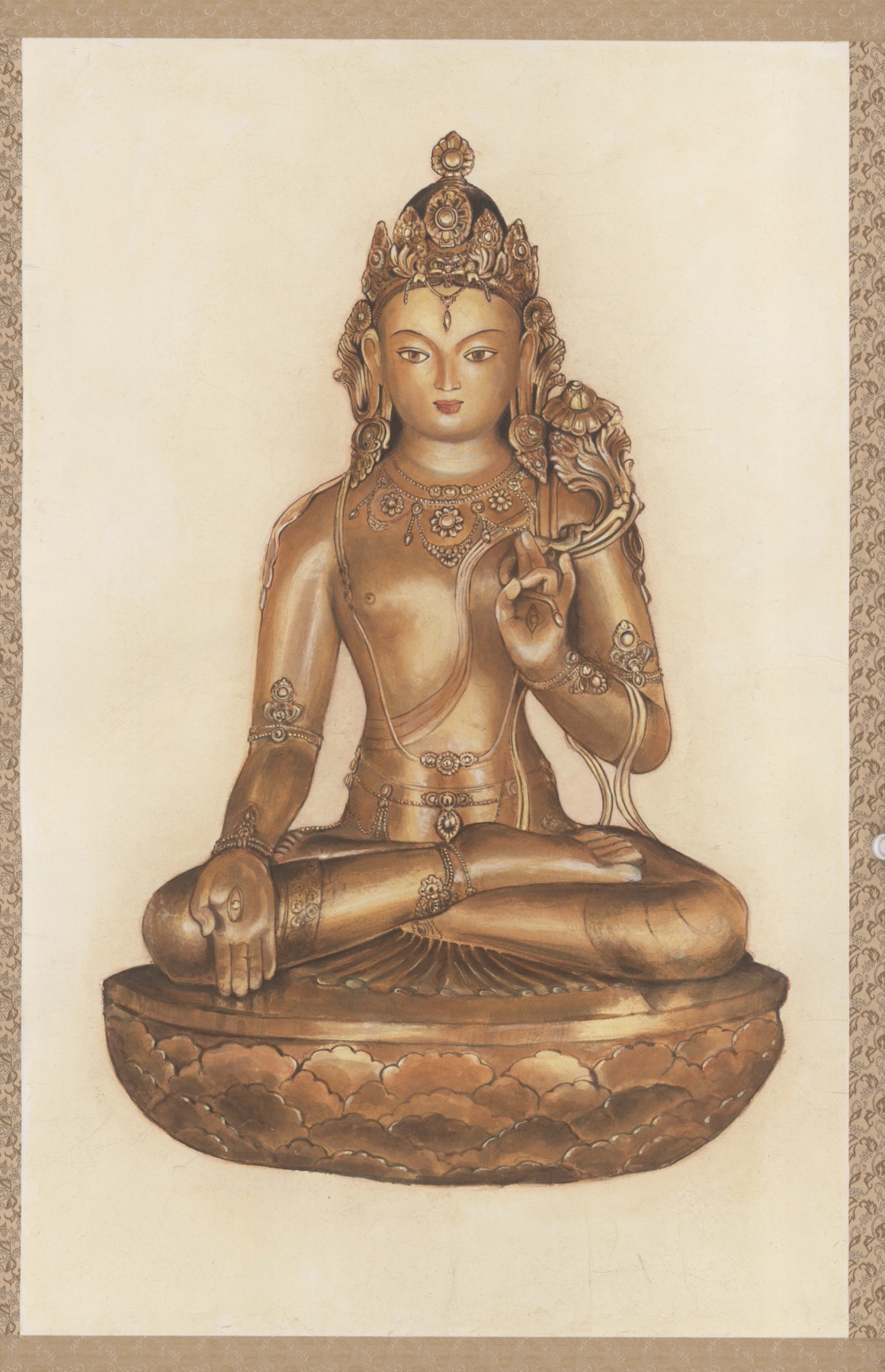
Quick answer: TK0183 shows an eye-shaped mark in the lowered palm of a crowned, seated figure. The detail invites comparison with eye-bearing Avalokiteshvara imagery, but alone it does not confirm a Thousand-Eyed form, exact identity, date, or provenance. Begin with its placement and composition, then test the archive label against independent evidence.
What is visibly present in TK0183?
TK0183 presents one large, richly ornamented figure seated cross-legged on a broad lotus-like base. The upper body is upright and frontal, the head wears a tall jeweled crown, and necklaces, armlets, bracelets, and a belt mark the body as a bodhisattva-like figure rather than a simply robed monk. One hand is raised near the chest beside a thin, curling stem-like form. The other extends down over the crossed leg, with an eye-shaped feature painted in the palm. These are observations from the image, not yet an identification.
The composition is unusually concentrated. There is no visible crowd of attendants, no surrounding ring of many arms, and no narrative landscape competing with the main figure. The pale ground leaves generous space around the body. The eye-bearing hand therefore reads as a deliberate focal detail: it is isolated against the darker leg and seat, while the raised hand gives the viewer a second point to compare. The eye does not float independently; it belongs to a hand attached to a specific seated body.
Why does the eye in the palm draw attention?
The mark attracts attention because three visual cues converge: its unusual shape, the open presentation of the palm, and the hand’s low position across the figure’s crossed legs. The hand is not hidden in the torso’s ornament or crowded among many attributes. Its placement lets the palm be read as a small image within the larger image. A viewer first notices the frontal face, follows the central axis down the torso, and then encounters the marked palm as a secondary focal point.
This description helps explain how the painting guides looking without claiming a fixed meaning for the mark. Composition can make one detail prominent; it cannot, on its own, tell us which text, ritual setting, or lineage governed its meaning. In a digital reproduction, a painted oval, highlight, or small decorative form can also resemble an eye. The feature is eye-shaped in this image, but a close examination of the source and comparison with well-documented examples would be needed before treating that reading as certain.
Notice also the contrast between the figure’s calm expression and the palm’s unusual sign. The face looks outward with a composed, almost symmetrical gaze. The lowered hand introduces a second kind of looking: not a human face looking toward the viewer, but a mark that appears to look outward from the hand itself. That visual pairing is meaningful as a compositional effect even while its doctrinal or ritual interpretation remains open.
Does one eye-mark identify the Thousand-Eyed form?
No single eye-mark is sufficient to identify a specific form of Avalokiteshvara. The TANGKAWORLD guide to Thousand-Armed Avalokiteshvara describes a broader coordinated system: many arms radiating around the central body, repeated eyes in palms, and other identifying features that must be considered together. TK0183, as shown here, has one prominent eye-marked palm and a compact figure. It does not display the large field of repeated arms that makes the thousand-armed composition visually distinctive.
This difference matters because an isolated attribute can occur in more than one image type, be rendered differently, or be misread in a scan. A comparison should ask how many arms are present, how the hands are arranged, whether heads or attendants add context, and whether inscriptions or a reliable catalogue support a name. TK0183 supplies one clue, not the complete cluster. It is therefore safer to say “an eye-shaped mark appears in the palm” than to leap from that mark to a full iconographic title.
The archive’s Avalokiteshvara label is useful as a search lead, particularly because eye imagery is associated with compassion in some Avalokiteshvara traditions. But a filename is not an independent object record. Until a documented source confirms the identity, the label should remain attributed to the archive. This distinction keeps the image discoverable while allowing later research to refine or correct the interpretation.
How to examine the palm without overreading it
A careful close reading can proceed from the whole composition toward the small mark, then return to the whole figure. This sequence prevents a tiny feature from taking over the interpretation before its scale and context are understood.
- Start at full view. Record the number of visible figures, the central axis, posture, seat, and the amount of open space. In TK0183, one seated figure dominates, with no visible retinue around the central body.
- Locate the hand. Note which side of the image it occupies, whether the palm faces outward or upward, how the wrist bends, and how the fingers relate to the knee. Avoid naming a mudra from hand direction alone.
- Describe the mark. Record its outline, position within the palm, surrounding lines, and contrast with the skin tone. If the resolution does not show a pupil or lid clearly, write “eye-shaped” rather than “eye” as a certainty.
- Compare the other hand and nearby attributes. The raised hand and curling stem-like form may add context, but the object should remain a “stem-like” or “flower-like” form unless its petals and stalk are clear enough to identify.
- Return to the title and source. Separate the archive’s wording from what the image itself supports. Seek an inscription, catalogue record, documented provenance, or specialist comparison before claiming a date, maker, school, or ritual purpose.
What the archive title can—and cannot—establish
The supplied English archive wording is “Avalokiteshvara - Anonymous.” It supports reporting that the image is catalogued under that name in this collection, and that no artist is named in the supplied title. It does not establish that the title has been checked against an inscription, that the maker was historically anonymous, or that the figure’s exact form has been confirmed. We therefore preserve the label as a label, not as a proven biography of the object.
The visible crown, jewelry, exposed upper torso, lotus-like seat, and serene frontal face support a cautious description as a bodhisattva-like image. The eye-shaped palm detail invites comparison with compassionate or eye-bearing imagery. Yet the artist, date, region, school, collection history, and provenance remain uncertain. Even the precise identity should be treated as provisional unless supported by documentary evidence beyond this digital image.
For a useful comparison, the adjacent TK0182 hand-gesture study demonstrates why direction alone does not settle the name of a gesture. The broader Thangka reading guide likewise recommends combining figure, hand, attribute, surrounding context, title, and source rather than guessing from one detail.
What questions would improve the identification?
Further research would be most useful if it addressed evidence not visible in this reproduction. Is there an inscription on the front, reverse, or mounting? Is the current English label taken from an older catalogue or assigned by the image archive? Does a documented collection record describe the same palm motif, hand arrangement, or distinctive stem? Are there technical images that clarify whether the mark is painted as an eye, a decorative emblem, or another form? Answers to these questions could strengthen the identification without requiring speculation.
Frequently asked questions
Is TK0183 certainly Avalokiteshvara?
The supplied archive title names Avalokiteshvara, but that identification has not been independently confirmed here. The eye-shaped palm is a comparison clue, not proof by itself.
Does the eye in the palm prove this is the Thousand-Eyed form?
No. TK0183 shows one prominent eye-shaped palm mark, while the Thousand-Eyed form is identified through a fuller visual system, including repeated eye-bearing hands and other contextual features.
What can be stated confidently from the image?
A crowned, ornamented figure sits cross-legged on a lotus-like base; one hand is raised near the chest, and the lowered palm bears an eye-shaped mark. Artist, date, school, and provenance remain uncertain.
How should I describe the palm in a catalogue note?
Use cautious wording such as “the lowered palm contains an eye-shaped mark” and distinguish that observation from any proposed religious meaning or deity identification.
Sources and editorial method
This article is based on direct visual analysis of the TANGKAWORLD image for TK0183. It separates visible features—the seated posture, ornaments, two hand positions, stem-like form, and eye-shaped palm mark—from the religious identification supplied by the archive title and from historical claims that cannot be established here. The eye-shaped description is intentionally cautious because a web reproduction cannot substitute for technical examination or an object record.
For comparison, see TANGKAWORLD’s guide to repeated palm eyes in Thousand-Armed Avalokiteshvara and its evidence-first method for reading a thangka. These pages provide comparative context; they do not independently authenticate TK0183. No artist, date, school, collection, or provenance is asserted without supporting documentation.
Prepared and reviewed by the TANGKAWORLD editorial team
Last reviewed: October 28, 2026
Continue exploring TANGKAWORLD: visit the home page, browse Learn, or get the image collection from Download.

