Halo or Mandorla? How TK0561 Builds Layered Radiance Around Vairocana
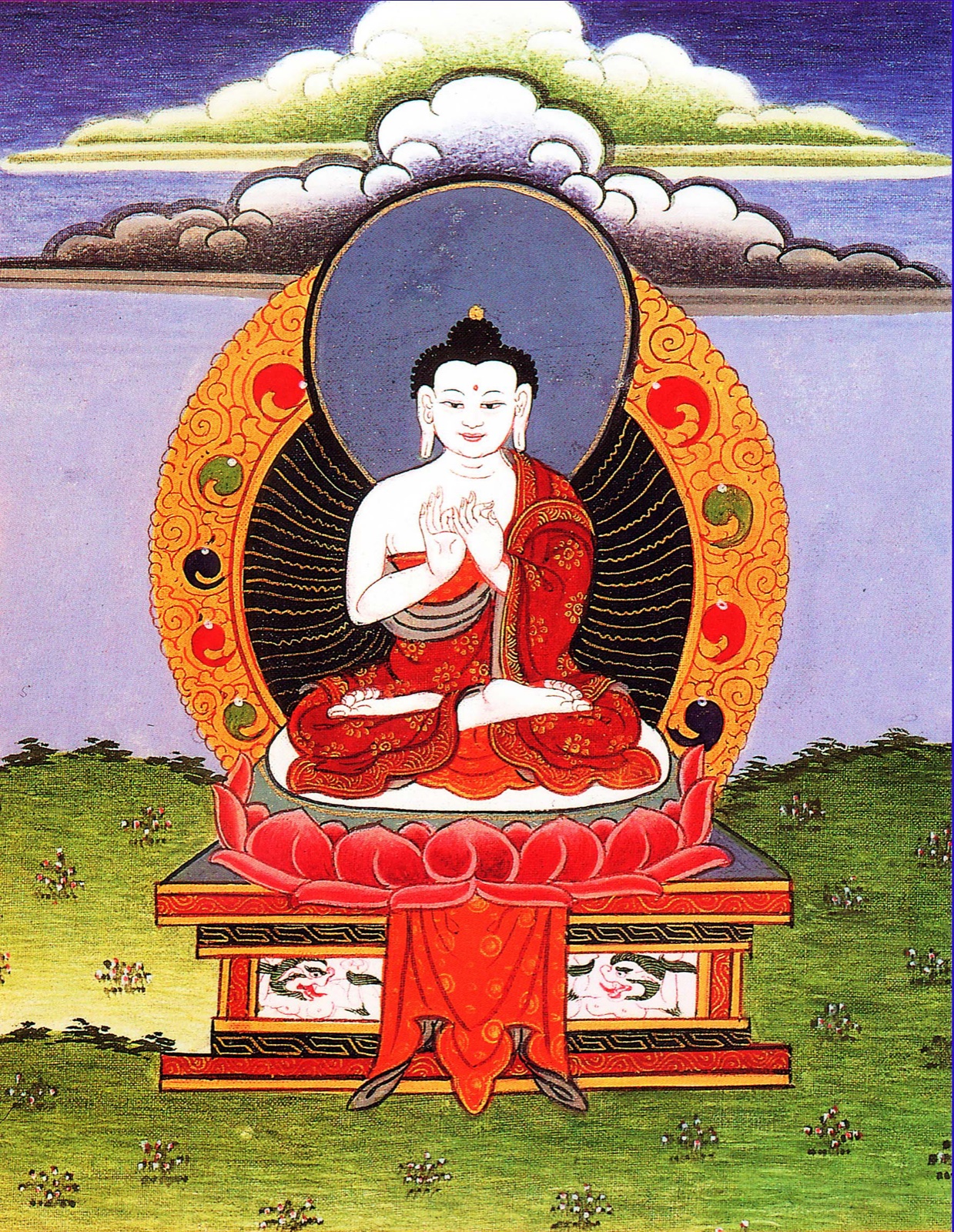
Quick answer: A halo surrounds the head, while a mandorla encloses more of the sacred body. In TK0561, a blue circular halo isolates the Buddha’s face, and a larger black-gold oval mandorla frames the torso and seated posture. Clouds and landscape form a third, environmental layer rather than another personal aureole.
The difference between a halo and a mandorla becomes easy to see when both appear in the same Buddhist image. TK0561 presents a pale seated Buddha-like figure wearing red robes and holding both hands before the chest. Behind the head is a blue circle. Around the upper body is a larger oval field, dark at its center and edged with gold, colored roundels, and curling ornament. Above and beyond both are bands of clouds.
The archive filename identifies the figure as Vairocana Buddha. The pale body, frontal seated posture, chest-level hand gesture, lotus seat, and strong axial symmetry are consistent with that reading. Yet the digital file alone does not verify the precise mudra name, ritual lineage, maker, date, school, collection, or provenance. This guide therefore concentrates on the visible construction of radiance.
What is the difference between a halo and a mandorla?
A halo is a luminous or sacred field centered on the head, while a mandorla is a larger enclosure that frames much or all of the body. The two can overlap without being interchangeable. A halo directs attention to awakened presence and the face; a mandorla expands that presence across posture, gesture, and throne.
In TK0561, the circular blue field sits directly behind the head and shoulders. Its gold rim makes the curve legible against the darker oval surrounding it. The mandorla is taller and wider, reaching from above the head toward the lotus seat. Its pointed or egg-like outline embraces the seated body rather than only the face.
| Visible layer | Shape and position in TK0561 | Visual function |
|---|---|---|
| Head halo | Blue circle centered behind the head | Separates the face and marks the sacred center |
| Body mandorla | Large black-gold oval around torso and seated body | Frames posture, hands, robe, and bodily presence |
| Cloud bands | Layered white, green, gray, and dark forms above | Establish an atmospheric realm around the icon |
| Landscape field | Pale sky and green meadow beyond the throne | Places the radiant figure within a visible environment |
How does the blue head halo control attention?
The blue circle controls attention by giving the pale face a calm, uninterrupted background. Without it, the head could merge with the clouds above or the ornament beside it. The circular boundary creates a quiet zone around the hair, ears, eyes, and small forehead mark, allowing the viewer to register expression before moving outward.
Its cool color also contrasts with the red robe and orange-gold ornament. The circle does not need painted rays to imply radiance. Its clean shape, centered position, and separation from surrounding patterns are enough. Because the halo is almost as wide as the shoulders, it also connects the face to the chest-level gesture without enclosing the whole body.
What does the oval mandorla add?
The oval mandorla turns the seated body into a complete sacred unit. Its dark interior makes the white torso, red robe, and pale hands highly visible. Fine gold lines spread outward on both sides like ribs or rays, guiding attention from the central body toward the decorated edge.
The outer border carries curling gold ornament and colored circular forms. These details create rhythm but should not be given specific symbolic names without clearer evidence. Their repeated placement thickens the boundary between the Buddha-like figure and the surrounding sky. The mandorla therefore works as both radiance and frame.
Why the halo remains visible inside the mandorla
The separate head halo prevents the larger oval from flattening all sacred light into one undifferentiated shape. The viewer can read two scales at once: a concentrated circle around consciousness and expression, and an expanded field around the embodied icon. This nesting makes the figure feel centered even though clouds and landscape extend beyond it.
Are the clouds another halo?
The clouds are better read as environmental forms than as a third personal halo. They stretch horizontally across the upper image, change color by band, and continue beyond the central axis. Their scalloped edges and layered placement suggest a celestial or elevated setting rather than a field attached only to the head or body.
This distinction matters when cataloguing. If every bright or curved form is called a halo, the image loses its spatial structure. The head halo belongs to the face, the mandorla belongs to the body, and the clouds belong to the surrounding realm. Recording their different centers and boundaries keeps description precise.
How do the lotus and throne complete the vertical structure?
The lotus and throne complete a vertical chain from landscape to body to radiance. A red lotus supports the crossed legs. Beneath it, a rectangular throne displays patterned bands, two small paired animal-like motifs, and a long red textile falling down the center. The exact animals are not clear enough in this reproduction to identify confidently.
The central hanging cloth repeats the robe’s red color and extends the main axis toward the bottom edge. Above it, the lotus petals lift the figure into the mandorla. Above the body, the circular halo leads into the stacked clouds. These linked forms make the image read upward without requiring narrative action.
What can the layered radiance tell us about Vairocana?
The layered radiance supports the archive’s Vairocana identification but does not prove it alone. Vairocana is associated with pervasive illumination and centrality, so a highly ordered radiant field is thematically appropriate. The white body, formal symmetry, lotus throne, and hands joined before the chest strengthen the reading when considered together.
However, halos and mandorlas appear around many Buddhas and bodhisattvas. A white body is also not exclusive. The hand configuration deserves close comparison with documented Vairocana images, and the existing archive title should remain visibly separate from confirmed object history. Iconographic plausibility and historical attribution are different evidence claims.
A practical checklist for reading halos and mandorlas
Readers can distinguish the layers by tracing centers, boundaries, and overlaps in a fixed order.
- Locate the head center. Identify the smallest field whose center aligns with the face.
- Trace the head halo. Record its shape, color, rim, and whether it stops near the shoulders.
- Find the body enclosure. Follow the larger boundary around torso, arms, seated legs, or the entire figure.
- Separate interior from border. Note rays, dark fields, ornament, flames, petals, or colored roundels without naming unclear motifs.
- Map environmental forms. Record clouds, sky, landscape, architecture, and textiles that continue beyond the personal aureoles.
- Check overlap. Observe which layer sits visually in front and which continues behind another.
- Test identification last. Combine halo structure with hands, dress, color, posture, seat, inscriptions, and documented records.
Why should researchers avoid using “halo” for every luminous field?
Using one word for every luminous field hides the composition’s hierarchy. A small head-centered circle, a full-body enclosure, and a band of clouds do different work. Precise terms allow photographs, catalogue notes, and comparison tables to describe the same visual relationships consistently.
The terminology should remain flexible when boundaries are damaged or traditions use different shapes. A mandorla may be circular, oval, pointed, flaming, petal-like, or highly ornamental. The practical test is not shape alone but attachment: does the field organize the head, the body, or the wider setting?
Frequently asked questions
Is a mandorla simply a large halo?
It can be described broadly as a body halo, but “mandorla” is more precise when the luminous field encloses much or all of the sacred body rather than only the head.
Why are both a circular halo and an oval mandorla used?
The circle concentrates attention on the face, while the oval unifies posture, hands, robes, and throne. Their nesting creates two levels of sacred emphasis.
Do the clouds behind TK0561 count as an aureole?
The clouds are better treated as the surrounding celestial environment because they extend horizontally beyond the figure and do not share the same personal center as the halo or mandorla.
Does the layered radiance prove the figure is Vairocana?
No. It supports the archive identification, but secure identification also depends on gesture, body color, dress, posture, inscriptions, comparison, and a traceable object record.
Conclusion
TK0561 makes the difference between halo and mandorla unusually clear. The blue circle isolates the face, the black-gold oval organizes the seated body, and the cloud bands open the icon into a broader celestial landscape. Reading those layers separately reveals how radiance can structure attention without turning every luminous boundary into the same symbol.
Sources and editorial method
This article is based on direct visual analysis of the TANGKAWORLD TK0561 image. Visible halo, mandorla, clouds, throne, lotus, body color, dress, and hand position are separated from the archive’s Vairocana identification and from uncertain maker, date, school, collection, and provenance. For related evidence and comparative method, consult Vairocana Buddha Thangka: Mudra and Meaning, Buddhist Halo in Thangka, and How to Study Thangka Iconography with High-Resolution Images.
Prepared and reviewed by the TANGKAWORLD editorial team. Last reviewed: October 1, 2026.

