How Clouds Frame a Lotus Base in a Standing Buddhist Image: TK1109
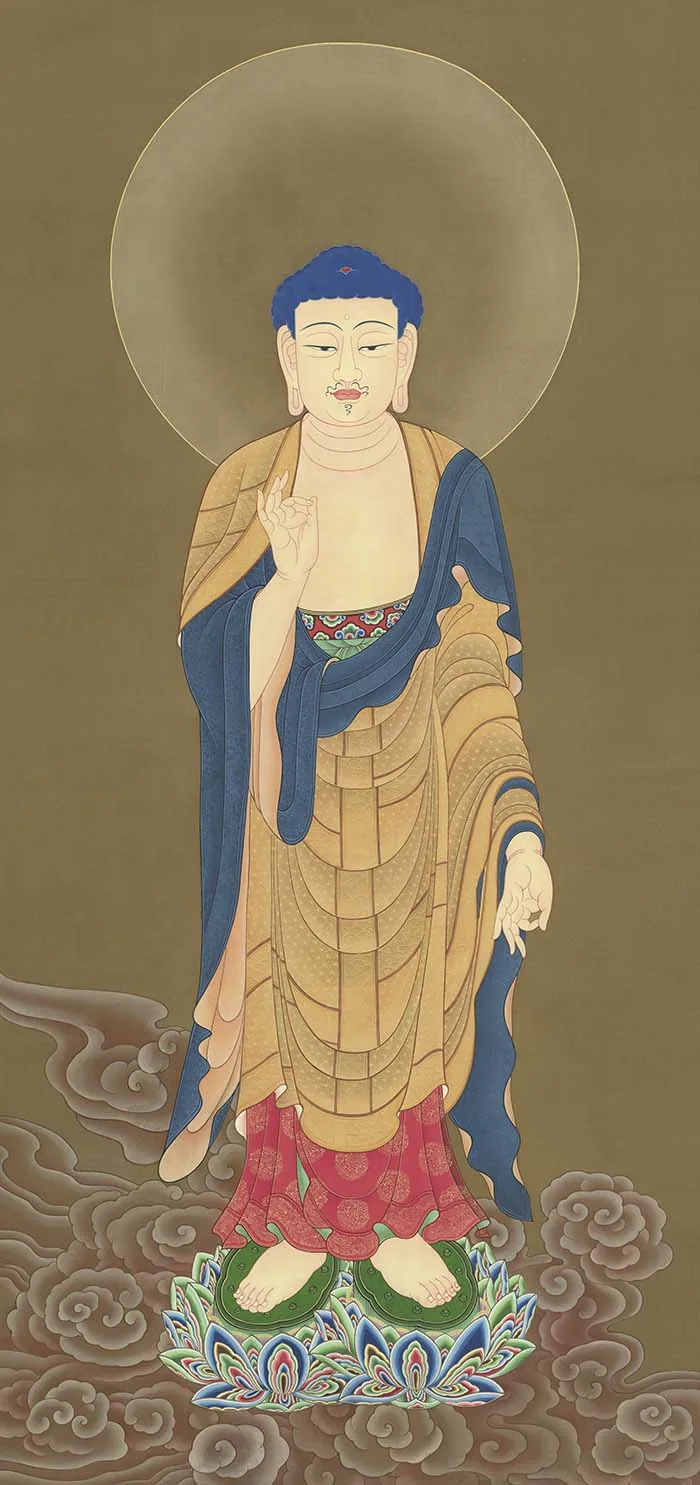
Quick answer: In TK1109, a single haloed standing figure rises above a multicolored lotus base, while stylized clouds gather around the lower edges. The flowers and cloud bands make a transition from feet to surrounding field, but they do not prove a specific landscape or deity. The archive filename is retained as a label, not verified object identification.
What can you see at the base of TK1109?
The lower part of TK1109 shows a standing figure supported by a richly colored lotus arrangement, with cloud forms occupying the surrounding lower field. The feet rest on two green, rounded supports above a layered cluster of petals. Clouds curl outward at both sides and partly behind the floral base. This is enough to describe a visual relationship: feet, supports, petals, and clouds form a transition from the figure to the image’s bottom edge.
Start with the visible shapes rather than naming their meaning. The figure is front-facing and upright; a large circular halo surrounds the head. Blue and ochre-gold garment forms frame the body, and red fabric gathers near the lower legs. At the bottom, the green foot supports sit above a fan of blue, red, gold, and pale petals. Brown-gray clouds curl around this base, most clearly at lower left and lower right. These observations are repeatable even if a viewer does not know the original title.
The archive filename reads “Three Saints of the West and Amitabha Buddha.” That English title is useful as a file label, but it is not proof of the image’s full original program. The displayed frame contains one principal standing figure and no visible flanking companions. Whether the file represents an isolated image, a crop, or one item in a larger group is uncertain.
How do the lotus and clouds work together visually?
The lotus cluster provides a concentrated, patterned support beneath the feet, while the clouds spread more loosely into the surrounding space. Their different shapes separate the central figure from the background without requiring a painted ground line. The lotus is compact and layered; the cloud contours are softer, irregular, and open at the edges. Together they create a visual threshold rather than a clearly mapped landscape.
Look first at the vertical sequence. The head and halo occupy the upper field, the body and long garment carry the eye downward, and the lotus forms gather attention near the feet. The clouds then move outward from this lower center. This sequence helps a viewer understand how the standing figure is positioned in the frame. It does not, by itself, establish that the figure is literally standing on a cloud, floating above water, or located in a named paradise.
The lotus and cloud motifs also differ in visual density. Repeated pointed petals create a clear edge around the base; the cloud curls have broader loops and less regular spacing. That contrast makes the support legible: the petals mark a centered platform-like form, while the clouds act as a surrounding atmosphere or frame. “Platform-like” and “cloud forms” are cautious descriptions, not claims about physical architecture or weather.
How can you document the lower register without guessing?
A useful record separates location, shape, color, and interpretation. For TK1109, note that the cloud forms appear around the lower field and that the lotus cluster is centered below the feet. Then describe what is directly visible before assigning a religious or narrative meaning.
- Keep the full frame in view. Record the halo, whole figure, feet, lotus base, and lower clouds together before making a detail crop.
- Mark the vertical order. Describe the sequence from robe hem to feet, green supports, petal tiers, and image edge.
- Map the side forms. Note where each cloud curl begins, which direction it turns, and whether it touches or remains separate from the petals.
- Record color and contour. Use terms such as “blue outer petals,” “green rounded supports,” or “brown-gray cloud loops” only where those colors and outlines are visible.
- Separate observation from interpretation. Keep labels such as “lotus base” distinct from a proposed explanation of what the lotus signifies in this specific image.
This method makes later comparison easier. Another researcher can check the same locations and decide whether the contour truly connects to the base. It also prevents a small crop from turning a cloud edge into a supposed architectural platform or from making a decorative petal look like a separate figure.
What does the image not establish?
The digital image alone does not establish a deity’s identity, the painting’s date, maker, school, region, collection, or provenance. Nor does the filename prove that unseen companions belong to this particular frame. The title can be retained in a catalogue note as supplied archive metadata, while its claims remain unverified until supported by an independent record or a legible inscription.
The same caution applies to material and condition. A screen image may show color and line, but it cannot verify pigments, support, textile construction, repairs, or the physical state of an original object. Even the apparent connection between the clouds and the lotus should be described as a visible arrangement, not as evidence for a specific ritual function. A responsible caption can state what is present and identify what remains uncertain.
This distinction does not make visual analysis weak. It makes the evidence traceable. “A standing figure above a multicolored lotus base, with curling cloud forms around the lower field” is more useful than an unsupported claim about a named Pure Land because another viewer can test the description against the image.
How is this different from identifying a Pure Land scene?
A Pure Land identification depends on a wider group of clues than a lotus or cloud motif alone. A central Buddha, attendants, architectural setting, assemblies, water, and repeated narrative features may collectively support such a reading. In TK1109, the filename points toward a Western Pure Land association, but the visible frame by itself does not show a full assembly or a complete landscape. The label should therefore remain a source note rather than a verified conclusion.
For broader context, compare the TANGKAWORLD Amitabha Pure Land painting guide, which discusses how a complete composition can be read through its central figure, setting, attendants, and surrounding details. That guide is a contextual reading aid, not evidence that TK1109 has the same subject or provenance. A general guide to reading a Thangka also explains why the whole image should be considered before a small detail is interpreted.
Frequently asked questions
Does TK1109 show the Three Saints of the West?
The archive filename uses that title, but the visible frame shows one principal standing figure and no flanking companions. The title is retained as a file label; the full subject and whether the image belongs to a larger group remain uncertain.
Are the clouds a literal ground beneath the figure?
The clouds surround the lower lotus base, but the image does not provide enough evidence to call them a literal ground. Describe their position and contours first, then leave symbolic or narrative meaning open unless another source confirms it.
Can the lotus alone identify the figure as Amitabha?
No. Lotus imagery appears across many Buddhist contexts. The archive filename names Amitabha, but the figure’s exact identity should not be treated as verified from the lotus base alone.
What is the safest way to caption the image?
State the visible composition, preserve TK1109 and the supplied English filename title, and label artist, date, school, collection, identity, and provenance uncertain unless independently documented.
Sources and editorial method
This article is based on direct visual analysis of the TANGKAWORLD TK1109 image. It distinguishes observable details—the single standing figure, halo, garments, feet, lotus base, and clouds—from religious identification and historical attribution, which remain uncertain. The archive filename is reported as a filename label only. For broader context, see the TANGKAWORLD Pure Land reading guide and the high-resolution image study guide.
Prepared and reviewed by the TANGKAWORLD editorial team
Last reviewed: October 9, 2026
Continue exploring TANGKAWORLD: visit the home page, browse Learn, or get images from the Download archive.

