How Do Multiple Faces Expand Avalokiteshvara’s Field of Vision? TK0185
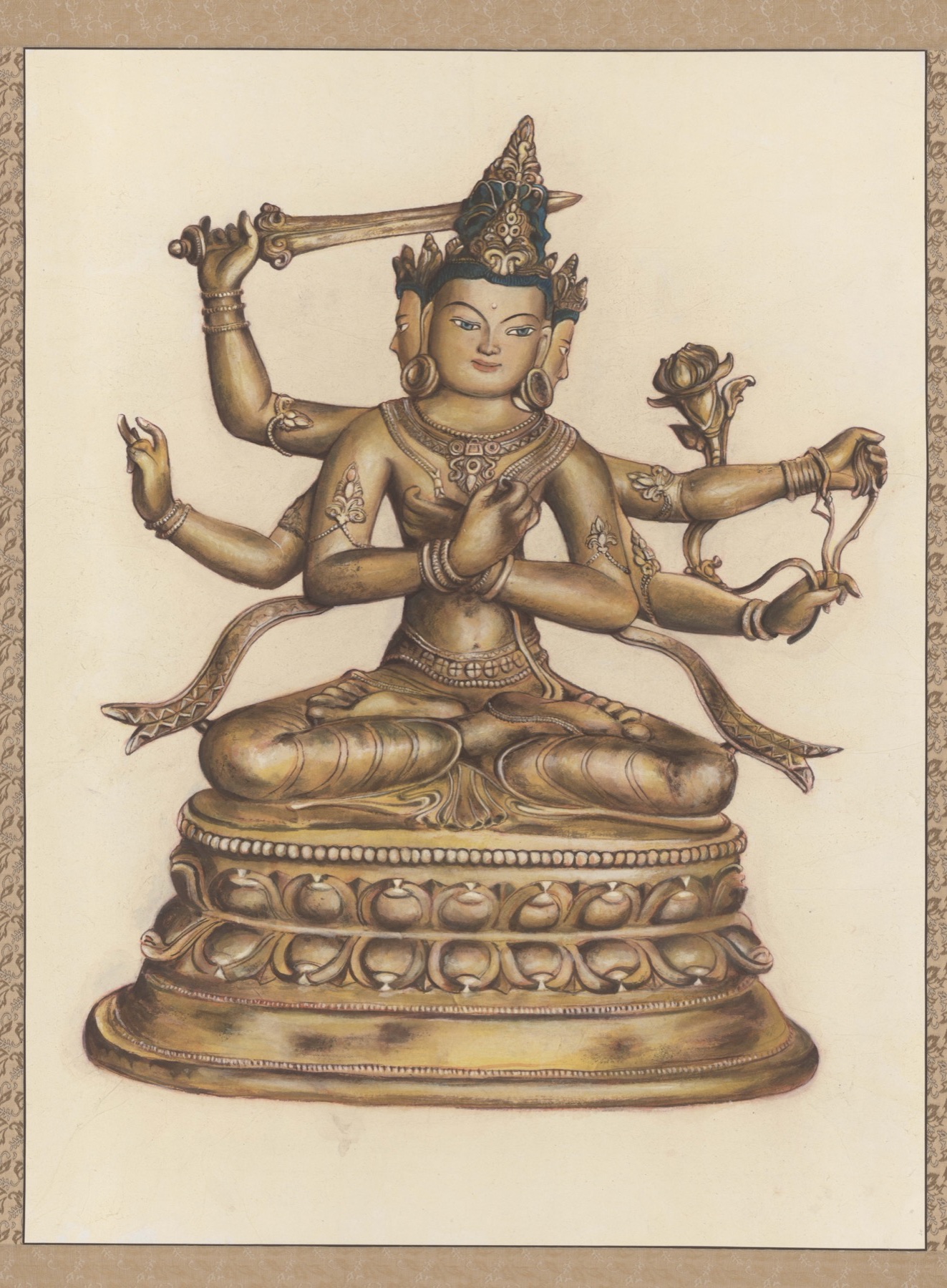
Quick answer: In TK0185, a central frontal face is flanked by visible side faces, while multiple arms extend the figure’s presence across the image. The arrangement creates a visual movement from centered attention to surrounding awareness. This reading describes the image’s visible structure; it does not establish the painting’s date, maker, lineage, or ritual use.
What can be seen in TK0185?
TK0185 presents a richly adorned, seated bodhisattva on a high, patterned lotus pedestal. The figure faces forward, with a calm central face and additional profiles visible at either side of the head. Several arms unfold around the torso. Among the objects that can be recognized visually are a sword-like implement and a flower resembling a lotus; other hands make gestures or hold forms that are difficult to identify confidently at this image scale. The figure wears a crown, jewelry, armlets, and a patterned sash. The background is comparatively open, so the body, attributes, and pedestal carry most of the visual information.
The archive labels the figure Avalokiteshvara and gives the artist as Anonymous. That is useful catalog information, but it is not independent proof of an exact manifestation or historical attribution. This article keeps those levels separate: the archive’s identification is retained, while the discussion below focuses on what the image itself makes visible.
Why does the central face anchor the composition?
The frontal face is the image’s clearest point of entry. Its direct orientation, balanced features, and placement above the joined central hands give the viewer a stable center before the eye notices the side faces and outward-reaching arms. The crown also rises on the same vertical axis, linking face, hands, torso, and pedestal into one central stack.
This hierarchy matters because a many-part figure can otherwise feel scattered. Here, the central axis remains readable even when the surrounding details are numerous. The gaze begins at the face, moves down through the hands and ornamented chest, and settles on the broad pedestal. The arrangement does not require the viewer to decode every object before understanding the whole. First comes a composed, frontal presence; only afterward does the image disclose its lateral complexity.
For close looking, compare the face’s calmness with the activity of the arms. The face stays still while the hands reach in several directions. This contrast lets the figure suggest both composure and capacity without relying on a narrative scene or a landscape setting.
How do the side faces change the viewer’s experience?
The side faces extend the head beyond a single, ordinary viewpoint. Rather than turning the main figure into a profile, they preserve a frontal encounter and add lateral views beside it. The viewer can therefore read the image as centered but not narrowly confined: the central face meets the gaze, while the profiles imply awareness beyond the straight-ahead line.
That effect is produced by placement as much as by subject matter. The side faces emerge close to the central head, beneath the crown, and remain smaller in the overall hierarchy. They broaden the composition without replacing its focal point. A useful comparison is between the straight-on symmetry of the body and the sideways orientation of the additional faces. One element stabilizes; the other opens the image outward.
We should not infer a complete doctrinal explanation from this visible arrangement alone. Multi-faced forms have specific meanings within Buddhist traditions, but identifying the precise system requires reliable textual or art-historical evidence beyond a single image. Here, “expanded vision” is a visual interpretation of how the faces are positioned, not a claim that the image’s exact theology has been established.
How do the arms and attributes create visual routes?
The arms make the figure’s outline wider and give the eye several paths through the composition. One raised hand supports a sword-like object above the head; another hand holds a flower-like form to the side. Other hands meet near the chest or extend outward. These differences make the limbs legible as separate gestures instead of a single mass of overlapping shapes.
Follow one route at a time: start at the central face, move to the raised implement, return through the crown, and then trace the opposite arm toward the flower. A second route begins at the central hands and follows the lower arms outward. These paths reveal how the painter distributes attention around the body. The composition remains connected because the arms return visually to the torso, even when they reach toward the edges.
The objects invite iconographic questions, but visual resemblance is not the same as confirmed identification. The implement appears sword-like and the flower resembles a lotus; their exact names, ritual functions, and relationship to a particular textual form are uncertain from this image alone. Describing what is visible is safer than assigning a fixed meaning without corroboration.
What role does the lotus pedestal play?
The pedestal gives the multi-faced figure a stable base. Its repeated petal forms, layered bands, and broad lower edge create a strong horizontal foundation beneath the complex body. This contrast helps the image feel ordered: the arms and faces expand outward, while the pedestal gathers the figure into a bounded, symmetrical support.
The base also holds a substantial share of the ornament. Its repeated shapes echo the jewelry and patterned borders above, but on a larger scale. As a result, the pedestal is not merely empty support; it completes the visual rhythm. The eye can move from the decorated crown down the body, pause at the crossed legs, and continue into the lotus tiers. This sequence reinforces the central vertical axis already established by the face.
Because the surrounding field is plain, these details remain especially prominent. The image asks for close attention to contour, repeated pattern, and the relation between figure and support rather than to a story unfolding in the background.
A careful way to study the image
A disciplined reading separates observation from interpretation. The following sequence keeps the discussion grounded in the available evidence:
- Record orientation and format. Note that the figure is seated frontally on a lotus pedestal, and confirm the image is upright before describing it.
- Count only what is clear. Describe a central face with visible side faces and multiple arms; avoid claiming a precise total when overlaps make counting uncertain.
- Name objects cautiously. Use terms such as “sword-like” and “lotus-like” until a reliable source confirms an exact attribute.
- Describe relationships. Explain how the face, hands, arms, and pedestal guide attention rather than turning a visual detail into a historical claim.
- Keep catalog data in its lane. Preserve “Avalokiteshvara - Anonymous” as the archive title, while marking maker, date, lineage, and provenance unverified unless another source establishes them.
This method is useful for digital study because a high-resolution image encourages confidence: detail may be visible even when the object’s history is not. Close looking can support a precise visual account, but it cannot by itself identify where an image was made, who made it, or how it was used.
What the image can—and cannot—establish
TK0185 supports observations about composition: a frontal center, side faces, multiple arms, visible attributes, elaborate dress, and a patterned lotus base. It also supports a cautious interpretation that the arrangement broadens the viewer’s field of attention while maintaining a stable center. Those claims refer to visible evidence and the way it functions in the composition.
The image alone does not securely establish a date, workshop, region, patron, collection history, ritual context, or the exact named form represented. Nor does the archive label prove those details. Such claims would require documentation or comparison with dependable catalog and scholarly sources. Until that evidence is available, the responsible description is specific about the image and modest about its history.
Frequently asked questions
Is the figure in TK0185 Avalokiteshvara?
The archive identifies it as Avalokiteshvara. This article preserves that catalog identification while treating the exact manifestation as unverified.
How many faces are visible?
A frontal face and side-facing profiles are clearly visible. The image suggests a multi-faced form, but this description avoids assigning a precise canonical count from the reproduction alone.
What objects does the figure hold?
A sword-like implement and a flower resembling a lotus are visually apparent. The identities and ritual meanings of the objects are not confirmed here.
Can the image be dated or attributed to a school?
Not from the visible image and archive title alone. No date, artist, school, or provenance is independently verified in this discussion.
Sources and editorial method
This article is based on direct visual analysis of the TANGKAWORLD reference image TK0185. It distinguishes visible features from the archive’s religious identification and from uncertain historical attribution. The title “Avalokiteshvara - Anonymous” is retained as supplied catalog wording, not treated as proof of maker, date, region, or provenance. For the project’s learning resources and source-aware approach, see TANGKAWORLD Learn.
Prepared and reviewed by the TANGKAWORLD editorial team
Last reviewed: October 30, 2026
Continue exploring TANGKAWORLD: Visit the home page, browse Learn, or explore the download collection.

