How Head Adornment Differentiates Figures in a Buddhist Assembly: TK1111
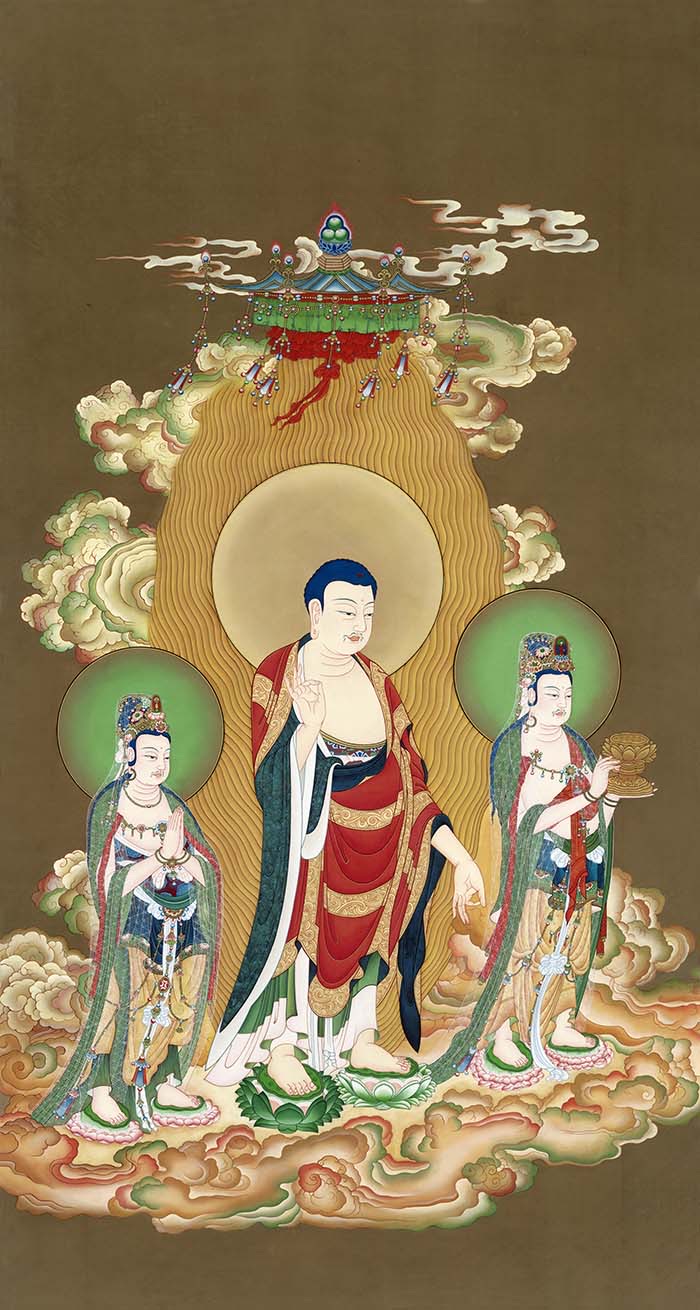
Quick answer: In TK1111, the central haloed figure has visible blue hair without the elaborate crown forms worn by the two flanking figures. This contrast is a useful way to describe how the group is visually differentiated. It does not, by itself, prove the figures’ names, ranks, or doctrinal roles.
What head adornment is visible in TK1111?
TK1111 shows three haloed figures arranged across a tall composition beneath an elaborate canopy. The central figure has blue hair and no large jeweled crown visible in this reproduction. Each flanking figure wears a taller, brightly colored headpiece with ornamental details. Those differences are clear enough to record, even though the exact identity of each figure remains uncertain.
The central figure occupies the highest and largest position among the three bodies. A pale circular halo surrounds the head; the blue hair forms a compact shape within it. At both sides, smaller haloed figures have green-toned circular surrounds and richly decorated crowns. Their headpieces create more complex silhouettes, with visible tiers, colored ornaments, and hanging details. The arrangement gives the viewer three distinct head zones to compare: blue hair at center, crowned heads at left and right.
The image also contains a decorated roof-like canopy above the group, clouds around the figures, and lotus seats below. These surrounding elements help locate the group but are not evidence for naming the figures. The archive filename uses the English wording “Three Saints of the West - Buddhist Painting”; here it is preserved as a catalog label rather than treated as a verified identification. A visual description should not silently turn a filename into a historical or iconographic fact.
How does headwear differentiate the three figures?
Head adornment differentiates the figures first through silhouette and surface detail. The central head reads as a compact blue-haired form, while the two side heads carry taller, patterned crowns. That difference is legible before a viewer can resolve small attributes or jewelry, so it offers a practical starting point for describing the group.
Position and scale work together with the headwear. The central figure is larger and vertically dominant; the side figures are smaller and placed lower. The simpler central hair shape therefore belongs to the composition’s visual center, while the elaborate side crowns add intricate accents at either side. This describes a relationship visible in the image. It does not establish why the painter chose that arrangement or whether the crowns correspond to specific doctrinal offices.
Symmetry should also be observed rather than assumed. The two flanking figures both wear crowns, but a careful close look may reveal differences in color, contour, ornament, or angle. Even when the overall arrangement appears balanced, the details need not be identical. A reader can record “both crowned” and then separately note whether the headpieces actually match. That distinction prevents a general impression of symmetry from obscuring meaningful visual variation.
The crown shapes also affect how the figures meet the surrounding field. Their ornaments sit against green halos and pale cloud forms, while the central blue hair is set inside a larger pale halo. These local contrasts make each head readable within its own small area. They are compositional observations, not a claim that a particular color or crown type has a fixed meaning in every Buddhist image.
What should a visual comparison record?
A useful comparison separates what is plainly visible from the questions that remain open. The table below records the three head zones without assigning names or ranks.
| Position | Visible head feature | What can safely be said |
|---|---|---|
| Center | Blue hair within a pale circular halo; no large jeweled crown is visible | The central head has a simpler silhouette than the side crowns in this reproduction. |
| Left side | Elaborate colored crown inside a green-toned halo | The headpiece adds a tall, ornamented outline; its exact type and meaning are uncertain. |
| Right side | Elaborate colored crown inside a green-toned halo | The figure is crowned; compare its ornament and angle directly with the left crown before calling the pair identical. |
This record is deliberately limited to visible shape, color, and placement. It does not identify the figures as specific Buddhas or bodhisattvas, and it does not infer that one crown signals a particular title. If a high-resolution source or another documented view becomes available, the ornament can be described in more detail without changing the cautious baseline note.
How can you document head adornment without guessing?
A repeatable note makes the observation easier to verify later. For TK1111, use the same sequence for the center and both flanking heads:
- Locate each figure. Record center, left, or right, and note whether the head is frontal, turned, or partly obscured.
- Describe the silhouette. Use plain terms such as hair, crown, band, top ornament, or hanging element only when the shape is visible. Avoid naming a crown type from a small or blurred view.
- Record color and detail separately. Note blue hair, colored crown sections, or bright ornaments as observations. Do not treat a color name as a symbolic interpretation.
- Compare the pair explicitly. Ask whether the side headpieces share the same outline, number of visible tiers, arrangement of ornaments, and angle. If an element is unclear, mark it uncertain rather than completing a pattern from expectation.
- Keep identification in a separate field. A proposed name should be supported by more than headwear—such as attributes, gestures, inscriptions, reliable contextual evidence, or documented comparisons.
This sequence is useful for catalog notes, image descriptions, and later research because another reader can repeat it on the same file. It also preserves the distinction between an observation and a hypothesis. For example, “the left and right figures wear ornate crowns” is checkable; “the crowns identify these figures as named attendants” is an interpretation that requires independent support.
What can crowns not establish on their own?
Crowns alone cannot securely establish a figure’s identity, rank, role, date, maker, school, collection, provenance, or ritual use. Headwear can contribute to iconographic identification, but it is rarely sufficient by itself. A group label in a filename is also not enough to prove that every figure in the image has been correctly named.
The visible evidence here supports a narrow conclusion: TK1111 contrasts a central blue-haired head with two smaller crowned heads. The central figure is larger and occupies the composition’s axis; the side figures wear more elaborate head ornaments. Whether those distinctions correspond to specific named beings remains uncertain in the absence of additional evidence. That boundary is not a weakness in description—it makes the visual record more dependable.
Digital reproductions impose further limits. Fine ornaments may be difficult to distinguish at reduced size, and image color can vary with capture, processing, and display. A cropped view may help inspect a crown, but it can remove the context that shows the figure’s position relative to the group. Record which version or crop was examined, and avoid presenting a small detail as if it were an exhaustive examination of the original object.
Frequently asked questions
Does a crown prove that a figure is a bodhisattva?
No. A crown can be an important clue, but it does not by itself establish a figure’s name or category. Attributes, gesture, context, inscriptions, and reliable comparisons should also be considered.
Are the two side crowns identical?
They appear broadly similar in the available image, but similarity should not be confused with exact identity. Compare their outlines, ornaments, colors, and angles at the same scale before describing them as matching.
Why does the central figure have blue hair rather than a crown?
The image visibly presents the central head differently from the two crowned heads, but the reason is uncertain. The contrast can be described compositionally without claiming a specific identity or doctrinal explanation.
Is “Three Saints of the West” a confirmed title?
It is the English wording in the archive filename and is retained as an unverified archive label. The visual arrangement contains three figures, but that alone does not confirm their names or the title’s historical status.
Sources and editorial method
This article is based on direct visual analysis of the TANGKAWORLD image TK1111. It distinguishes visible hair, crown forms, position, and scale from iconographic identification and from uncertain claims about authorship, date, school, collection, or provenance. The filename is treated as an archive label, not proof. For broader methods and documented references, see the TANGKAWORLD Learn guides.
Prepared and reviewed by the TANGKAWORLD editorial team
Last reviewed: October 11, 2026
Explore more with TANGKAWORLD: visit the home page, browse Learn, or explore the download collection.

